


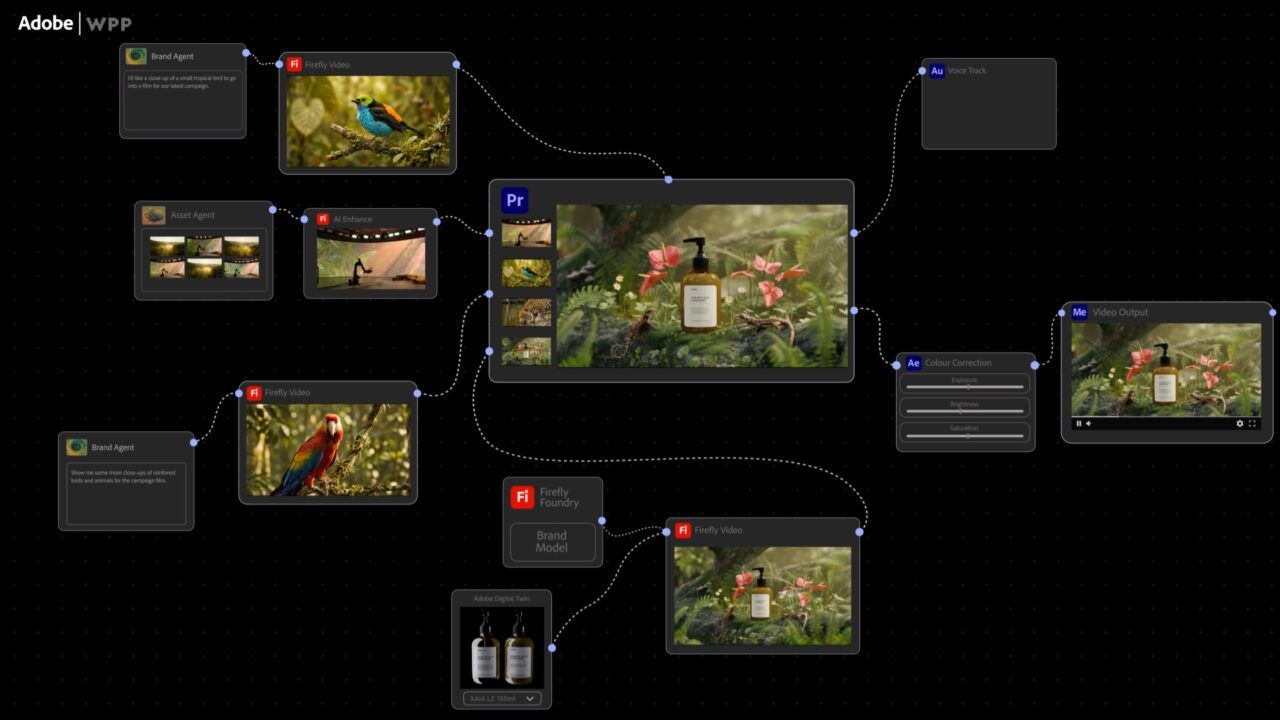
Adobe AI Agents Nvidia WPP are deploying autonomous AI agents that generate on-brand content at scale — governed, fast, and built for the modern enterprise.
Creative AI agents, secured by the NVIDIA OpenShell runtime, generate on-brand content, transforming how brands create, personalize and activate content.
AI agents are no longer a research project or a distant promise. They are showing up inside the workflows of the world’s largest brands, making decisions, generating content, and triggering actions in real time — and a new collaboration between Adobe, NVIDIA, and the global marketing group WPP is one of the clearest signals yet of how fast this shift is moving.
The three companies have deepened their strategic relationship to bring what they are calling agentic AI to the heart of enterprise marketing operations. The scope of the collaboration is broad, touching creative production, customer experience orchestration, and the infrastructure required to keep autonomous systems operating safely inside a corporate environment.
What You Need to Know: Adobe AI Agents Nvidia WPP
- Adobe, NVIDIA, and WPP have expanded their strategic collaboration to bring autonomous AI agents into enterprise marketing at scale.
- Adobe’s new CX Enterprise Coworker agent is powered by NVIDIA’s Agent Toolkit, Nemotron models, and the OpenShell secure runtime.
- Brands can now generate on-brand content across millions of product, audience, and channel combinations in minutes rather than months.
- Adobe Firefly Foundry and a new 3D digital twin solution, built on NVIDIA Omniverse, are central to the content production engine.
- The NVIDIA OpenShell runtime acts as a governed sandbox, ensuring every agent action is observable, auditable, and policy-compliant.
The Problem These Companies Are Trying to Solve
The core challenge facing modern marketing teams is not a shortage of ideas or creative talent. It is a scaling problem. A global retailer, for example, might need to deliver a distinct offer, a tailored image, precise copy, and the right price point across millions of product, audience, and channel combinations. Under traditional workflows, updating those combinations takes months. The market moves in minutes.
The answer, according to all three companies, is intelligent systems that can plan, create, produce, and activate content on a continuous basis — without compromising the brand controls and governance structures that enterprise legal and marketing teams require.
“Brands no longer have to choose between speed and safety. Autonomous agents can now generate, adapt, and activate content at scale while operating within governed, policy-driven environments.”
That sentence captures the central ambition of this collaboration: closing the gap between what AI can do at speed and what corporate governance allows in practice.
Three Companies, Three Complementary Strengths
The partnership is built on a deliberate division of labor. Adobe contributes its creative and customer experience platforms, along with a new product called the CX Enterprise Coworker — an AI agent designed to orchestrate downstream marketing workflows from personalization through to content activation. WPP brings its global media and marketing expertise, providing the strategic and operational context that makes these systems relevant across different markets and industries. NVIDIA supplies the computational backbone: accelerated computing infrastructure, the Nemotron family of open models, the Agent Toolkit for building agentic systems, and a runtime environment called OpenShell.
That last element is worth dwelling on. As AI agents begin handling multistep workflows — accessing sensitive customer data, making decisions across marketing stacks, triggering real-world actions — enterprises face a serious question about control. What stops an agent from acting outside its defined boundaries? What creates accountability when something goes wrong?
Governance as Infrastructure
NVIDIA’s answer to that question is OpenShell. Rather than relying solely on software policies that describe what an agent should do, OpenShell operates as a containerized, policy-based sandbox that enforces what an agent can do. Every operation is observable. Every action is auditable. Enterprises deploying these agents on their own premises or in the cloud have verifiable control over the scope of each agent’s activity.
This distinction between a policy that is written and a constraint that is technically enforced matters enormously in regulated industries and in any company where brand integrity is a legal and financial concern. The collaboration effectively treats governance not as an afterthought but as a structural layer of the system itself.
What the Collaboration Actually Delivers
Beyond the architecture, the partnership delivers four concrete capabilities that marketing and creative teams will encounter in practice.
The first is end-to-end agentic workflows. Adobe’s creative agents can generate, adapt, and version on-brand assets without human intervention at each step. The CX Enterprise Coworker then picks up those assets and orchestrates the downstream customer experience — from personalization decisions to content activation — creating a closed loop between production and delivery.
The second is Adobe Firefly Foundry, the company’s commercial content generation platform, which is accelerated by NVIDIA’s AI infrastructure. Organizations can use it to fine-tune custom models on their own proprietary creative assets, enabling agents to generate new content that is both commercially safe and visually consistent with an established brand identity.
The third is a 3D digital twin solution for marketing production, now generally available and built on NVIDIA’s Omniverse libraries and the OpenUSD open standard. These digital twins serve as persistent, three-dimensional product identities that agents use as source material for generating high-fidelity content across formats, markets, and configurations. A single product can become the basis for thousands of market-specific variations without requiring a separate photoshoot or design session for each one.
The fourth capability returns to OpenShell. In governed environments, companies can also keep critical intelligence services inside their own trust boundary. This includes the ability to securely invoke Adobe’s CX Intelligence tools as part of a customer experience agent workflow — keeping sensitive customer data and proprietary models from traveling outside the enterprise perimeter.
Why This Moment Matters
Taken together, what Adobe, NVIDIA, and WPP are describing is a new operational foundation for marketing — one where creative intelligence and performance intelligence are unified inside a governed, continuously running system rather than separated into discrete human-led campaigns.
A live demonstration of the CX Enterprise Coworker, powered by NVIDIA’s Agent Toolkit, OpenShell runtime, and Nemotron models, was featured during the day-two keynote at Adobe Summit 2026. The demonstration was intended to show enterprise customers not just a concept but a working system operating under real governance constraints.
The ambition, as the companies frame it, is a marketing operation that is always on, always relevant, and always on brand — not because human teams are working around the clock, but because the agents running underneath are designed well enough and governed tightly enough to be trusted to operate without constant supervision.
Whether that trust proves warranted at scale is the question that will define this generation of enterprise AI deployment. The partnership between Adobe, NVIDIA, and WPP is one of the most significant bets yet that the answer can be yes.