


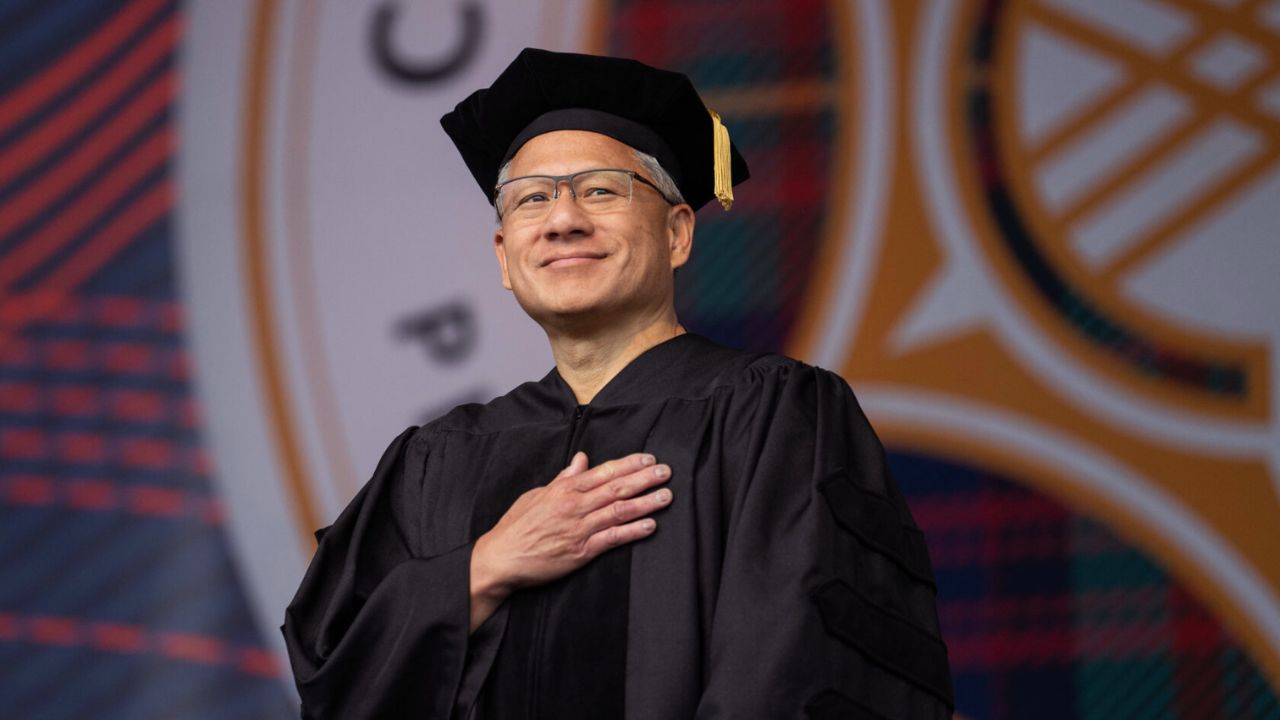
Jensen Huang: NVIDIA’s CEO, urged Carnegie Mellon’s Class of 2026 to embrace the AI revolution, calling it the biggest industrial shift in human history and their moment to lead.
On a rainy Sunday morning at Gesling Stadium in Pittsburgh, Pennsylvania, NVIDIA founder and CEO Jensen Huang stepped to the podium before thousands of graduates, families, and faculty gathered for Carnegie Mellon University’s 128th commencement ceremony. What followed was not the kind of polished, carefully measured address that often marks these occasions. It was, by turns, personal, urgent, and genuinely moving — a speech from a man who has spent over three decades building toward a moment he believes the world is only now beginning to understand.
“You are entering the world at an extraordinary moment,” Huang told the Class of 2026. “A new industry is being born. A new era of science and discovery is beginning.” He paused, then added what would become the defining line of the afternoon: “No generation has entered the world with more powerful tools — or greater opportunities — than you.”
Huang drew a direct parallel between his own entry into the workforce at the start of the personal computer revolution and the moment these graduates now face. He walked through the major computing platform shifts of the past half-century — the PC, the internet, mobile, and cloud — framing each as a stepping stone to something altogether larger. “But what is about to happen now is bigger than anything before,” he said. “Because intelligence is foundational to every industry, every industry will change.”
A Once-in-a-Generation Industrial Shift
Much of Huang’s address centered on what he described as the largest technology infrastructure buildout in human history. He spoke of AI not merely as a product category or a software upgrade, but as the engine of a new industrial era — one with the potential to reindustrialize America and give the country back its capacity to build at scale.
He was careful to make clear that the benefits of this transformation are not reserved for the technically elite. The opportunity, he said, extends to electricians, plumbers, ironworkers, technicians, and all kinds of builders — workers whose trades have long been treated as separate from the technology economy. “For the first time, the power of computing and intelligence can truly reach everyone and close the technology divide,” he said. “Now it’s your time to realize your dreams — and the timing could not be more perfect.”
AI Automates Tasks. It Elevates People.
On the question of fear — a word that tends to follow AI wherever it goes — Huang was measured but direct. “Every major technological revolution in history created fear alongside opportunity,” he said. “When society engages technology openly, responsibly and optimistically, we expand human potential far more than we diminish it.”
To illustrate the distinction between what AI replaces and what it preserves, Huang turned to the example of radiologists. A radiologist’s job, he explained, involves far more than reading scans. AI can automate the scan-reading task. But the radiologist’s purpose — caring for patients, making consequential decisions, building trust — is not something a model can take over. “AI automates tasks but elevates workers,” he said. “The task and purpose of a job are not the same.”
History shows that societies that retreat from technology do not stop progress — they only surrender the opportunity to shape it and to benefit from it.”
Advancing AI Responsibly — and Together
Huang did not shy away from the weight of what he was asking this generation to carry. Realizing AI’s “great promise” while addressing its “real risks” demands, in his framing, a clear-eyed approach — not naive optimism, but disciplined engagement. He spoke of the responsibility in terms that were inclusive rather than narrow.
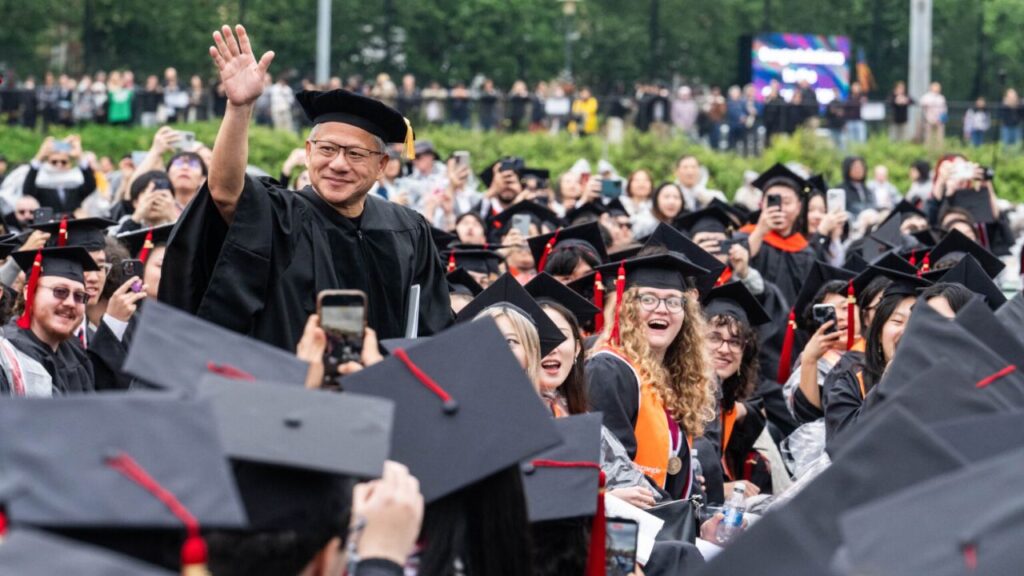
Scientists and engineers, he said, have a profound responsibility to advance AI capabilities and AI safety in parallel — not as competing priorities, but as inseparable ones. But he extended the same obligation to policymakers, calling on them to create thoughtful guardrails that protect society while leaving room for innovation, discovery, and progress to move forward.
His counsel to graduates was to hold four imperatives at once: advance safely, create thoughtful policies, make AI broadly accessible, and encourage everyone to engage. “The answer is not to fear the future,” he said. “The answer is to guide it wisely, build it responsibly and ensure that its benefits reach as many people as possible.”
A First-Generation Story: Jensen Huang
At one point, Huang set aside the broad strokes of industry and technology and spoke more quietly about himself. “Like many in this audience, I am a first-generation immigrant,” he said. He described his experience of America as something he has never stopped feeling grateful for — not easy, but full of possibilities. Not a guarantee, but a chance. “My parents came here because they believed America could give their children a chance,” he said. “How can we not be romantic about America?”
It was a moment that visibly resonated in the stadium. CMU draws students and faculty from across the world, and the audible response in the crowd suggested that Huang’s words landed somewhere beyond the scripted.
An Honorary Degree and a Lasting Challenge
CMU President Farnam Jahanian presented Huang with an Honorary Doctor of Science and Technology — one of the university’s highest distinctions — during the ceremony. Ahead of the event, Huang visited the Robotics Institute, where he spent time with students working on projects designed to address real-world challenges.
He closed his address by invoking Carnegie Mellon’s motto: “My heart is in the work.” He asked the graduating class to carry that ethos forward. “Build something worthy of your education, your potential and the people who believed in you long before the world did,” he told them. It was the kind of line that stays with you after the ceremony ends and the caps come down — a reminder that the measure of a generation is not the tools it inherits, but what it chooses to build with them.