


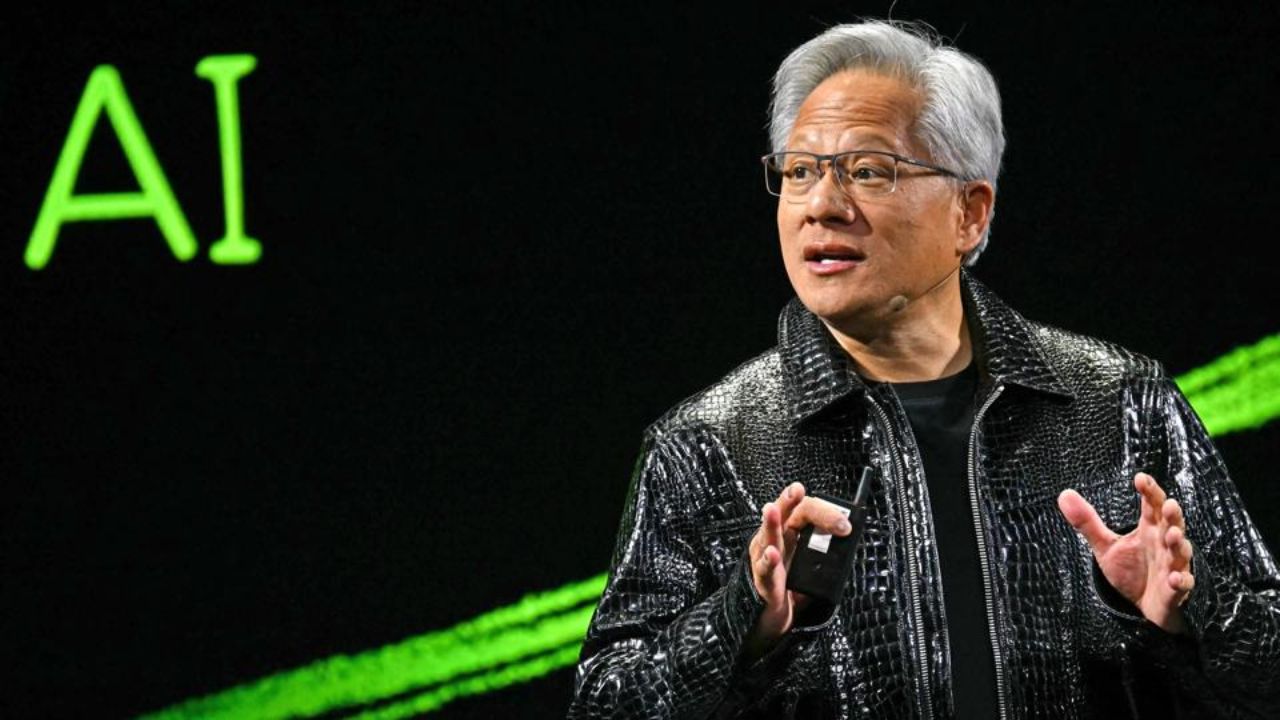
Nvidia $5.5 trillion market cap milestone was hit on May 13, 2026, as shares surged 3% and CEO Jensen Huang joined Trump’s China summit, shattering every valuation record in corporate history.
There are moments in corporate history that feel genuinely impossible until they happen. On Wednesday, Nvidia became the first company in the history of publicly traded markets to reach a market capitalization of $5.5 trillion — a number so large it exceeds the annual economic output of every nation on earth except the United States and China. Shares climbed as much as 3 percent, hitting an intraday high of $227.16, as investors absorbed news that CEO Jensen Huang had joined President Donald Trump on a high-stakes diplomatic trip to Beijing.
The milestone was not merely a rounding up from the previous record. It was a statement about where the global economy is heading and who is positioned to profit most from it. Nvidia, once a company known primarily to video-game enthusiasts for its graphics cards, has spent the last three years becoming the indispensable foundation of the artificial intelligence industry. Its processors power the training of large language models, the operation of cloud data centers, and the emerging infrastructure of autonomous vehicles and robotics. In the parlance of the gold rush that preceded the AI era, Nvidia is selling the picks and shovels — and the entire world cannot seem to get enough of them.
Nvidia is now more valuable than the annual economic output of Japan, the United Kingdom, and France combined — a comparison that illustrates, more than any stock chart, just how dramatically this company has reshaped the idea of corporate scale.”
The surge on Wednesday was immediately tied to a geopolitical development as much as a financial one. Reports earlier in the week had suggested Huang was not among the executives invited to join Trump’s trip to China, where the president was scheduled to meet with Chinese President Xi Jinping. Then, in a turn that briefly dominated both financial news and diplomatic coverage, Trump personally called Huang and asked him to board Air Force One — which the CEO did, reportedly flying to Alaska to catch up with the delegation. Nvidia confirmed Huang was attending at the president’s invitation, with a spokesperson saying he was there “to support America and the administration’s goals.”
Why China Matters So Much to Nvidia
China once accounted for at least a fifth of Nvidia’s data center revenue. U.S. export restrictions have for years blocked the company from selling its most advanced AI chips into the Chinese market, forcing Nvidia to develop downgraded products to comply with regulations. Despite that headwind, the company has continued growing at a pace that few mature companies could imagine. A deal — or even a signal of diplomatic openness — could unlock what Huang has called a $50 billion opportunity.
Wall Street was quick to absorb the implications. Bank of America, which has maintained a bullish stance on Nvidia for several quarters, raised its calendar-year 2030 outlook for the AI data center systems market to $1.7 trillion from $1.4 trillion. The firm also raised its price target on the stock by $20, to $320 — a level that, if reached, would represent nearly 45 percent upside from where shares closed the previous day. BofA analysts wrote that 2026 would continue to be a year of accelerating AI sales and return on investment for Nvidia’s customers, with further efficiency gains expected as new computing architectures ramp up in 2027.
To appreciate what a $5.5 trillion market cap actually means, it helps to look at what surrounds it. Nvidia’s two closest rivals on the list of the world’s most valuable companies are Google’s parent Alphabet, at approximately $4.7 trillion, and Apple, at roughly $4.3 trillion. Nvidia now sits $800 billion above its nearest competitor — a gap larger than the entire market value of most Fortune 500 companies. Its valuation also makes it the world’s second-largest asset class behind gold, which sits at roughly $32.6 trillion, but ahead of silver.
| Company / Asset | Market Value (approx.) |
|---|---|
| Nvidia (NVDA) | $5.5 trillion |
| Alphabet (Google) | $4.7 trillion |
| Apple (AAPL) | $4.3 trillion |
| GDP of Japan | ~$4.1 trillion |
| GDP of United Kingdom | ~$3.1 trillion |
| Silver (global) | ~$4.9 trillion |
The figures are not a perfect apples-to-apples comparison — stock market capitalization measures investor expectations for future cash flows, while GDP measures a year’s worth of economic output. But the juxtaposition captures something real: the scale Nvidia has reached is genuinely new. There is no historical precedent for a single private company accumulating this kind of investor confidence.
How Nvidia Got Here
The trajectory starts, as most Nvidia stories do, with Jensen Huang — the company’s co-founder and CEO, who has led the company since its founding in 1993. Huang made a calculated bet years ago that the GPU, a chip originally designed to render video-game graphics, could be repurposed for the massively parallel computations that machine learning requires. That bet paid off at a scale he could not have fully anticipated. When OpenAI released ChatGPT in late 2022, demand for Nvidia’s processors exploded almost overnight. The company went from respected technology firm to global indispensability in the span of about eighteen months.
The financial results tell the story cleanly. In its most recent fiscal year, Nvidia generated total revenue of nearly $216 billion — a 65 percent increase from the year before. Its data center division, which sells AI chips and systems to cloud providers, technology companies, and governments, accounted for $193.7 billion of that total, or about 90 percent of all revenue. Free cash flow for the year came in at $96.6 billion. Wall Street analysts project the company could produce more than $400 billion in cumulative free cash flow over the next two fiscal years. For a company that five years ago had a market cap measured in the hundreds of billions, the arc is difficult to describe in ordinary terms.
Nvidia has also spent this period constructing partnerships and infrastructure that make it harder, not easier, for competitors to displace it. It has worked with Microsoft, Amazon Web Services, Google Cloud, and CoreWeave to deploy its next-generation Rubin chips, which are expected to enter broad production in the second half of 2026. It has pursued deals in autonomous driving with Uber, in quantum computing with the U.S. Department of Energy, and in optical connectivity with Corning — each one deepening its position not just in AI chips but in the physical infrastructure that AI will increasingly depend on.
Nvidia has added more than $5 trillion in market value in just five years — a gain approaching 1,500 percent. That growth did not happen because the company stumbled into a lucky product cycle.”
What Comes Next
The immediate calendar is busy. Nvidia is scheduled to report first-quarter earnings for fiscal year 2027 on May 20, after the closing bell. Analysts expect the company to report revenue of approximately $79 billion for the quarter, along with adjusted earnings of $1.78 per share. Given the company’s recent habit of exceeding estimates by substantial margins, the number investors are watching is not whether Nvidia beats consensus — it is by how much, and what guidance management provides for the quarters ahead.
The China situation will also command attention in the days ahead. Huang has lobbied the Trump administration repeatedly to loosen export controls so that Nvidia can sell its H200 AI processors into China, a market the company has described as representing a $50 billion opportunity. As of February, U.S.-government-approved versions of those chips had still not been cleared for sale in China. Whether the Beijing summit produces any movement on that front remains to be seen. Experts who spoke to financial news outlets this week were measured in their expectations, noting that a breakthrough agreement on semiconductor export controls was unlikely in the near term, even if Huang’s presence in the delegation was symbolically significant.
Retail investors, for their part, seemed unbothered by the geopolitical uncertainty. Sentiment on investing platforms shifted to “extremely bullish” on Wednesday, according to market trackers, with some individual investors suggesting the stock could touch $300 if a meaningful U.S.-China chip deal materializes. Nvidia shares have gained more than 21 percent since the start of 2026 and more than 84 percent over the past twelve months — a performance that has comfortably outpaced the broader S&P 500 by a wide margin. Jensen Huang’s own net worth jumped approximately $5 billion on Wednesday alone, a single-day gain that is itself larger than the market capitalization of hundreds of publicly traded companies.
The $5.5 trillion mark is a number with no real precedent and, for now, no real competitor. What it represents — beyond a stock price and a set of commas — is something closer to a bet by the investment world that artificial intelligence is not a technology trend but a structural transformation of the global economy, and that Nvidia, for the foreseeable future, holds the keys.