


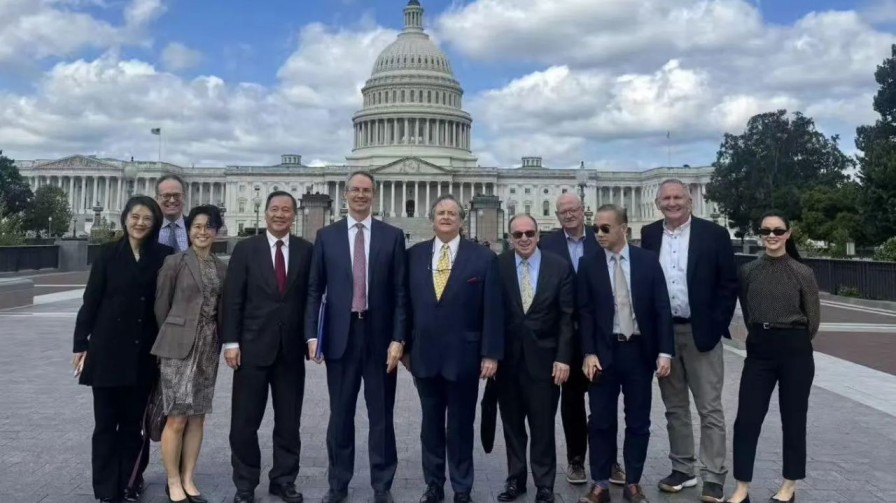
AI Security Rivalry: AmCham China delegates arrived in Washington as the AI security rivalry with Beijing reached a critical point, pressing US policymakers to keep business channels open amid rising tech tensions
Every spring, a group of American executives who have built careers in China make an unusual journey: they fly west to Washington to speak on behalf of a relationship that most of their home country has grown deeply skeptical about. This year, against the backdrop of intensifying competition over artificial intelligence and a renewed debate over national security, that conversation felt more urgent than ever.
The American Chamber of Commerce in China, known as AmCham China, brought its 2026 delegation of China-based business leaders to the U.S. capital this month for its annual DC Doorknock, a structured week of meetings with members of Congress, senior administration officials, think tank researchers, and trade representatives. The trip coincided with the 16th Annual China Business Conference, co-hosted with the U.S. Chamber of Commerce at its Washington headquarters.
It was a week defined by two questions that now sit at the center of the bilateral relationship: how to compete with China on artificial intelligence without triggering a deeper rupture, and how to preserve the space for American companies to operate in China when policymakers on both sides are drawing harder lines.
The AI Question Dominates Every Room
Artificial intelligence has moved from a background concern in US-China policy to a defining one. In the weeks leading up to the AmCham China visit, the Trump administration sent some of its most senior AI policy architects to Beijing for the Trump-Xi summit, including Treasury Secretary Scott Bessent and Michael Kratsios, director of the White House Office of Science and Technology Policy. The message from Washington was unmistakable: AI is now central to how the United States thinks about its rivalry with China.
Just three weeks before the summit, Kratsios had circulated a memo to federal agency heads targeting Chinese AI companies over alleged efforts to reverse-engineer complex AI systems developed by American firms. That document set a combative tone that AmCham China delegates would encounter in virtually every meeting they attended during the Doorknock.
The competition between the US and China is now viewed less as innovation-driven rivalry and more as a strategic struggle with geopolitical implications.”
That framing reflects a shift that has accelerated sharply over the past year. When Chinese AI startup DeepSeek released its V4 large language model in April 2026, the reaction among Western analysts was more measured than the alarm that greeted the earlier R1 release in January 2025. But the underlying anxiety remained: China has demonstrated it can make meaningful progress in AI even under US export controls, and no one is entirely sure what that means for the longer-term contest.
The Council on Foreign Relations assessed in late April that the new DeepSeek model is not competitive with frontier US systems, but acknowledged it is likely the best available open-source option globally. What it did not provide, analysts noted, is evidence that Chinese AI firms are closing the gap with American companies at the frontier. Yet the assumption that cutting off advanced chip exports would stall China’s AI development has, by most accounts, not held up as cleanly as US policymakers once hoped.
What the Delegates Carried Into the Room
AmCham China has been making versions of the same argument in Washington for years: that American companies doing business in China are not simply commercial actors, but functioning channels of information, relationship-building, and influence that benefit US interests. The chamber’s February 2026 leadership visit to Washington, led by Chairman James Zimmerman and President Michael Hart, began laying the groundwork for this year’s broader Doorknock delegation.
That February visit covered considerable ground. The delegation met with officials at the Treasury Department, the Commerce Department, the Office of the U.S. Trade Representative, and the State Department’s China House, in addition to conversations on Capitol Hill and at the US Chamber of Commerce’s China Center. By the time the spring Doorknock arrived, AmCham China had already been working to shape how the new administration understood the stakes for American business in China.
The core message delegates carried was consistent with what AmCham China has advocated for years: keep economic and trade channels open, coordinate with allies on areas of genuine concern, and ensure that American business remains a credible and active presence in China. What changed this year was the degree of difficulty in making that case, given how much the policy environment in Washington has shifted since the start of the Trump administration’s second term.
A Pivotal Year for Multinationals
The 2026 DC Doorknock took place at what AmCham China itself has called a pivotal moment for multinational companies with significant exposure to both the US and Chinese markets. The chamber’s application for delegate participation had framed the stakes plainly: as Washington advances its policy agenda, China will remain a central focus of debate across Congress, federal agencies, and the broader policy community, and the perspectives of companies operating on the ground need to be heard.
That kind of on-the-ground credibility has always been the delegation’s strongest asset. While policy researchers and congressional staffers deal in models and assumptions, AmCham China delegates can speak to what export controls actually do to supply chains, what regulatory changes in Beijing mean for day-to-day operations, and what kinds of conversations American business leaders are actually having with Chinese counterparts. It is a form of intelligence that Washington increasingly needs but often undervalues
Security Concerns That Cannot Be Dismissed
The delegates did not arrive in Washington to minimize legitimate security concerns. Technology development and national security have become core preoccupations for the congressional offices and administration officials that AmCham China meets with every year, a trend that has sharpened considerably since the initial DeepSeek shock in early 2025.
The AI Diffusion Rule, introduced under the Biden administration, had sought to create what it described as a trusted ecosystem of technology access, imposing export controls on nearly all global markets in an effort to limit the Chinese military’s access to American AI technology. That approach illustrated the challenge at the heart of US-China tech policy: because it is genuinely difficult to wall off the commercial sector in China from its military applications, controls tend to run broad, and broad controls create collateral effects for legitimate business.
China, for its part, has taken a notably stricter approach to AI governance than the United States. New powerful generative AI models in China must be registered with the central government before they can be released publicly. In the US, similar pre-release testing is voluntary. That divergence in regulatory philosophy is itself a point of tension in the bilateral relationship, and one that came up repeatedly in discussions during the Doorknock week.
Finding Room to Talk
Despite the heat of the rivalry, there were signs at the margins that both governments recognized the risks of total disengagement on AI. During the Trump-Xi summit in Beijing in mid-May, officials signaled interest in establishing some form of emergency communication channel or framework for preventing non-state actors from deploying powerful AI systems for dangerous purposes. Treasury Secretary Bessent made the point publicly, framing it as a pragmatic matter of mutual interest rather than ideological alignment.
That kind of limited, targeted cooperation is precisely the model AmCham China’s delegates have spent years arguing for: address genuine risks, but do not let the rhetoric of rivalry crowd out every conversation that could serve both countries’ interests. It is a harder sell than it used to be, but the people making it in Washington this May know the ground better than almost anyone.
What the 2026 DC Doorknock illustrated, above all, was that the conversation between American business and American government on China is not over. It is, if anything, more necessary than it has been at any point in recent memory, precisely because the decisions being made in Washington have consequences that extend far beyond the policy community and into the offices, factories, and supply chains where American companies are still, for now, doing business in China.