


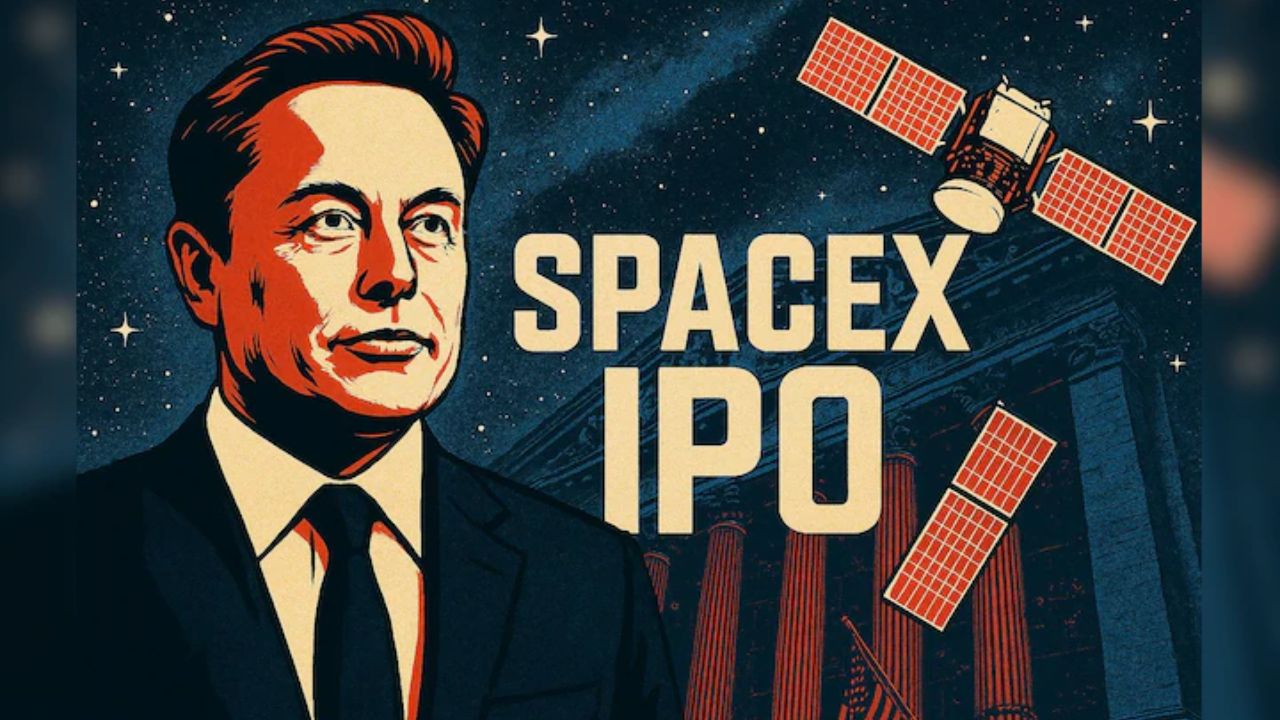
SpaceX IPO Filing Reveals $41 Billion: SpaceX IPO filings show a $41.3 billion accumulated deficit and a $4.28 billion Q1 loss, yet the June Nasdaq debut could become the largest in stock market history.
For the first time in its 24-year history, SpaceX has opened its books to the public — and what they show is a company simultaneously generating blockbuster revenue and burning through capital at a pace that surprised even seasoned Wall Street analysts. The S-1 registration statement filed with the Securities and Exchange Commission on Tuesday disclosed an accumulated deficit of $41.3 billion, a net loss of $4.28 billion in the first quarter of 2026 alone, and a governance structure that hands Elon Musk near-absolute authority over the company’s future — including its push to put humans on Mars.
The filing is the prelude to what could become the largest initial public offering ever staged. SpaceX is targeting a Nasdaq listing under the ticker symbol SPCX as early as June 12, with plans to raise up to $75 billion at a valuation the company is marketing at between $1.75 trillion and $2 trillion. If those numbers hold, the debut would surpass Saudi Aramco’s 2019 record and reshape the way investors think about capital-intensive, mission-driven technology companies.
Yet the prospectus makes clear that the SpaceX being offered to public shareholders is not quite the company that private investors have backed for years. In February, Musk engineered an all-stock merger between SpaceX and xAI — the artificial intelligence startup he founded in 2023, which owns the Grok language model and the X social media platform. That transaction, valued at $1.25 trillion at the time of closing, folded xAI’s history and its formidable cash burn into SpaceX’s consolidated financials. The S-1 restates prior-year results to reflect the combined entity, which means every headline loss figure reflects both businesses, not the rocket and satellite company in isolation.
“The combined company generated $18.67 billion in revenue in 2025 and posted a net loss of $4.94 billion — with capital expenditure surging nearly fivefold in a single year.”
Three Businesses, Three Very Different Stories
Beneath the headline numbers, the filing describes a company that is really three distinct enterprises operating under one roof, each with a fundamentally different financial profile — and only one of them is currently making money.
Starlink, the global satellite internet service, is the undisputed financial engine of the combined group. The division accounted for more than two-thirds of total revenue in 2025, and in the most recent quarter it generated $1.2 billion in operating profit. The subscriber base more than doubled over the course of last year, and independent analysts at research firm Payload projected revenue growth of roughly 80 percent through 2026. For investors looking to anchor a valuation, Starlink is the most legible asset in the prospectus — a subscription business with recurring revenue, genuine global scale, and a regulatory moat that would take years and billions of dollars for any competitor to replicate.
The core launch business — the rockets, the Falcon 9 fleet, the Starship development program — tells a more complicated story. SpaceX remains the world’s most active launch company and has driven down the cost of putting payloads into orbit in ways the industry once believed impossible. But the division lost money during the first quarter, and the prospectus is careful to note that Starship, the enormous next-generation vehicle designed to carry crews to the Moon and eventually Mars, remains in active development. The costs associated with that program are real and ongoing.
Then there is xAI. The filing shows that capital expenditure at the combined company surged from $5.6 billion in 2024 to $20.7 billion in 2025 — an increase of nearly fivefold in twelve months. Of that figure, $12.7 billion was directed at artificial intelligence initiatives, a sum that exceeded total spending on space and satellite operations. The prospectus describes orbital AI data centers as part of the company’s long-term strategy, but offers limited detail on the timeline or the expected returns. For investors trying to model xAI’s contribution to future cash flows, the honest answer embedded in the filing is that it is, for now, an expensive bet on where computing is heading.
| Period | Revenue | Net Income / Loss | Capital Expenditure |
|---|---|---|---|
| Full Year 2024 | $14.1 billion | +$791 million | $5.6 billion |
| Full Year 2025 | $18.67 billion | -$4.94 billion | $20.7 billion |
| Q1 2026 | $4.69 billion | -$4.28 billion | Not disclosed |
| Accumulated Deficit (as of Mar 31, 2026) | $41.3 billion | ||
Revenue Is Growing. So Are the Losses.
Investors will note an important detail buried in the revenue line: the pace of growth is genuine. Full-year revenue of $18.67 billion in 2025 represented roughly 33 percent growth over the $14.1 billion the combined entity reported in 2024. First-quarter 2026 revenue of $4.69 billion came in 15 percent higher than the same three months in 2025. The filing also disclosed that SpaceX has reached an agreement with Anthropic — the AI safety company behind the Claude family of models — that will deliver an additional $1.25 billion per month for the next three years through a services arrangement. That contract alone, if it holds, adds roughly $15 billion in committed revenue to the pipeline.
The challenge is that costs are growing faster than revenue. The merger with xAI transformed a company that earned $791 million in net income in 2024 into one that lost nearly $5 billion in 2025 and burned through more than $4 billion in just the first three months of this year. The accumulated deficit — a measure of all the net losses a company has absorbed since its founding — now stands at $41.3 billion. That number will be one of the most discussed figures on Wall Street in the weeks ahead.
Musk Keeps the Keys
For any investor reading the S-1 carefully, the governance section is as significant as the income statement. The filing confirms that through a dual-class share structure, Musk will hold 85.1 percent of total voting power after the IPO, despite owning approximately 42 percent of the company’s equity. That is because his Class B shares carry ten votes each, compared to one vote per Class A share sold to the public. Under the terms of this structure, Musk can only be removed from control by a vote of Class B shareholders — a group he effectively controls himself.
The prospectus is candid about the implications, warning potential investors in a dedicated risk section that the structure “concentrates voting control with Mr. Musk,” who has the authority to select board members, approve or block major transactions, and set the strategic direction of the company without needing the agreement of public shareholders. The filing also notes that Musk divides his time between SpaceX, Tesla, where he serves as chief executive, and his other ventures — a scheduling reality that the company flags as a material risk.
For investors who prioritize conventional corporate governance, this arrangement will be a serious concern. For those who have followed Musk’s track record in building Tesla and SpaceX from the ground up, it may be precisely the point. His continued, unchecked control is the mechanism by which he intends to execute the missions — Mars colonization, orbital AI infrastructure, global satellite internet — that no publicly accountable board would approve on a conventional timeline.
What Wall Street Is Actually Buying
The fundamental question facing institutional investors is not whether SpaceX will eventually be valuable. The question is what it is worth right now, and whether the price being asked reflects a rational assessment of the businesses on offer or a premium for the mythology surrounding the man who runs them.
Analysts who follow the company closely have noted that the public float — the portion of shares that will actually be freely tradeable after the IPO — will be relatively small compared to the company’s overall size. A large proportion of stock will remain in the hands of Musk, long-term employees, and early institutional backers including Alphabet, which reportedly holds between 5 and 6 percent. When a small float meets enormous institutional demand, price discovery can be driven more by scarcity than by any underlying measure of value. Critics have raised that concern explicitly in the days since the filing became public.
What the filing does make clear is that SpaceX is not a straightforward bet on any one technology. It is a wager on a vertically integrated empire — rockets, satellites, artificial intelligence, social media — being assembled by a founder who has repeatedly confounded skeptics, funded his ambitions with profits from one division while losing money in another, and structured his companies to ensure that no external pressure can force him off course. Whether that vision justifies a $2 trillion price tag is the question that markets will answer on June 12.