


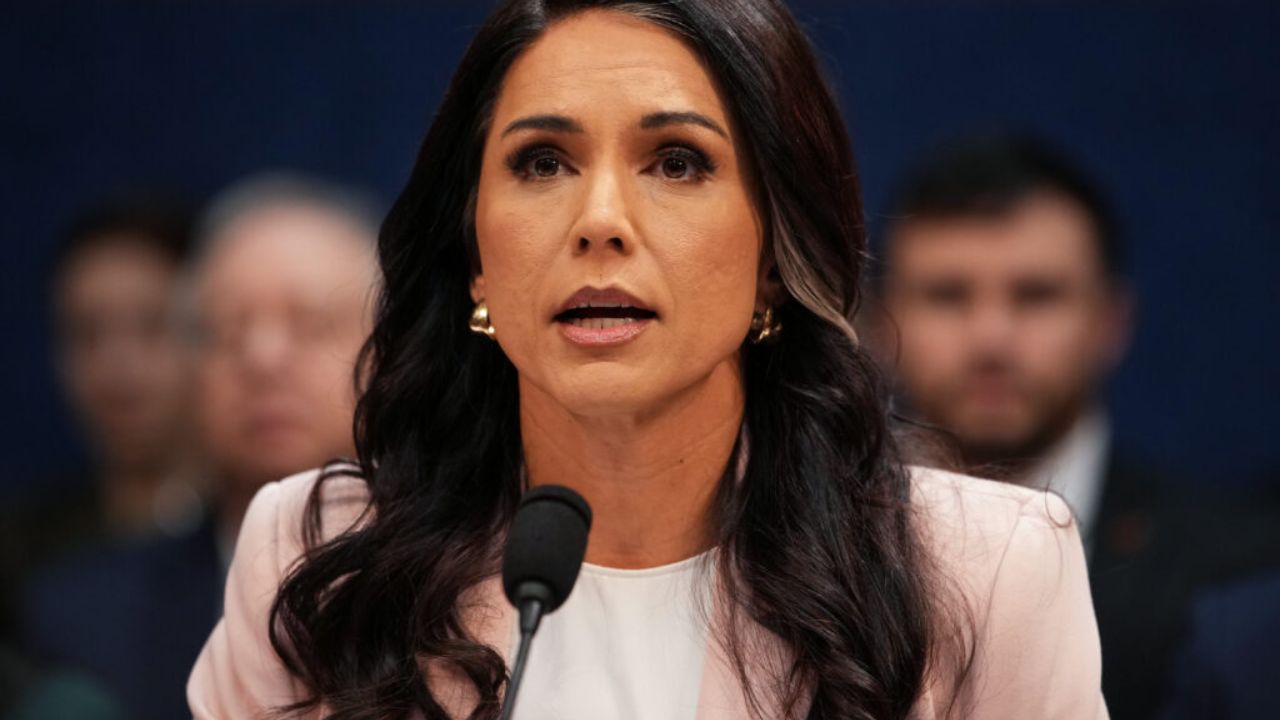
Tulsi Gabbard resigns as Director of National Intelligence effective June 30, 2026, after husband Abraham Williams is diagnosed with a rare form of bone cancer.
Tulsi Gabbard, the Director of National Intelligence and one of the most prominent figures in the Trump administration’s national security apparatus, announced Friday that she is resigning from her post — not because of political pressure or policy disagreement, but for a reason that cuts far deeper than Washington’s usual calculations. Her husband, Abraham Williams, has been diagnosed with an extremely rare form of bone cancer.
The resignation, first reported by Fox News Digital and later confirmed across major outlets, will take effect on June 30, 2026. Gabbard broke the news publicly by posting her resignation letter directly to social media, allowing Americans to read her words without a political filter.
“At this time, I must step away from public service to be by his side and fully support him through this battle.”
In the letter, Gabbard described Williams as the steady foundation of her life throughout years of personal and professional upheaval. She wrote that he had stood by her during her military deployment to East Africa on a Joint Special Operations mission, through multiple political campaigns, and throughout her time as the nation’s top intelligence official. Now, she wrote, it was her turn to stand by him.
Williams and Gabbard have been married for eleven years. The specific type of bone cancer he was diagnosed with was described only as “extremely rare,” and few additional medical details were made public. Gabbard made clear that her husband faces significant challenges in the weeks and months ahead, and she stated plainly that leaving public service was not a difficult decision when weighed against his health.
A Personal Meeting at the Oval Office: Tulsi Gabbard
Rather than communicating her decision through staff channels, Gabbard chose to deliver the letter in person. On Friday, she met with President Trump at the Oval Office, handing him the letter directly. The gesture reflected the working relationship the two had built since she endorsed Trump during the 2024 presidential race, a move that surprised many in Washington given her long history as a Democratic congresswoman from Hawaii.
Trump responded on Truth Social with characteristic directness and warmth. He praised Gabbard for doing what he called “an incredible job” in the role, adding that the administration would miss her. He also expressed confidence about Williams’s recovery, writing that he had no doubt her husband would “soon be better than ever.” Trump announced that Aaron Lukas, the Principal Deputy Director of National Intelligence, will serve as acting director once Gabbard departs.
The Fourth Cabinet Departure of Trump’s Second Term
Gabbard’s exit makes her the fourth Cabinet-level official to leave during Trump’s second administration. Former Homeland Security Secretary Kristi Noem and former Attorney General Pam Bondi were both removed from their posts, while Labor Secretary Lori Chavez-DeRemer resigned earlier this year. Unlike those departures, which carried political undertones, Gabbard’s exit appears to be entirely personal in nature.
Still, her tenure at the Office of the Director of National Intelligence was not without turbulence. As a former Democrat with a history of skepticism toward U.S. military interventionism, Gabbard was never a seamless fit within a wartime Republican Cabinet. According to reporting from Axios, she never fully broke into Trump’s inner circle. There were also reported tensions behind the scenes between ODNI and the CIA that became public just last week during a Senate Homeland Security Committee hearing, where a CIA insider affiliated with Gabbard’s special Directors Initiative Group testified about agency conflicts.
In the weeks leading up to the announcement, White House officials had been hearing quiet rumors that she might be preparing to leave. As recently as two weeks ago, however, Gabbard was privately denying any plans to exit the administration, according to a senior administration official.
From Hawaii Democrat to Trump’s Intelligence Chief
Gabbard’s path to leading the intelligence community was one of the more unusual political journeys in recent memory. Born in American Samoa and raised in Hawaii, she served in the Hawaii House of Representatives and on the Honolulu City Council before winning election to the U.S. House in 2012, becoming one of the first Hindu members of Congress. She served four terms representing Hawaii’s 2nd congressional district.
During the 2020 Democratic presidential primaries, she mounted a brief and ultimately unsuccessful campaign for the White House. By 2024, she had broken entirely from the Democratic Party, publicly endorsing Trump and making the case that the national security and foreign policy establishment needed to be challenged from within. That endorsement paved the way for her nomination as DNI, a role she assumed on February 12, 2025, after a Senate confirmation process that drew both scrutiny and support.
Whatever the political complexities of her time in office, the reason she is leaving is entirely human. A spouse has been diagnosed with a serious illness, and she has chosen to put her family first. That decision, at least on a personal level, is one that requires no political explanation.
What Comes Next for U.S. Intelligence Leadership
With Gabbard’s departure set for the end of June, the administration has approximately five weeks to prepare for a leadership transition at one of the country’s most sensitive agencies. Aaron Lukas, who has served as Principal Deputy Director under Gabbard, will step in as acting director while the White House determines a permanent successor.
No formal nomination has been announced. Given the current geopolitical environment and the ongoing tensions between ODNI and other parts of the intelligence community, the selection of Gabbard’s replacement will be watched closely by both intelligence professionals and congressional oversight committees.
For now, however, the story is a simpler one. A woman who spent more than a decade in public life, who deployed overseas as a military officer and served in Congress and led one of the most powerful intelligence agencies in the world, is going home to be with her husband. The rest, for the moment, can wait.