


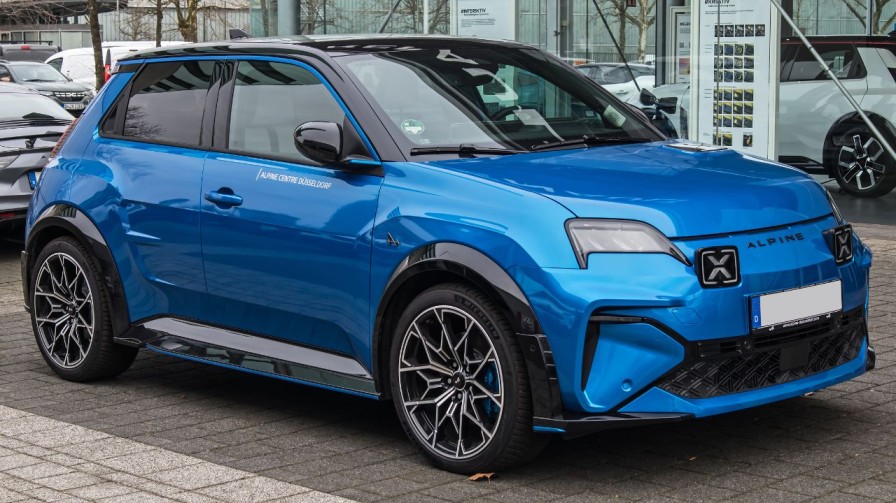
Alpine A290 GTS tested for 2,000 miles through winter — real-world range, ride quality, charging costs, and whether this electric hot hatch is worth buying as a daily driver.
The electric hot hatch has been a class in search of a leader. For years, automakers have tossed out contenders with more power than purpose — the MG 4 XPower, the Smart #1 Brabus, the Abarth 500e — each of them offering a sliver of the magic but none delivering it consistently enough to truly matter. The Alpine A290 arrives promising to change all of that, and for a car we named our favorite fun EV of 2025, spending a winter with one turns out to be a more complicated experience than that accolade might suggest.
The bones are undeniably strong. The A290 is built on the Renault 5 platform, a genuinely brilliant small electric car that handles with surprising confidence, looks great, and works well in everyday life. What Alpine has done is sharpen everything: firmer suspension, more aggressive tuning, 217 horsepower in the top GTS trim, and a visual identity loud enough to draw stares at traffic lights. On paper, it is exactly what the segment has needed.
Our test car — the range-topping GTS with a two-tone Vision Blue and black roof livery — stickered at $38,600 fully loaded. That puts it in the same orbit as the Abarth 600e and just below the Volkswagen Golf GTI, which is probably its most natural gasoline-powered rival. Since this test began, Alpine has repriced the A290 with government incentives factored in, bringing equivalent spec down to roughly $34,245 — a meaningful improvement, even if it remains a punchy ask for a car with a barely usable rear seat.
Living With It Through Winter
There is an almost amusing irony in the name Alpine being attached to a car that genuinely struggles in cold weather. The brand’s founder, Jean Redele, built his reputation on icy mountain passes. The electric A290 would rather not know about any of that.
At freezing temperatures, our GTS managed as little as 125 miles of real-world range. A trip from south London to Coventry — a mundane 124 miles — consumed the battery from full down to approximately 20 percent under milder conditions. When the mercury drops below freezing and you add sustained highway cruising, that two-hour journey starts to feel genuinely risky without a planned charging stop. The A290 officially claims 226 miles; over the course of this test, average real-world range settled at 164 miles, with the worst cold-weather results dipping to 125.
For context, the Mini Cooper SE — a car of nearly identical dimensions, battery capacity, and power output — managed north of 200 miles in mixed use during our comparative testing. That gap stings.
The charging speed is also a factor. At a maximum of 100 kW, the A290 is not the kind of car you can top up in fifteen minutes at a highway rest stop and carry on feeling confident. Without a home charger — our tester’s situation throughout this winter — you are playing a constant game of range arithmetic, rationing throttle inputs and toggling into the energy-saving drive mode more often than anyone who just spent serious money on a performance car should ever have to.
On at least one occasion, a four-mile errand to the shops used four percent of the battery just pootling through suburban streets — the combination of cold cabin warmup, heated everything, and a near-dead battery making for a sobering reminder of the A290’s biggest limitation. There were days when the old family beater came out of the driveway instead, simply to preserve the Alpine’s charge for a more important journey. That is not a situation that inspires confidence in a car billing itself as a daily driver.
The Roads Fight Back
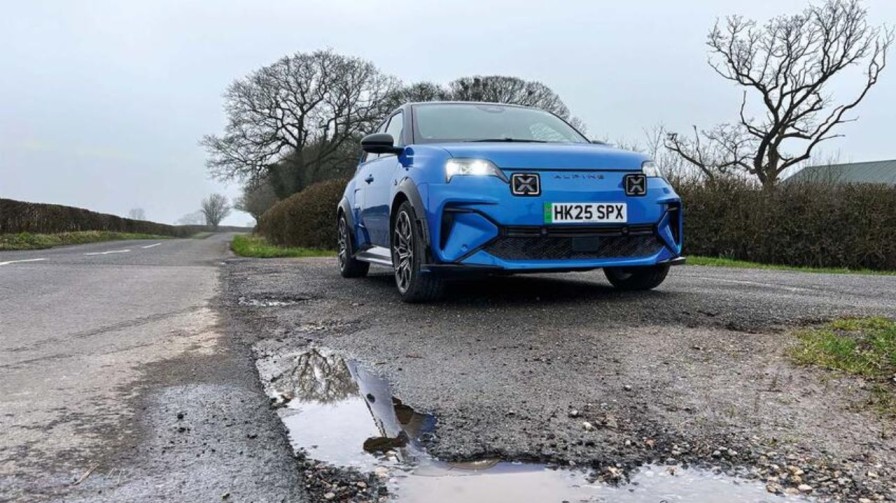
Winter delivered one more obstacle: the roads. The pothole situation in and around our tester’s regular routes was, by any objective measure, catastrophic — craters large enough to damage alloy wheels, patched tarmac that resembled quilted fabric more than a driving surface, and speed bumps that seemed to materialise from nowhere.
The reasonable assumption was that the A290’s stiffened suspension and 19-inch wheels would amplify all of this into something genuinely unpleasant. Previous hot hatches on similar setups — the Cupra Leon, the Abarth 500e — had fatigued us with their harsh low-speed ride on broken surfaces.
The A290, to its considerable credit, does better than either. Over the worst urban roads, it absorbs impacts with more composure than expected. Shock waves reaching the seat and steering column are generally well-muffled by the time they arrive. The suspension does not clunk and thump with the stomach-dropping drama of some performance cars when you fall into a deep pothole. There is juddering over coarser ground, and approach speed over speed bumps requires care, but broadly this is a car you can commute in without feeling punished.
What Alpine has managed is no small thing: it has injected dynamic sharpness into the Renault 5 chassis without sacrificing the composed, confident ride that makes that underlying car one of the better-rounded small EVs on sale. The compromise is real but livable — at least on reasonably maintained roads.
When the Sun Came Out
Spring changed everything. A clear calendar, a full battery, a switchback B-road through the Berkshire Downs, and the phone on airplane mode. This is when the A290 started to make its case properly.
It is fast, and it feels it. The official 0–62 mph time of 6.4 seconds does not sound dramatic in an era when many family haulers match that number, and the A290 is actually a touch slower to 62 than a Volkswagen Golf GTI. But Alpine has worked hard to make the act of going fast feel like something — there is a convincing electronic whoosh note fed into the cabin and a space-themed graphic that hijacks the driver’s display when you hit the dedicated red “overtake” button on the steering wheel. It is gamified, certainly, but this is not a car that takes itself too seriously, and the theater works.
What impresses more than the raw pace is the way the A290 handles a winding road. It will not match the surgical precision of a Honda Civic Type R, and it lacks the planted, all-weather confidence of a performance four-wheel-drive car like the Mercedes A35 AMG 4Matic. But within those limits there is genuine dynamic character: the steering is satisfyingly weighted and honest about what the front tires are doing, body roll is controlled without being entirely suppressed, and the chassis feels lighter and more agile than the car’s near-crossover dimensions and 3,260-pound curb weight would suggest.
The torque-vectoring system — which works by selectively braking individual front wheels rather than through a mechanical limited-slip differential — does a credible job of managing corner exit power. You will notice the traction control intervening with some force when you ask for maximum acceleration from rest, which can feel like a gatekeeper rather than an aid. Think of it, if you like, as a digital approximation of the turbo lag in the original Renault 5 Turbo. The character is different, but the principle of rewarding patience is the same.
Life Inside the Cabin
The interior of the A290 is largely a pleasant place to spend time. The technology stack — borrowed and evolved from the Renault 5 — works reliably in daily use, which is more than can be said for many competitors at this price point. Physical controls are present in useful numbers, the screens are responsive, and the general ambiance manages to feel sporting without resorting to aggressive plastics and faux carbon fiber everywhere.
The rear seat is, for practical purposes, a polite fiction. There is space back there for small children on short trips and not much else. The trunk at 326 liters is usable for weekly groceries and not much more. Neither of these things will surprise anyone who has spent time with a hot hatch, but they are worth noting for anyone considering the A290 as a primary vehicle for a household that occasionally needs to carry more than one passenger.
Then there is the cupholder situation. Alpine made the decision to remove the Renault 5’s cupholders in the interest of driver focus. The logic is understandable in a strictly performance context. In the real world, where most owners will commute in this car every day, it is an aggravating oversight that generates a disproportionate amount of frustration. The owner forums are full of people hunting for 3D-printed solutions. Our tester eventually found one, and the car felt warmer from that point forward in almost every sense.
The rear-view camera deserves a mention for all the wrong reasons: in low light or rain, it is effectively useless, rendering a feature that should be a safety asset into an afterthought.
The Verdict
The Alpine A290 is the best electric hot hatch that exists right now. That is a genuine statement of quality, not faint praise — it handles with real character, it goes fast in a way that is genuinely involving, it rides well enough for urban duty, and it looks spectacular. By the standards of a class that has produced very little to get excited about, it is a breakthrough car.
But living with it forces a conversation about what it actually is. In winter, with limited charging infrastructure, it is a stressful companion. The range anxiety is real and constant in a way that a larger-battery EV simply does not impose. The GT version — slightly less powerful, considerably more efficient, and around $4,000 less expensive — starts to look like the rational choice within the range; the performance gap in normal driving is negligible, and the range benefit is meaningful.
If you have a home charger and you are using the A290 as a second vehicle — handling the daily school run and supermarket duty while occasionally pressing into service for a Sunday morning blast — it is excellent. If you are buying it as a sole car and you depend on public charging, the math gets uncomfortable quickly. This is a car that rewards commitment to the right lifestyle and punishes mismatches with it.
The EV hot hatch has a champion. Just make sure your circumstances let you enjoy it.
What We Loved
- Genuinely involving dynamics with real steering feel and character
- Impressive ride quality for a performance car on 19-inch wheels
- Acceleration that feels theatrical and exciting, not just fast
- Reliable, intuitive cabin technology with meaningful physical controls
- Strong visual identity — it looks exactly as quick as it is
- Heat pump standard on GTS, a genuine cold-weather help
What We Didn’t
- Real-world winter range well below official figures — as low as 125 miles
- No home-charger access makes ownership genuinely stressful
- No cupholders — an inexplicable omission for a daily-driven hot hatch
- Rear seat is nearly unusable for adults on any journey of length
- Rear camera nearly useless in rain or darkness
- Traction control intervenes aggressively during hard acceleration
Full Specifications — Alpine A290 GTS
- List Price New = $37,500
- Price as Tested = $38,600
- Motor Type = Permanent Magnet Synchronous
- Max Power = 217 bhp
- Max Torque = 221 lb-ft
- 0–62 mph = 6.4 sec
- Top Speed = 106 mph
- Battery (Usable) = 52.0 kWh
- Official Range = 226 miles
- Real-World Average = 164 miles
- Best Test Efficiency = 3.7 mi/kWh
- Worst Test Efficiency = 2.4 mi/kWh
- Max Charge Rate = 100 kW
- Drivetrain = Single-speed, FWD
- Wheels = 19-in Alloy
- Tires = 225/40 R19 Michelin Pilot Sport EV
- Curb Weight = 3,260 lb (1,479 kg)
- Trunk Volume = 326 liters
- CO2 Emissions = 0 g/km
- Fuel Cost (Test Period) = $256.81