

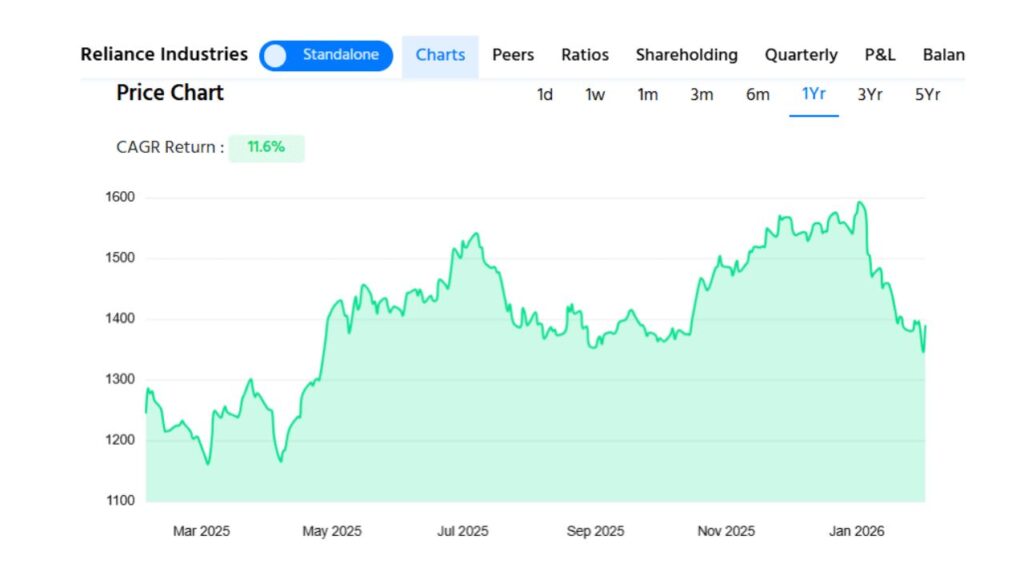
Reliance Industries has once again grabbed market attention. Its share price surged sharply after news around the India-US trade deal lifted overall market sentiment. For retail investors and market watchers, the big question is simple: why did Reliance rally, and what does it mean going forward?
In this article, we break down the Reliance share price rally in simple terms, explain how the India-US trade deal played a role, and discuss whether this momentum can sustain. If you’re a general investor trying to make sense of the headlines, you’re in the right place.
Reliance Share Price Rally: What Happened?
Reliance Industries’ stock jumped strongly in recent trading sessions, outperforming many other large-cap stocks. This rally came alongside a broader market surge, with benchmark indices like the Sensex and Nifty posting sharp gains.
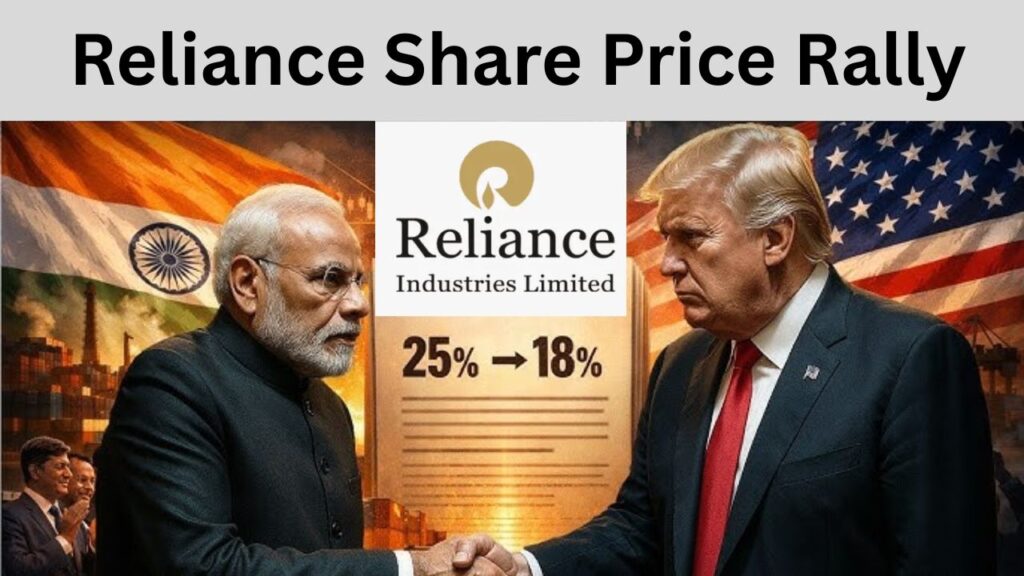
The trigger? Positive sentiment around the India-US trade deal, which eased concerns about tariffs, global trade tensions, and supply-chain disruptions. Big companies with global exposure—like Reliance—stood to benefit the most, and investors reacted quickly.
Market participants viewed the development as a confidence booster, especially for heavyweight stocks that influence index movement .
Why Reliance Industries Reacted Positively
Reliance Industries is not just an Indian company anymore—it has global linkages across energy, telecom, retail, and technology. Any improvement in trade relations between major economies like India and the US tends to work in its favour.
Here’s why investors turned bullish:
1. Global Business Exposure
Reliance has partnerships, investments, and supply chains connected to global markets. A smoother trade environment reduces uncertainty, which is always good for large conglomerates.
2. Improved Investor Sentiment
Markets move not only on fundamentals but also on sentiment. The India-US trade deal signalled cooperation rather than conflict, leading to a risk-on mood among investors.
3. Heavyweight Stock Effect
Reliance is a market heavyweight. When confidence returns, institutional investors often increase exposure to large, stable names first, pushing prices higher.
Analysts described the trade deal as “incrementally positive” for Reliance, especially from a medium- to long-term perspective .
India-US Trade Deal: A Simple Explanation
For many retail investors, trade deals sound complicated. Let’s simplify it.
The India-US trade deal aims to improve economic cooperation by:
- Reducing trade barriers
- Easing tariffs on select goods
- Improving market access for businesses
- Strengthening strategic and economic ties
While not every detail directly impacts Reliance, the overall message matters: less friction, more opportunity.
When the world’s largest and fastest-growing economies work together, large Indian companies benefit indirectly through better trade conditions and stronger investor trust .
How the Trade Deal Translates into Market Gains
You might wonder: “How does a trade deal announcement lead to a stock rally?”
Here’s the chain reaction:
- Positive trade news reduces uncertainty
- Foreign investors feel more confident
- Capital flows increase into Indian markets
- Large-cap stocks attract buying
- Indices and heavyweight stocks rally
This is exactly what happened when the news broke. Reliance, being a frontline stock, was one of the biggest beneficiaries.
Broader Market Impact: Reliance Wasn’t Alone
Reliance’s rally was part of a larger market move. Other major groups and sectors also gained as investors cheered the development.
- Sensex surged by over 2,000 points on strong buying
- Nifty crossed key psychological levels
- Banking, energy, and infrastructure stocks saw renewed interest
Such broad-based rallies usually indicate strong institutional participation, not just short-term retail trading .
Is the Reliance Share Price Rally Sustainable?
This is the most important question for investors.
Short-Term View
In the short term, some profit-booking is natural after a sharp rise. Volatility may increase, especially if global cues turn weak.
Medium- to Long-Term View
From a longer perspective, Reliance remains well-placed due to:
- Strong balance sheet
- Diversified businesses
- Leadership in telecom and retail
- Ongoing investments in green energy and digital platforms
Analysts believe that while the trade deal alone won’t drive earnings overnight, it supports the broader growth narrative for companies like Reliance .
What Retail Investors Should Understand
If you’re a retail investor, here are some simple takeaways:
- The rally was sentiment-driven, supported by global optimism
- Reliance remains a long-term story, not just a short-term trade
- Avoid chasing prices after sharp rallies
- Focus on fundamentals and your investment horizon
Big news events often create fast price moves, but smart investing means separating temporary excitement from long-term value.
Key Risks to Watch
No rally is risk-free. Investors should keep an eye on:
- Global economic slowdown
- Changes in US interest rate expectations
- Execution risks in Reliance’s new-age businesses
- Any delays or disagreements in trade deal implementation
Markets react quickly to headlines, but they also correct when expectations get too high.
Final Thoughts: What This Rally Really Means
The Reliance share price rally following the India-US trade deal highlights one key truth: markets love certainty and cooperation.
While the trade deal itself may not immediately change Reliance’s earnings, it improves confidence, sentiment, and long-term outlook. For a stock as influential as Reliance, that’s often enough to trigger strong buying interest.
For investors, the message is clear—stay informed, stay patient, and focus on long-term fundamentals rather than short-term noise.
FAQs
1. Why did Reliance shares rise after the India-US trade deal?
Because the deal improved overall market sentiment and reduced global trade uncertainty, which benefits large companies like Reliance.
2. Did Reliance gain directly from the trade deal?
Not directly in earnings terms, but indirectly through better investor confidence and global business sentiment.
3. Is this a good time to buy Reliance shares?
That depends on your investment horizon. Long-term investors may consider dips, while short-term traders should be cautious after a sharp rally.
4. Will the rally continue?
Short-term volatility is possible, but the long-term outlook depends on company fundamentals and global conditions.
5. Are trade deals important for stock markets?
Yes. Trade deals reduce uncertainty, improve investor confidence, and often lead to market rallies.