

Markets Fall SIP Concerns Rise: Many investors give up on Systematic Investment Plans (SIPs) far too early. Short-term market swings, comparisons with flashy returns elsewhere, or temporary cash-flow pressures often push them to stop investing—just when compounding is about to do the heavy lifting. SIPs reward patience and time, not perfect timing, and exiting midway can mean locking in losses while missing out on long-term wealth creation.
That temptation has resurfaced as Indian equity markets retreat from record highs. The Nifty 50 and Sensex have each fallen more than 4 percent in a week, unsettling retail investors who had grown used to a steady rally.
The Nifty is now over 4 percent below its all-time high of 26,373.2, reached on January 5, while the Sensex has slipped a similar margin from its peak of 86,159.02 touched in December. On January 20, the Nifty ended the session at 25,232 and the Sensex at 82,180, extending the losing streak.

As volatility returns, a familiar dilemma arises: should investors continue their SIPs or pause contributions until markets stabilise?
Financial advisors caution that this is precisely the phase when many investors make costly errors. Stopping SIPs during corrections often means missing out on the most powerful phase of long-term wealth creation. Understanding why staying invested matters can help investors navigate uncertain markets more confidently.
Why investors stop SIPs too soon
Market volatility is the biggest trigger. Short-term losses fuel anxiety, leading to panic decisions during corrections—despite the fact that these periods allow SIP investors to accumulate more units at lower prices.
Other common reasons include comparing returns with trending assets or top-performing funds, temporary financial stress due to job changes or large expenses, and weak conviction in how market cycles actually work.
Lt Col Rochak Bakshi (Retd.), founder of True North Finance, explains that behavioural biases play a major role. “Recency bias pushes investors to chase recent winners, while loss aversion makes temporary declines feel unbearable. SIPs then get treated like short-term trades instead of long-term investments, causing many to exit just before the real wealth-building phase begins.”
The real cost of quitting early
Stopping SIPs prematurely robs investors of two powerful advantages: rupee-cost averaging during downturns and the exponential impact of compounding, which becomes most visible after seven to ten years.
“SIPs flourish with time, not timing,” says Vijay Maheshwari, founder of Stocktick Capital. “Exiting early turns them into ordinary savings tools, locks in losses, and sacrifices future growth.”
Consider a ₹75,000 monthly SIP earning 15 percent annually. After three years, an investment of ₹27 lakh grows to around ₹34 lakh. Continue the same SIP for 20 years, and the total investment of ₹1.8 crore can build a corpus of nearly ₹9.97 crore. Quitting after just three years results in an opportunity loss of over ₹9.6 crore. Even stopping after 10 years—when the corpus reaches around ₹2 crore—means foregoing nearly ₹8 crore in potential gains.
Maheshwari explains that wealth creation is heavily back-loaded. “The first few years lay the foundation, the middle phase builds momentum, and the final phase delivers explosive growth through compounding on a much larger base. Consistency, not luck or timing, does the job.”
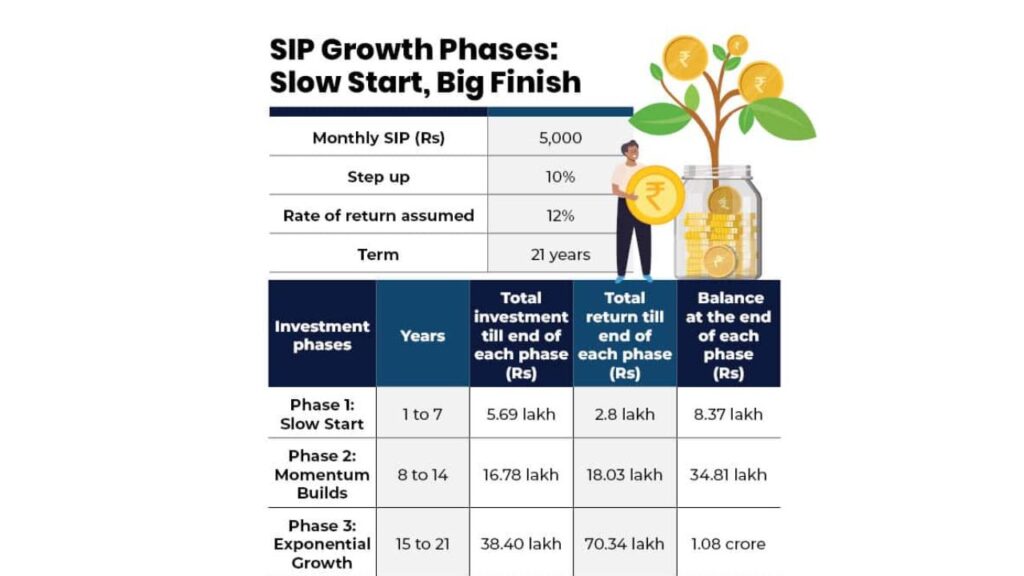
A smaller SIP shows the same pattern. A ₹5,000 monthly SIP with a 10 percent annual increase and 12 percent returns grows to about ₹1.08 crore over 21 years. The first seven years show modest growth, the next seven pick up speed, and the final phase accounts for the bulk of the wealth.
Using step-up SIPs to accelerate growth
A step-up SIP, where contributions rise annually, can significantly improve outcomes. For example, a ₹5,000 monthly SIP over 15 years at 12 percent returns results in about ₹24 lakh without step-ups. Adding a 10 percent annual increase raises the total investment but boosts the final corpus to nearly ₹36 lakh—around 50 percent more.
This approach works especially well for salaried individuals and young professionals whose incomes grow over time. Even late starters can benefit. Someone beginning at 45 with a ₹10,000 SIP and increasing it by 15 percent annually can still build close to ₹90 lakh in 15 years.
However, Bakshi cautions that step-up SIPs may not suit self-employed individuals with uneven cash flows. “For most people, the mid-30s—when income stabilises—is an ideal time to start stepping up contributions for maximum impact.”
Staying calm during market corrections
For new investors, advisors recommend shifting focus from short-term returns to long-term goals such as buying a home or funding retirement. Automating SIPs, reviewing portfolios only once a year, and viewing volatility as an opportunity rather than a threat can help maintain discipline.
Gradually increasing contributions, staying informed through credible sources without obsessing over daily market moves, and remembering that compounding rewards patience can make a big difference.
Turning SIPs into long-term wealth engines
Consistency alone isn’t enough. Starting early gives compounding more time to work its magic. Regularly stepping up investments, maintaining proper asset allocation through rebalancing, and choosing quality funds with strong investment processes are equally important.
“Behavioural discipline is critical,” says Maheshwari. “Ignore market noise, keep costs and taxes low, and review portfolios periodically to ensure they still align with your goals. These simple habits can significantly enhance long-term outcomes—without taking unnecessary risks.”
In volatile markets, staying invested often feels uncomfortable. But for SIP investors, patience and discipline remain the most reliable path to meaningful wealth creation.