

Mid and Small-Cap Funds: Despite a tough year for broader markets, investor interest in mid-cap and small-cap mutual funds remained remarkably strong in 2025.
Market performance told a mixed story. The BSE MidCap index ended the year with a modest gain of 1.1 percent, while the BSE SmallCap index slipped 6.6 percent. In contrast, benchmark indices outperformed, with the Sensex rising nearly 9 percent and the Nifty gaining around 10.5 percent during the year.
Beneath the surface, however, market breadth stayed weak. Out of 140 stocks in the BSE MidCap index, 86 finished the year in negative territory. The picture was even more pronounced in small caps, where 871 of the 1,186 stocks in the BSE SmallCap index ended the year with losses. Even in the BSE100, 39 stocks declined, while 61 managed to post gains.

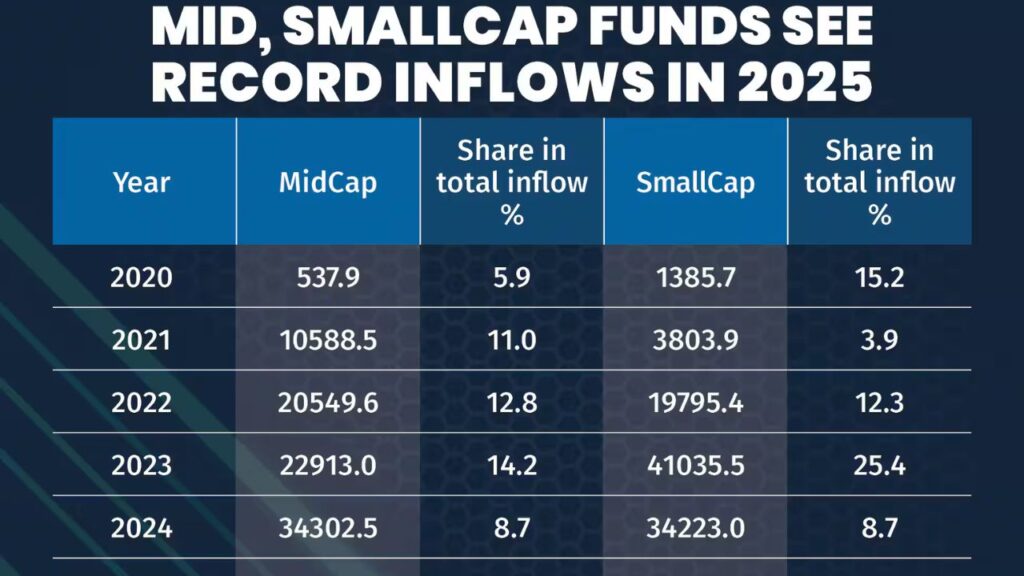
Yet, mutual fund inflows into these segments hit record highs. According to data from the Association of Mutual Funds in India (AMFI), mid-cap mutual fund schemes attracted ₹49,939 crore in 2025, marking a 46 percent jump from the previous year. Small-cap funds saw even stronger interest, pulling in ₹52,321 crore, up 53 percent year-on-year.
Market experts attribute this resilience largely to steady SIP inflows and investors continuing to add money during market dips. Rajesh Palviya of Axis Securities said that many investors remain encouraged by the strong three- and five-year performance of mid-cap and small-cap stocks compared with large caps, and are using corrections as an opportunity to average their investments.
Domestic investors have played a dominant role in these flows over the past two years. With foreign institutional investors largely staying away from mid- and small-cap stocks and focusing their selling on large caps, domestic money has increasingly found its way into these higher-growth segments.
This shift is reflected in the changing composition of equity inflows. Mid-cap funds accounted for a record 14.26 percent of total equity inflows in 2025, up sharply from 8.7 percent in 2024. Small-cap funds also saw their share rise to a two-year high of 14.26 percent, compared with 8.68 percent last year.
Overall equity mutual fund inflows for the year stood at ₹3.51 lakh crore, an 11 percent decline from ₹3.94 lakh crore in 2024, though still well above the ₹1.62 lakh crore seen in 2023.
Analysts note that the absence of large-scale outflows, despite nearly 16 months of subdued returns, signals sustained investor confidence. Many investors appear willing to stay invested with a three- to four-year perspective, especially as alternative assets like gold and silver are trading at elevated levels, making them less attractive for fresh long-term allocations.
Independent market analyst Ambreesh Baliga believes mutual fund inflows are likely to remain steady. He pointed out that while many individual stock portfolios are down 20 to 30 percent or more, even the weakest mid-cap and small-cap mutual funds were down only about 5 to 6 percent by the end of December.
However, Baliga cautioned that investor behaviour can change if losses deepen. “As long as drawdowns remain manageable, investors continue averaging. But once losses become large, averaging stops, liquidity dries up, selling pressure intensifies, and the risk of sharper declines — even margin calls — increases,” he said.