


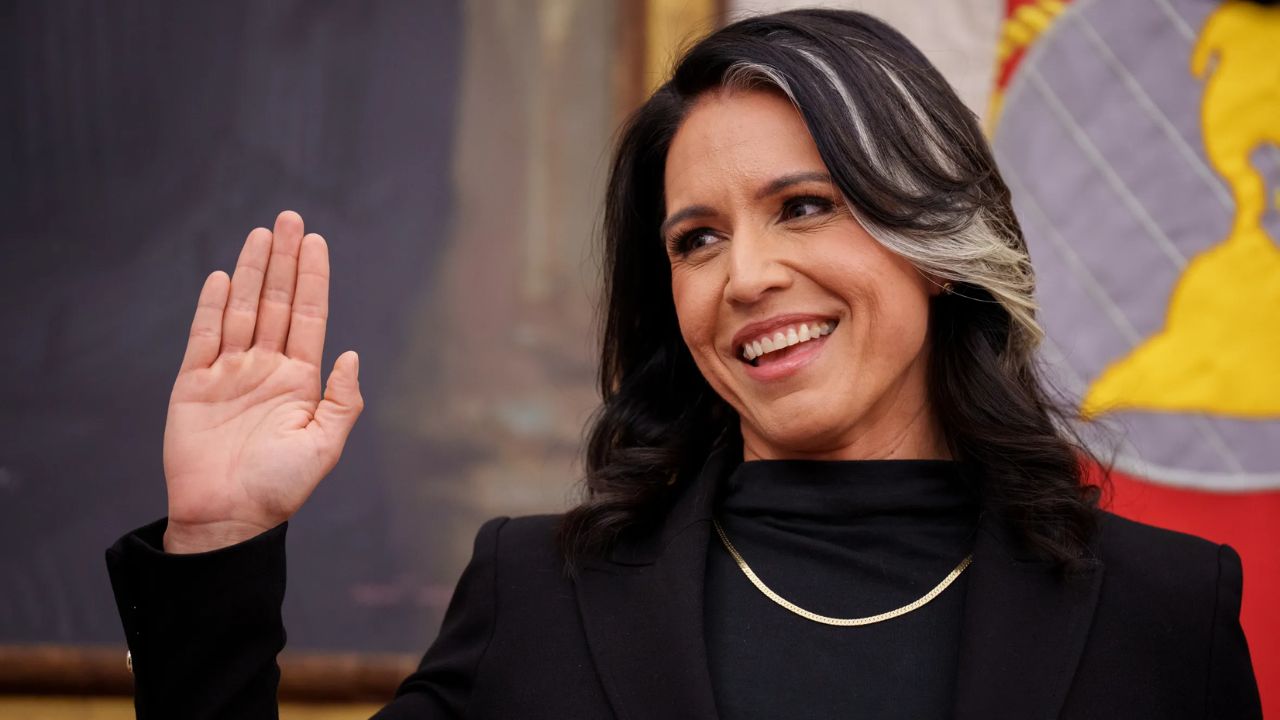
Tulsi Gabbard resigns as Trump’s intelligence chief effective June 30, 2026, after a turbulent tenure marked by Iran controversies and her husband’s cancer diagnosis.
Tulsi Gabbard, the Director of National Intelligence who spent 16 months navigating the turbulent waters of Washington’s intelligence community, announced Friday that she is resigning from her post. The reason is not political. Her husband of eleven years, Abraham Williams, has been diagnosed with an extremely rare form of bone cancer, and she says she cannot ask him to face that alone.
The announcement, which came on Friday afternoon via a letter Gabbard posted directly to social media, blindsided much of Washington even as rumors about a potential departure had been circulating for weeks. As recently as two weeks ago, Gabbard was privately telling people she was not going anywhere. Then came the diagnosis, and everything changed.
“Unfortunately, I must submit my resignation, effective June 30, 2026,” Gabbard wrote. “My husband, Abraham, has recently been diagnosed with an extremely rare form of bone cancer. He faces major challenges in the coming weeks and months. At this time, I must step away from public service to be by his side and fully support him through this battle.”
She went further, describing Williams not just as her spouse but as the person who has made her public life possible. During her military deployment to East Africa on a Joint Special Operations mission, through congressional campaigns, through the bruising confirmation process and her time overseeing 18 intelligence agencies — he was there. Now she intends to return the commitment.
I cannot in good conscience ask him to face this fight alone while I continue in this demanding and time-consuming position.”
President Trump, who confirmed the departure in a Truth Social post, struck a warm tone. He said Gabbard had done “an incredible job” and that the administration would miss her. He expressed confidence that Williams would recover, and announced that Aaron Lukas, the Principal Deputy Director of National Intelligence, would assume the acting director role when Gabbard departs at month’s end.
On the surface, the resignation letter reads as a straightforward story about love and family duty. And at its core, that is exactly what it is. But Gabbard’s time as the nation’s top intelligence official was rarely simple, and it is impossible to fully understand her departure without understanding the turbulence that preceded it.
A Tenure Defined as Much by Controversy as by Service
Gabbard came into the role on February 12, 2025, as one of the more unexpected figures in Trump’s Cabinet. A four-term Democratic congresswoman from Hawaii who had spent years criticizing American military adventurism, she endorsed Trump during the 2024 campaign and was rewarded with the DNI nomination — a position that placed her atop the entire American intelligence apparatus.
For a time, she appeared to be settling into the role. But the controversies came quickly, and they came in waves.
Then came Iran. When the Trump administration launched military strikes against Tehran in February 2026 — an operation called Operation Epic Fury that cost more than $11 billion in its first six days alone and resulted in the deaths of at least thirteen American service members — Gabbard found herself in a deeply uncomfortable position. She had built her entire political identity on opposition to exactly this kind of military intervention.
She had even released an unusual public video warning about “warmongers carelessly fomenting fear and tensions between nuclear powers” — a video that, according to reporting from Politico, infuriated President Trump at the time. Her top aide and closest adviser, Joe Kent, the director of the National Counterterrorism Center, resigned in March 2026 in protest over the Iran war, saying he could not in good conscience back it. His departure put Gabbard in an even more exposed position inside the administration.
At a Senate Intelligence Committee hearing in March 2026, Gabbard was unable to clearly state whether Iran had posed an imminent threat to the United States before the strikes. When pressed, she told lawmakers that “the only person who can determine what is and is not an imminent threat is the president.”
What made the exchange more striking was what came later: it emerged that her prepared remarks had actually stated that Iran’s nuclear program had been “obliterated” in earlier strikes and that there had been no effort to rebuild it — a statement that contradicted the administration’s public justification for the war. She had not read that portion aloud. When asked why, she said she had been running long on time.
Gabbard’s tenure has been riddled with contradictory and confusing messaging, particularly on the U.S. war with Iran, which at times put her out of favor with the White House.”
By early April, reports emerged that Trump himself had begun casually polling Cabinet members about whether Gabbard should be replaced. According to reporting from The Guardian, she had narrowly survived being fired after a mutual friend — longtime Trump adviser Roger Stone — persuaded the president to hold off. Laura Loomer, a Trump confidante who was frequently critical of Gabbard, was notably the first to report Friday’s resignation.
The Fourth Cabinet Departure of Trump’s Second Term
Gabbard’s exit makes her the fourth Cabinet-level official to leave during Trump’s second administration. Former Homeland Security Secretary Kristi Noem and former Attorney General Pam Bondi were both dismissed from their positions, while Labor Secretary Lori Chavez-DeRemer stepped down earlier this year. Gabbard’s departure is the only one rooted in a personal family circumstance rather than a political rupture.
There were also institutional frictions during her tenure. A behind-the-scenes feud between ODNI — the office Gabbard led — and the CIA had reportedly been building for months before it spilled into public view during a Senate Homeland Security Committee hearing just last week. A CIA insider who had been part of Gabbard’s special Directors Initiative Group testified about conflicts between the two agencies, exposing divisions that intelligence professionals rarely air in open hearings.
Despite all of it, Trump’s public statement Friday was generous. He praised her work and said the administration would miss her. Whether that reflects genuine warmth, a desire for a clean exit, or both is difficult to say from the outside. What is clear is that both sides appear content to let this end without a public fight.
Tulsi Gabbard: What the Intelligence Community Faces Next
With Gabbard’s departure effective June 30, the Office of the Director of National Intelligence will be led in an acting capacity by Aaron Lukas, who has served as her principal deputy. The administration has not announced a permanent nominee, and the confirmation process for a new DNI — given the complexity of the Senate and the sensitivity of the role — is unlikely to be brief.
The intelligence community Gabbard is leaving behind is one that has been reshaped in meaningful ways over the past year and a half: by the controversies she generated, by the institutional tensions with the CIA, by the questions raised over the Iran intelligence picture, and by personnel departures that have thinned the leadership ranks. Her successor will inherit all of that, along with the ongoing demands of a world that has grown no simpler.
Gabbard, for her part, has made her choice. Whatever one thinks of the decisions she made in office, the decision she made Friday — to leave a powerful job to sit beside a sick husband — is one that needs no political explanation. Some things are simply more important than the work, and she said so plainly.