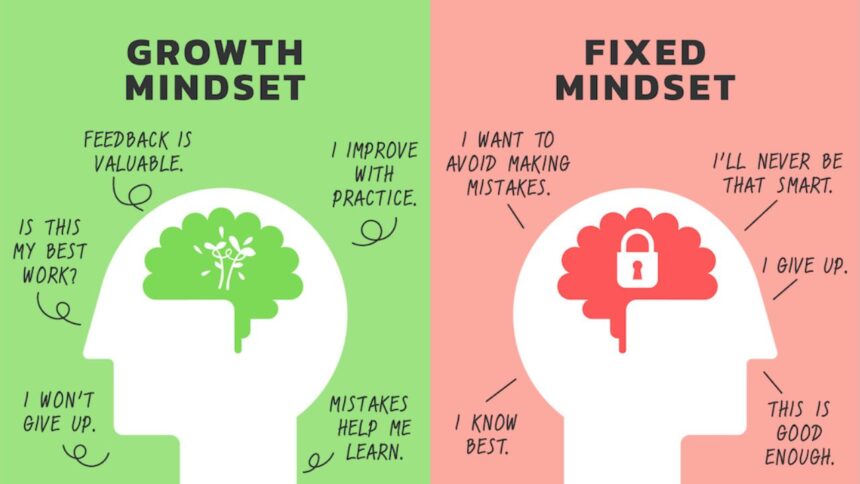
Growth Mindset vs. Fixed Mindset: The way we think about our abilities and intelligence has a profound impact on our success and personal growth. Some people believe that intelligence, talent, and abilities are fixed traits—they are either born with them or not. Others believe that these qualities can be developed through effort, learning, and persistence.
These two distinct perspectives are known as the fixed mindset and the growth mindset, concepts introduced by psychologist Carol Dweck. Research in psychology and neuroscience has proven that our mindset shapes the way we approach challenges, setbacks, and opportunities.
A growth mindset allows individuals to see failures as learning experiences and persist in the face of obstacles, while a fixed mindset leads to self-doubt, fear of failure, and avoidance of challenges. The good news is that the brain is not hardwired in one way forever. Just like a muscle, it can be trained and rewired to adopt a growth-oriented perspective.
By shifting from a fixed mindset to a growth mindset, individuals can unlock their full potential, develop new skills, and achieve greater success in every aspect of life. Understanding how these mindsets work and applying strategies to rewire the brain can lead to a transformation in career, relationships, and personal development.
Understanding the Fixed Mindset: The Limitations of a Rigid Belief System
A fixed mindset is the belief that intelligence, talents, and abilities are set in stone and cannot be changed. People with a fixed mindset often believe that they are either naturally good at something or they are not, which leads them to avoid challenges where they might struggle. They tend to shy away from difficult tasks because they fear failure, believing it is a reflection of their abilities rather than a part of the learning process.
For example, a student who struggles with math might think, “I’m just not a math person,” and give up rather than put in the effort to improve. Similarly, someone who fails in business might believe, “I’m just not cut out for entrepreneurship,”
instead of analyzing what went wrong and trying again with a better strategy. This mindset creates a fear of failure, causing individuals to avoid risks, take criticism personally, and feel discouraged when they don’t immediately succeed. Over time, these thought patterns limit personal and professional growth, leading to stagnation and a lack of progress. The fixed mindset reinforces itself through self-fulfilling prophecies—when people believe they can’t improve, they don’t put in the effort, which then confirms their belief that they are incapable of growth.
The Power of the Growth Mindset: Embracing Challenges and Learning from Failure
In contrast, a growth mindset is the belief that intelligence and abilities can be developed through effort, practice, and perseverance. People with a growth mindset see challenges as opportunities to learn rather than threats to their self-worth. They understand that failure is not a permanent condition but a stepping stone toward improvement.
When faced with obstacles, they don’t give up; instead, they ask themselves, “What can I learn from this?” or “How can I improve?” This mindset allows them to develop resilience and adaptability, two key traits for long-term success. Research has shown that individuals with a growth mindset are more likely to achieve their goals, persist through difficulties, and develop new skills because they embrace the learning process.
For example, world-class athletes, successful entrepreneurs, and innovative thinkers all share one common trait: they continuously push themselves to improve and learn, even after facing setbacks. They don’t view intelligence or talent as fixed traits but as qualities that can be cultivated through hard work and dedication. By adopting this perspective, they develop the ability to bounce back from failures and ultimately achieve greater success.

How Neuroplasticity Supports a Growth Mindset
The concept of neuroplasticity, which refers to the brain’s ability to reorganize itself and form new neural connections, provides strong scientific support for the growth mindset. Research in neuroscience has shown that the brain is not fixed—it changes in response to learning and experience. When individuals challenge themselves, learn new skills, and practice repeatedly, their brain physically changes, creating new neural pathways that strengthen over time.
This means that no one is born with a set level of intelligence or ability; instead, our brains can be trained to develop and grow. The more we engage in activities that require learning and effort, the stronger our brain’s capacity for improvement becomes.
This is why musicians who practice regularly, athletes who train consistently, and professionals who continuously educate themselves develop expertise in their fields. Understanding neuroplasticity reinforces the idea that talent and intelligence are not pre-determined, and that anyone can improve through persistence and dedication.
Also See: How to Overcome Self-Doubt and Build Unshakable Confidence 2026
Overcoming a Fixed Mindset: How to Rewire Your Brain for Success
Rewiring the brain to shift from a fixed mindset to a growth mindset requires conscious effort and self-awareness. One of the first steps is recognizing fixed mindset thoughts when they arise. These might include statements like, “I’m not good at this,” “I always fail at this,” or “I’ll never be as talented as others.” Instead of accepting these limiting beliefs, individuals can challenge them by reframing their thoughts.
For example, instead of saying, “I’m not good at public speaking,” they can reframe it as, “I can improve my public speaking skills with practice.” Shifting from a fixed mindset to a growth mindset also involves embracing challenges rather than avoiding them.
It’s essential to push beyond comfort zones and take on new experiences that require effort and persistence. Instead of seeing difficulties as signs of failure, individuals can view them as opportunities to develop new skills. Another powerful strategy is focusing on effort rather than results.
People with a growth mindset understand that success is the result of consistent effort over time, not just natural talent. By rewarding the process rather than just the outcome, individuals build resilience and confidence in their ability to improve.
The Role of Feedback and Criticism in Developing a Growth Mindset
Feedback and constructive criticism are essential for growth, but individuals with a fixed mindset often struggle to accept them. They see criticism as a personal attack rather than an opportunity to improve. However, those with a growth mindset understand that feedback is a valuable tool for learning. Instead of taking criticism personally, they use it as guidance to identify areas for improvement.
For example, an athlete receiving coaching feedback doesn’t see it as a judgment of their abilities but as advice that will help them get better. Similarly, in the workplace, professionals who embrace feedback are more likely to advance in their careers because they continuously refine their skills.
Developing a growth mindset involves shifting the perspective on feedback—from something to fear to something that fuels progress. Seeking feedback from mentors, colleagues, or even self-reflection can accelerate personal development and lead to greater success.
Building a Growth-Oriented Environment
The environment plays a significant role in shaping mindset. Surrounding oneself with growth-minded individuals creates an atmosphere of learning and progress. When people interact with those who embrace challenges, learn from failures, and continuously improve, they are more likely to adopt the same mentality.
This is why successful organizations encourage a culture of innovation and learning, where employees are motivated to take risks and improve their skills. In personal life, being part of a supportive community—whether it’s a mastermind group, a study circle, or a professional network—fosters a growth-oriented attitude. Engaging with mentors, reading books on personal development, and consuming content that promotes growth further strengthens this mindset.
Conclusion
The difference between a growth mindset and a fixed mindset can determine whether someone reaches their full potential or remains stuck in self-imposed limitations. The belief that intelligence and abilities are unchangeable holds people back from taking risks, embracing challenges, and learning from failure.
In contrast, adopting a growth mindset unlocks endless possibilities, allowing individuals to improve, develop new skills, and achieve greater success. By understanding the science of neuroplasticity, reframing self-limiting beliefs, embracing challenges, and seeking feedback, anyone can rewire their brain for success. The journey toward a growth mindset is not about being perfect—it’s about continuous improvement and resilience in the face of setbacks.
Those who commit to this transformation will not only enhance their personal and professional lives but will also inspire others to do the same. The power to change lies within the mind, and by choosing growth over limitation, individuals can achieve remarkable success and fulfillment in life.