


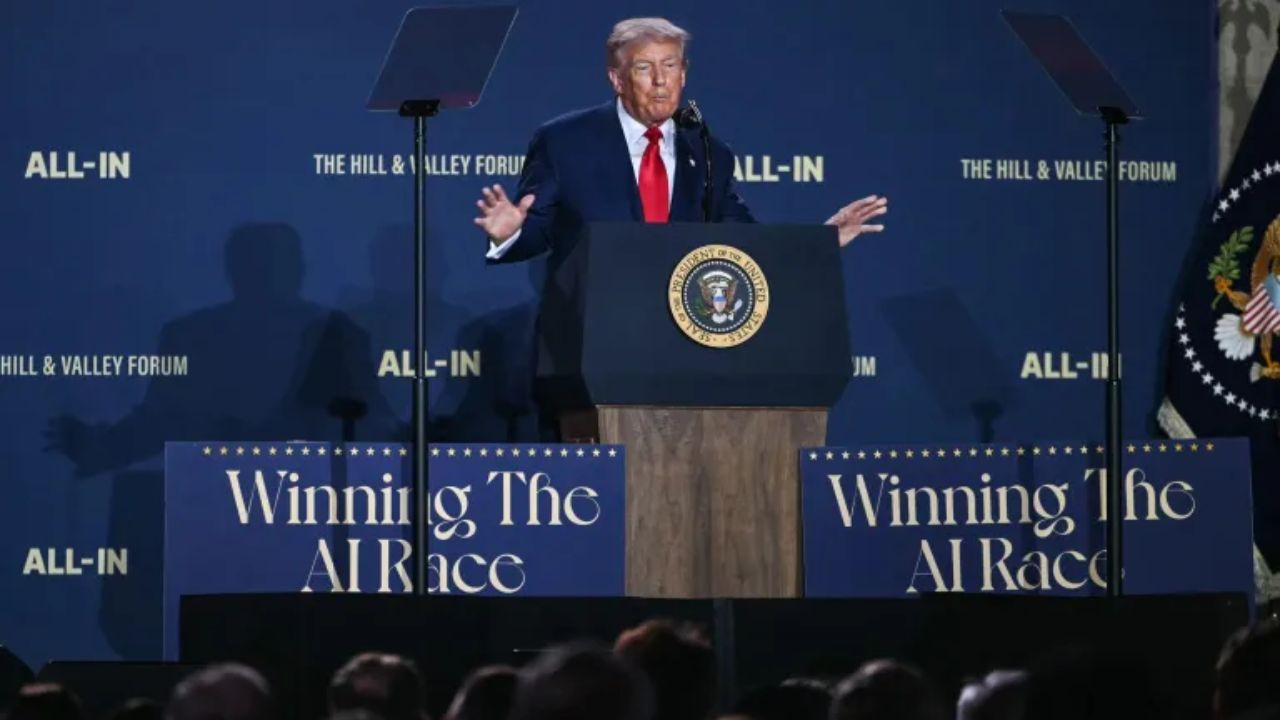
AI regulation is gaining serious momentum in Washington as the Trump administration quietly shifts course under public pressure and a powerful new AI model changes the stakes.
For most of the past year, the Trump White House treated AI regulation the same way it treated most government rules: as something to be dismantled rather than built. The approach was straightforward and familiar. Technology companies argued that too much oversight would hobble American innovation and hand an advantage to China. The administration listened. Bills died in committee. State laws were preempted. The message from Washington was clear: the industry would regulate itself.
That message is changing. Reporting from Washington last week captured a significant shift in tone inside the administration. Rather than fighting the idea of federal oversight, officials are now discussing what a federal licensing regime for AI models might actually look like. It is not a done deal. But the fact that the conversation is happening at all marks a dramatic departure from where things stood just months ago.
An Angry Public Is Changing the Math
The politics of AI have moved against the industry faster than most Washington insiders expected. Recent polling from Pew Research paints a stark picture: most Americans say they are more worried than optimistic about artificial intelligence, and in some surveys the gap between those two camps runs as wide as 40 percentage points. That is not a fringe sentiment or a niche concern. It is a majority position that cuts across party lines.
A poll released last week by the Annenberg Public Policy Center found that two-thirds of Americans believe the government has not done enough to regulate AI. Crucially, that view was shared by majorities of Republicans and independents, not just Democrats. For a White House with populist instincts and a midterm election on the horizon, numbers like that are hard to ignore.
A viral moment captured the mood in vivid terms. When former Google CEO Eric Schmidt delivered a commencement address at the University of Arizona, students booed him each time he mentioned artificial intelligence. The video spread widely. It was a single data point, but it landed because it felt true to a broader current of frustration that has been building across the country.
Politicians know they cannot afford to be on the wrong side of numbers like this. Trump, who has populist instincts, is starting to see this too.”
Inside the White House, the shift in political calculus has reportedly reshuffled who has the ear of the president on AI. More politically minded advisors, including Treasury Secretary Scott Bessent and Chief of Staff Susie Wiles, have taken a larger role in shaping AI policy. Figures more closely tied to Silicon Valley’s venture capital world, who had previously driven the administration’s hands-off stance, appear to have lost some of their influence on the issue.
One AI System That Changed the Conversation
Public opinion alone does not fully explain the pivot. A second force has been just as consequential, and it goes by a single name: Mythos.
Mythos is Anthropic’s most powerful AI model to date. What makes it different from its predecessors is not just raw capability, but the specific capabilities it has demonstrated. The system has shown what experts describe as superhuman hacking skills, giving it the potential to find and exploit software vulnerabilities in ways that surpass what human security researchers can do on their own.
The administration has already acted as though a de facto licensing regime for the model exists, even without formal legislation. Officials reportedly blocked Anthropic’s plans to expand a program called Project Glasswing, which had been sharing a version of Mythos with select companies for defensive cybersecurity purposes. Treasury Secretary Bessent has been personally involved in deciding which foreign financial institutions get access to the model. In practice, Mythos is already being governed. The question is whether that governance gets formalized.
Brad Carson, the former Oklahoma congressman who now heads the advocacy group Americans for Responsible Innovation, described Mythos as the turning point in the regulatory debate. He reached for a World War II analogy: the Battle of El Alamein, which Winston Churchill called “the end of the beginning.” Before El Alamein, the British had never beaten the Germans. After it, they never lost. Carson says the fight over AI regulation has now passed its own El Alamein. The outcome, he argues, is no longer really in question.
Opening a Door to China
Perhaps the most surprising development to come out of Washington’s evolving stance is what happened on the international stage. When President Trump met with Chinese President Xi Jinping last week, the two sides apparently agreed to hold talks on AI safety. That agreement, reported by the New York Times, would have been virtually unthinkable under the previous framework guiding administration policy.
The officials who had shaped the administration’s earlier approach viewed any engagement with China on AI as naive at best and strategically dangerous at worst. Their argument was that the U.S. should not constrain its own AI development through international agreements that China would ignore the moment it became convenient to do so. They also used the threat of Chinese AI progress as a political argument against domestic regulation: regulate too much, and Beijing wins.
That argument appears to be losing its power. Polling suggests that most Americans are more worried about AI taking their jobs than about China getting ahead in the technology. At the same time, Mythos seems to have focused minds on both sides of the Pacific. When a single AI model can cause significant damage in the hands of non-state actors, neither Washington nor Beijing has a clear interest in a world where such tools proliferate without any guardrails.
The Export Control Problem
There is also a quiet acknowledgment growing in Washington that its main tool for slowing China’s AI development may not be working as intended. The Biden administration and then the Trump administration have both relied heavily on export controls, restricting the sale of advanced AI chips and chipmaking equipment to China. The goal was to prevent Chinese companies and the Chinese military from developing AI systems that could threaten American interests.
Research from Georgetown University’s Center for Security and Emerging Technology suggests the picture is more complicated than that. Many of the AI applications that matter most for military purposes, such as autonomous navigation for drones or analyzing satellite imagery, do not depend on the kinds of massive, cutting-edge models that require enormous volumes of advanced chips. For those applications, China is not meaningfully behind. Where the export controls do appear to bite is in the commercial deployment of AI across the broader Chinese economy, where the country lacks enough chips to run AI inference at scale.
That gap in effectiveness creates a potential opening. If export controls are not delivering their stated national security benefits, the U.S. might have room to relax some restrictions in exchange for Chinese cooperation on an international AI governance framework. What exactly that framework would look like is far from settled, but the fact that officials are thinking about it at all is new.
The Industry Reads the Room
The shift in Washington has not gone unnoticed by the companies building AI. OpenAI last week endorsed two pieces of legislation it had previously either opposed or avoided: the Kids Online Safety Act, which would require online platforms to take steps to protect children from harm, and a state bill pending in Illinois that would require companies building frontier AI models to establish safety frameworks, conduct annual audits, report critical incidents, and protect whistleblowers. The Illinois bill is substantially similar to a California measure that OpenAI had lobbied against earlier.
The reversals signal that at least some of the major AI companies have concluded that federal regulation is coming, and that it is better to engage with the process than to fight it. Whether the rest of the industry reaches the same conclusion, and what form any resulting legislation actually takes, will define the next chapter of AI policy in the United States.
What seems clear, for now, is that the chapter currently closing was written by the assumption that Washington could afford to do nothing. That assumption is gone.