


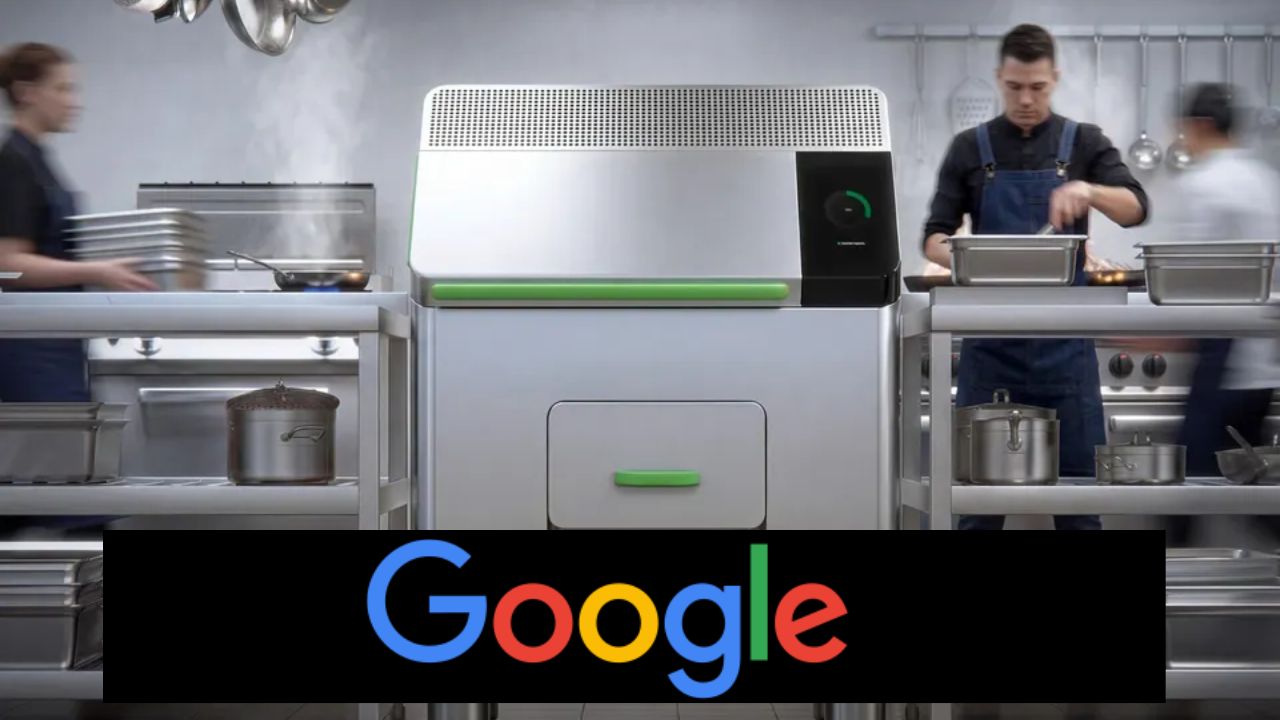
Google x Mill: Google’s AI Futures Fund partners with Mill to train Gemini on real commercial kitchen waste — turning food scraps into powerful, real-world AI training data.
For decades, the data that powered artificial intelligence came from obvious places: books, websites, code repositories, and academic papers. The idea that one of the world’s most sophisticated AI labs would someday train its models on wilted lettuce and restaurant plate scrapings would have sounded absurd. It doesn’t anymore.
Mill Industries, the San Bruno-based food recycling company founded by Nest alumni Matt Rogers and Harry Tannenbaum in 2020, announced in late April that its commercial food recycler would feature a visual waste characterization system built on Google’s Gemini AI models. The technology uses embedded computer vision to identify, classify, and track exactly what food is being thrown away in large commercial kitchens — and why. That stream of real-world data flows back to Google’s AI teams, giving Gemini something it has never had access to before: high-volume, real-time footage of what America wastes, measured in actual pounds, one kitchen at a time.
The deal was made possible through Google’s AI Futures Fund, the company’s program for accelerating novel applications of its Gemini platform. Under the arrangement, Mill receives early access to next-generation Gemini models and Google engineering resources before they reach the public. In return, Google gets feedback on model performance in an environment that is genuinely difficult: chaotic, fast-moving, dimly lit commercial kitchens where the contents of a compost bin change by the hour.
Building Mill’s waste characterization capabilities with pre-release Gemini models allows us to move faster than ever before, getting our customers closer to eliminating food waste for good.”
Why Google Wants to See Inside Your Trash
The question worth asking is why Google cares at all. The answer has two parts, and they are not unrelated.
The first is commercial. The AI Futures Fund exists precisely to find new places where Gemini can prove its value. Food service is a massive, largely untapped sector for AI, and the data generated by Mill’s hardware creates a type of training signal that text-based datasets simply cannot replicate.
According to Jonathan Silber, co-founder and director of the AI Futures Fund, physical environments where outcomes are measurable in pounds and dollars are some of the most valuable proving grounds an AI company can find. When a model learns to identify a half-eaten watermelon rind versus an untouched avocado in a busy hotel kitchen, that capability generalizes to other complex visual recognition tasks in ways that controlled, staged datasets never could.
The second reason is reputational. Google has made commitments around the responsible use of resources, and a partnership that simultaneously advances AI capabilities and addresses food waste hands the company a story that is far easier to tell publicly than, say, a new data-scraping initiative. Food waste is a topic that has genuine cross-partisan appeal — it costs money, it fills landfills, and it produces methane. Aligning Gemini with a solution to that problem is good for the brand in a way that purely technical achievements rarely are.
What Mill Actually Does: Google x Mill
Mill’s core product is a smart food recycler — essentially a compact, countertop machine that dries and grinds food scraps overnight, reducing them to a nutrient-rich material that can be repurposed rather than sent to a landfill. The consumer version of the product has won fans in households for its simplicity and the data it provides through a companion app that tracks waste habits week by week.
The commercial version, Mill Commercial, is a considerably larger beast designed for cafeterias, hotel kitchens, hospital dining facilities, and stadium concession operations. That is where the new Gemini integration lives.
The system uses integrated camera hardware and computer vision to watch what goes into the machine. It is not simply counting scraps by weight. It is identifying categories of food — vegetable trimmings, prepared dishes, proteins, bread, dairy — and correlating that data with the time of day, the day of the week, and the volume of service.
The result is procurement and operational intelligence that a kitchen manager can act on: not a vague sense that the kitchen wastes too much, but a precise accounting of which menu items are generating the most uneaten food and why.
Mill is tackling a tangible, important real-world application of AI — bringing intelligence directly to the point where waste is generated, in physical environments where the stakes are measurable in pounds and dollars.”
A New Kind of Training Data
The AI industry has spent years arguing about where the next frontier of training data lies. The obvious sources — the open internet, books, academic corpora — are either exhausted or increasingly subject to legal challenges from publishers and authors who did not consent to their work being used in this way. What companies like Google, OpenAI, and Meta need now is novel, high-quality data from domains that have not yet been systematically captured.
Mill’s garbage bins, it turns out, are one such domain. The company’s hardware is already deployed in a growing number of commercial kitchens, and each machine generates a continuous stream of visual data that is both specific enough to be useful for training and varied enough to be genuinely challenging. Teaching a model to distinguish overripe mangoes from fresh ones, or to recognize a pasta dish as wasted versus a sauce as scraped off a plate, requires the kind of nuanced visual reasoning that most AI vision systems have never been forced to develop.
Crucially, Mill will give Google’s AI teams real-world feedback on model performance from what it describes as a testing lab environment. That is not a laboratory in the traditional sense. It is a living, breathing dataset generated by the actual behavior of commercial food service workers under real operational pressures. For a company like Google, which increasingly needs its AI to perform in uncontrolled physical environments rather than just on screens, that feedback loop is worth a great deal.
Momentum Is Building Fast
The Google partnership is not the only major news Mill has generated in recent weeks. Just days after the Gemini announcement, the company revealed a strategic partnership with Compass Group, the largest foodservice and facilities management company in the world. Under that agreement, Mill Commercial units will be deployed in Compass-operated dining facilities starting in 2027 — covering corporate campuses, hospitals, universities, and stadiums. Compass has committed publicly to cutting its food waste by 50 percent by 2030, and it is betting that Mill’s AI-enabled hardware can help get it there.
Mill has also previously announced a collaboration with Amazon, which brought Mill’s food recycling technology to Whole Foods locations. The company was founded with backing and DNA from Nest, the smart home company that Google acquired in 2014, which gives its current partnership with Google’s AI teams a certain poetic symmetry.
The Bigger Picture
What is happening between Google and Mill is a small but telling example of a broader shift in how the AI industry thinks about data. The most valuable training signals are increasingly going to come from physical systems operating in the real world — robots, medical devices, industrial sensors, and, yes, food recyclers. Companies that can instrument those environments and build the pipelines to capture that data are going to have an edge that is genuinely hard for competitors to replicate.
For Mill, the arrangement accelerates a product roadmap that might otherwise take years. Pre-release access to Gemini models and Google engineering talent is the kind of advantage that a startup cannot easily buy at any price. For Google, it is a relatively low-cost way to get its most capable models exposed to a domain where performance translates into something visible and measurable — not just a benchmark score, but actual pounds of food kept out of a landfill.
Neither company is claiming the partnership will end food waste in America. The problem is too large and too deeply embedded in how the food system works for any single technology to solve. But as a demonstration of what AI can do when it leaves the server farm and enters the kitchen, it is one of the more concrete examples to emerge in a field that often struggles to connect its capabilities to tangible human outcomes.
The next big AI dataset, it turns out, smells a little like last Tuesday’s leftovers. And that might be exactly what the technology needed.