


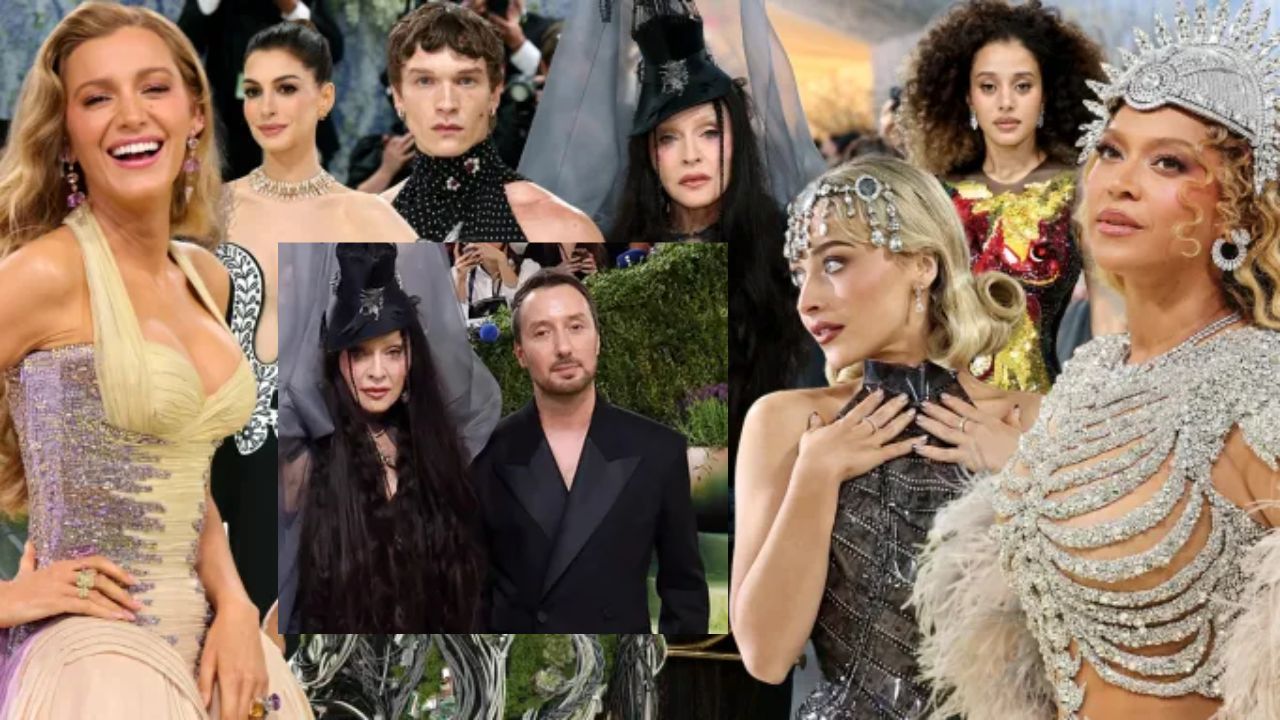
Met Gala 2026: After wearing a swaggering Tom Ford double-breasted suit (complete with a cigar) to the 2025 Met Gala in honour of the exhibition “Superfine: Tailoring Black Style” and its dress code “Tailored for You”, the Material Girl pulled a 180 – a classic Madge move if ever there were one – and went full dark enchantress for the 2026 Met Gala.
There is a version of the Met Gala that exists purely as spectacle: beautiful people in expensive clothes, cameras flashing, the internet offering its verdict by morning. That version still happened this year. But something ran beneath the surface of the 2026 edition that felt different from recent memory. The theme, “Fashion Is Art,” was deceptively broad, and yet it produced some of the most intellectually considered and emotionally direct red carpet moments the event has seen in years. In that space between art history and personal mythology, a few names did more than show up well. They made a case for what fashion can actually mean.
The evening’s co-chairs — Beyonce Knowles-Carter, Nicole Kidman, and Zoe Kravitz — set a tone that was both ambitious and precise. The Costume Institute’s spring exhibition, titled “Costume Art,” organized roughly four hundred garments and accessories around categories of the human body, tracing five thousand years of the dressed form. That kind of curatorial ambition demands more than a matching outfit. It demands an idea. Most guests arrived with one.
Saint Laurent and the Architecture of Dominance
No house commanded the 2026 carpet more completely than Saint Laurent. Creative director Anthony Vaccarello dressed thirteen celebrities for the evening — a number that, in any other context, might suggest factory efficiency over artistry. What made the night remarkable is that it suggested neither. Across thirteen very different bodies, personalities, and cultural identities, Vaccarello found thirteen distinct arguments for what Saint Laurent means in the present moment.
Hailey Bieber delivered what many called the night’s most surprising look: a 24-carat gold sculpted breastplate paired with a lapis-blue maxi skirt, inspired by a 1969 collaboration between Yves Saint Laurent and sculptor Claude Lalanne. For someone whose public style has tended toward the lean and monochrome, the gesture landed with real force. It was not a departure for departure’s sake. It was a woman stepping into a different register of herself, and doing it inside the history of a house that has always understood femininity as something constructed rather than given.
Charli XCX wore a custom strapless black gown featuring what appeared to be a handblown glass iris flower climbing up the ruched bodice, drawn directly from Yves Saint Laurent’s 1988 couture tribute to Van Gogh. Rosé, who has spent years as a reliable Saint Laurent presence on the carpet, introduced an unexpected bird brooch to an otherwise classic floor-length silhouette. Small move. Large statement. Zoe Kravitz, arriving on the arm of Vaccarello himself, wore a basque-waisted black lace gown that even skeptics noted as a structural evolution from her previous appearances.
“Thirteen Saint Laurent looks in a single evening is not a coincidence. It is a campaign.”
The house also dressed Doja Cat, Kate Moss, Rami Malek, Imaan Hammam, and Anja Rubik, among others. In a night framed around fashion as art, Vaccarello made a persuasive case that a single creative vision, executed across enough distinct personalities, can become something closer to a cultural argument than a marketing exercise. The Saint Laurent after-party at People’s Bar continued the energy into the early hours, drawing Katy Perry, A$AP Rocky, and Kendall Jenner.
The Temptation of Madonna
If Saint Laurent won the carpet strategically, Madonna won it theatrically. She always does, and has for nearly thirty years at this event. But what made her 2026 entrance genuinely memorable was not the scale of it — though the scale was considerable — but the specificity of the reference beneath it.
Madonna arrived in a black Saint Laurent gown by Vaccarello, wearing a cornflower chiffon veil attached to a black hat shaped like a pirate ship. The veil swept across the carpet steps behind her. An entourage of seven women, each dressed in colorful lace slips with white veils across their eyes, moved with her in procession. She carried what appeared to be a French horn.
The full tableau was drawn from “The Temptation of St. Anthony, Fragment II,” a 1945 painting by the British-Mexican surrealist Leonora Carrington — one of the 20th century’s most consequential and persistently underappreciated female artists. Madonna accessorized with platform boots, opera gloves, and a pendant necklace, and matched the gothic visual register with a shift from her signature blonde to ink-dark long hair.
It was, as one observer put it, unapologetically performative and exactly what you would expect from someone whose style has been evolving for five decades. But the choice to root the performance in Carrington — rather than in more obvious surrealist figures — showed a certain deliberateness. Carrington spent years being described primarily in relation to the men around her, Max Ernst above all. Invoking her at fashion’s most-watched annual event was a small reclamation. Whether it read that way to every viewer is a separate question. The gesture was there.
Madonna’s history with the Met Gala stretches back to 1997, a first appearance in Versace for the memorial tribute to Gianni Versace, then a long run through the 2010s in Stella McCartney, Givenchy, Moschino, and Jean Paul Gaultier. She had been absent for seven years before returning in 2025 in Tom Ford by Haider Ackermann. The 2026 appearance felt like a return to something larger: not just an outfit, but an event within the event.
Fashion as a Living Argument
The 2026 Met Gala arrived with a certain amount of ambient controversy attached to it. Ticket prices reportedly reached $100,000 per seat in recent years, with the 2025 gala raising $31 million for the Costume Institute. This year, the sponsorship involvement of Jeff Bezos and Lauren Sanchez Bezos added a new dimension to what the event represents, and the conversation around access and wealth did not disappear simply because the dress code said “Fashion Is Art.” Some critics noted that watching the extraordinarily wealthy move from hotel rooms to carpet to after-parties — while the rest of the world watched from their phones — was itself a kind of art: an unreconstructed portrait of a new gilded age.
And yet the carpet itself kept delivering on the stated theme in ways that felt genuinely earned. Bad Bunny arrived in a prosthetic transformation inspired by the concept of the aging body, with effects by makeup artist Mike Marino. Hunter Schafer interpreted Klimt’s portrait of Mada Primavesi through Prada with the kind of precision that suggests real research, not just a mood board. Rachel Zegler, also in Prabal Gurung, wore a sheer blindfold drawn from Paul Delaroche’s 1833 painting of Lady Jane Grey’s execution. Each of these looked like a decision made by someone who had spent time thinking about what they wanted to say.
Fashion has always been capable of carrying meaning. The question the Met Gala poses every year is whether the people walking the carpet are using that capacity or simply wearing it. In 2026, a notable number of them were using it — and doing so inside a framework, the “Costume Art” exhibition and its five-thousand-year arc, that gave the references somewhere to land. A woman dressed as a Klimt subject inside a museum that houses Klimt paintings is not performing art appreciation. She is extending a conversation that began more than a century ago. That is, if you choose to read it that way, something closer to influence than to fashion.
What the Evening Actually Measured
The Forbes analysis of influence at the Met Gala has always been partly about fashion and partly about something harder to quantify: who gets to define the cultural conversation, and for how long. Saint Laurent’s dominance of the 2026 carpet was a lesson in the former. Thirteen outfits, a headline sponsorship alongside Conde Nast, an after-party — the house did not merely participate in fashion’s biggest night. It structured the night around itself. That is a different kind of influence than making beautiful clothes. It is the influence of a house that understands the evening as infrastructure.
Madonna’s appearance measured something else entirely. She is seventy-seven appearances deep into the project of being Madonna, and she still manages to show up on a carpet and produce a moment that runs ahead of the commentary for several days. The choice of Leonora Carrington as a reference, the procession of women behind her, the French horn in her hands — none of it was accidental, and all of it will be discussed by people who have never heard of Leonora Carrington but will now look her up. That is not a small thing. That is how influence actually moves: not through channels but through collisions between the familiar and the unknown.
The shift the 2026 Met Gala documented — if it documented a shift at all — is not toward influence as a concept. Influence has always been the real currency at these events. The shift is toward influence that knows what it is doing: references chosen rather than stumbled into, houses that treat the evening as strategic terrain rather than exposure, celebrities who arrive having actually thought about what they want to communicate. Whether that produces better fashion is debatable. Whether it produces a more interesting cultural event is harder to argue against.
Fashion’s biggest night ended, as it always does, with the commentary arriving before the carpet was rolled up. By morning, the debate had moved to social media, where the distance between what an outfit intended and what an audience received collapsed to nothing. But the looks that held up under that pressure — Madonna’s procession, Bieber’s gold breastplate, Charli XCX’s glass iris — all shared something in common: they had been built to survive it. That, more than anything, is what it looks like when fashion does the work of art.