


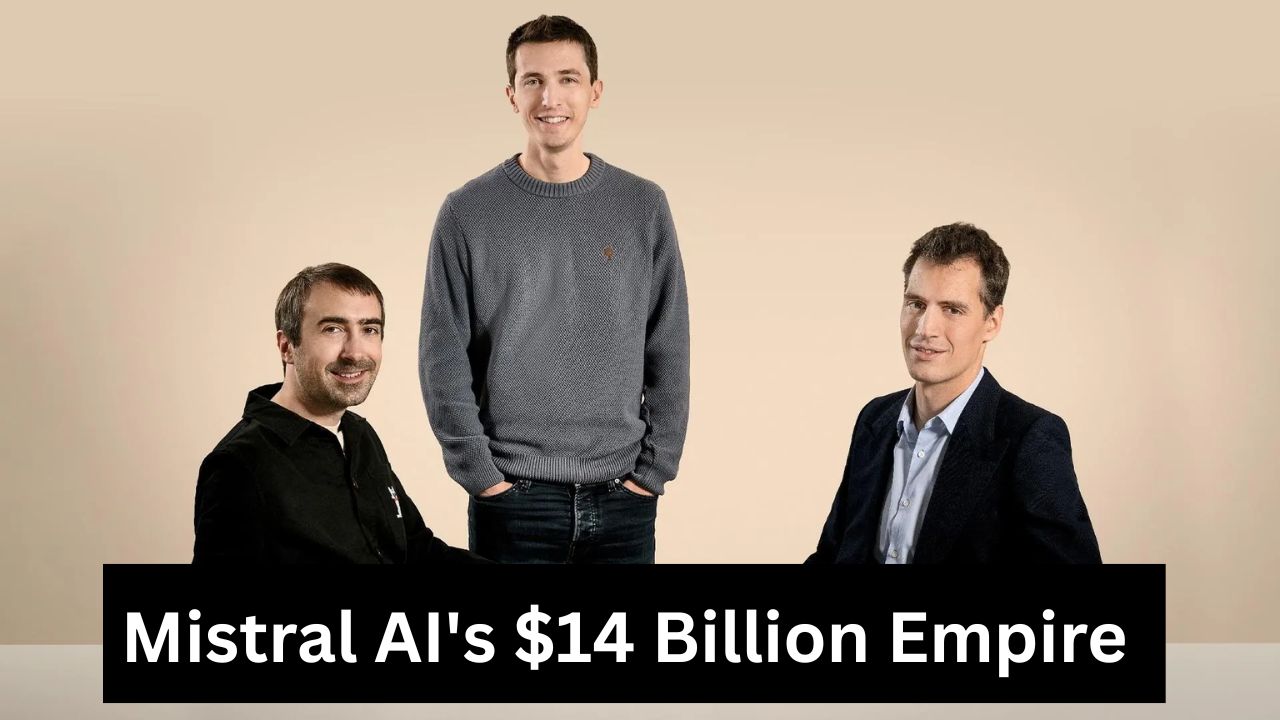
Mistral AI built a $14 billion company in 29 months without being American. Here is how data sovereignty and open models created Europe’s most valuable AI startup.
When Arthur Mensch, the 33-year-old co-founder and chief executive of Mistral AI, took the stage at the AI Action Summit in New Delhi in February 2026, the crowd was thin. Nearly everyone in the room had drifted toward the sessions featuring OpenAI’s Sam Altman and Anthropic’s Dario Amodei, the men who have come to define how the world talks about artificial intelligence.
Mensch spoke to a smaller audience. He spoke about something different: independence. Control. The right of companies and governments to own their own AI infrastructure, to understand what is running inside it, and to trust that their data is not flowing to servers in a jurisdiction that operates under foreign law.
That pitch, in that room, drew modest applause. But over the previous three years, it had built a $14 billion company from nothing. Mistral AI, founded in Paris in April 2023 by Mensch and two colleagues from Meta’s research division, grew from a seed-stage startup with no product into Europe’s most valuable artificial intelligence company in 29 months, matching a pace that no AI company outside of San Francisco had ever managed. The growth happened not because Mistral built the most powerful model in the world. It happened because Mistral understood that a large and growing market of enterprises and governments did not need the most powerful model in the world. They needed a model they could control, deploy privately, customize for their own operations, and trust to remain on their own soil.
That distinction, easy to underestimate from Silicon Valley, turned out to be the foundation of a real business.
Three Researchers, One Insight, and Europe’s Largest Seed Round in History
Mensch came from DeepMind’s Paris office, where he had spent nearly three years working on large language models. His co-founders, Guillaume Lample and Timothée Lacroix, came from Meta’s AI research team. All three had studied at École Polytechnique, France’s most selective engineering school. They left their jobs within days of each other in early 2023 and spent roughly six weeks writing a business plan before announcing the company.
Their first fundraise, completed in June 2023, was the largest seed round in European startup history: 105 million euros, raised before the company had released a single product. Lightspeed Venture Partners led the round. Eric Schmidt, the former Google chief executive, and Xavier Niel, the French technology billionaire, also participated. The valuation at that point was roughly 240 million euros, based almost entirely on the reputation of the founding team and the clarity of their stated intent.
That intent, which Mensch has repeated in various forms at every major conference since, can be reduced to a single word: sovereignty. Mensch’s view, stated plainly and without the millennial-prophet energy that characterizes much of American AI communication, is that the world has too much at stake to let artificial intelligence be controlled by two or three companies in a single American city. His models, therefore, would be open. Customers would be able to inspect the weights, run the software on their own hardware, customize it with their own data, and operate it entirely behind their own walls if they chose.
We are really the only company that allows building core business automation and products on top of an open stack, and that is something that is valuable everywhere in the world.”
The Open-Weight Bet That Built Developer Trust Fast
Mistral released its first model, Mistral 7B, in September 2023, just four months after founding. The release was not accompanied by a lengthy announcement or a carefully staged event. The company simply published the model weights publicly, under a permissive license that let anyone download and run it. The technical community noticed immediately. Despite having only 7 billion parameters, a small footprint by the standards of the time, Mistral 7B outperformed much larger models from Meta and matched significantly bigger systems on standard benchmarks. It could run on a laptop with reasonable performance, which was something no comparable model had achieved.
That single release did several things for Mistral at once. It built credibility with researchers who could see exactly how the model worked. It attracted developer goodwill that translated into community adoption. And it demonstrated, concretely, that Mistral’s core technical insight was sound: if you spent more computing power during training to compress knowledge more efficiently, you could produce a smaller model that punched well above its weight. Smaller models meant lower operating costs. Lower costs meant enterprises could deploy AI without the infrastructure budgets that working with OpenAI or Anthropic implicitly required.
By December 2023, just eight months after founding, Mistral closed a 385 million euro Series A round that brought in Andreessen Horowitz, BNP Paribas, and Salesforce. Its valuation crossed 2 billion euros. Six months after that, a 600 million euro Series B led by General Catalyst pushed it to 5.8 billion euros, making it the first AI company outside the San Francisco Bay Area to reach the top four globally by valuation. The funding trajectory reflected a market willing to pay for the credibility Mistral had established, and for what investors believed the European AI market, specifically, was about to demand.
Why Being French Turned Out to Be a Structural Advantage
The conventional view of European technology companies is that geography is a handicap. The talent pool is thinner. The venture capital market is smaller. The regulatory environment, particularly around data privacy, makes it harder to build and deploy AI at scale. Mistral, almost accidentally, discovered that this framing gets the story backwards for a specific and growing category of customer.
European enterprises in healthcare, financial services, and government face a concrete legal problem when they consider American AI tools. The United States CLOUD Act gives American intelligence and law enforcement agencies the legal authority to demand access to data stored by American companies, even when that data is held on servers physically located in Europe.
For a French bank processing client financial records, or a German hospital managing patient data, or a government ministry handling classified procurement decisions, this is not an abstract concern. It is a compliance problem with real consequences. Sending sensitive data to OpenAI or Anthropic means accepting that an American government agency could, under the right legal conditions, gain access to it. Mistral, headquartered in Paris and incorporated under French law, does not have that problem. Its infrastructure operates within Europe. Its models can be deployed entirely on a customer’s own servers, with no data leaving the building at all.
This distinction matters even more in markets beyond Europe. At the AI Action Summit in New Delhi, the small crowd that gathered to hear Mensch was not there by accident. India, like many large economies outside the United States and China, has a strong political and institutional preference for AI tools that do not create dependency on either superpower.
Mistral’s open-weight models, which can be downloaded and run entirely on local infrastructure, speak directly to that concern. Mensch’s message, that AI sovereignty is a legitimate goal and that his company is uniquely positioned to deliver it, resonates in markets that American AI companies rarely think about seriously.
The Revenue Model Behind the Open-Source Reputation
A company that gives away its models for free needs a way to make money, and Mistral’s business model is more layered than its open-source reputation suggests. The company earns revenue from several overlapping streams. Enterprises that want access to more capable proprietary models pay through a cloud API called La Plateforme, priced on a per-token basis.
Organizations that need private deployments, typically in regulated industries, pay for dedicated installations that run entirely within their own infrastructure. Le Chat, Mistral’s consumer-facing AI assistant launched on mobile in early 2025, offers a paid subscription tier at $14.99 per month that competes directly with ChatGPT Plus and provides access to more advanced models with unlimited messaging and web browsing.
On top of those product revenues, Mistral has signed a series of large enterprise partnerships that operate more like professional services contracts than software licenses. The company sends engineers directly to client sites to set up, configure, and run AI systems alongside the customer’s own technical teams, a model that Mensch describes as “deploying engineers to set up and run the tech.” That hands-on approach is deliberately different from the API-first philosophy of OpenAI and Anthropic, and it commands a price premium from enterprises that need more than a key and a documentation page.
In February 2026, Mistral formalized a version of this at scale when it announced a multi-year strategic partnership with Accenture, the global consulting firm. Under the agreement, Accenture itself became a Mistral customer, equipping its roughly 784,000 employees with Mistral’s models and embedding the technology into client delivery.
The deal expands Mistral’s enterprise reach into industries and geographies it could not penetrate alone. Accenture’s chief executive for Europe, Middle East, and Africa described what Mistral offered as something specific: “complete ownership” of AI, a phrase that does not appear in OpenAI’s or Anthropic’s marketing materials because the concept is structurally unavailable to them.
By January 2026, Sacra estimated that Mistral’s annual recurring revenue run rate had reached approximately $400 million, up from roughly $16 million at the end of 2024 — a roughly 25-fold increase in a single year. Speaking at the World Economic Forum in Davos that same month, Mensch said the company is on track to exceed $1 billion in total revenue by the end of 2026.
Mistral Compute and the Infrastructure Push
For most of its short history, Mistral has been a model company that rented compute from others. In 2026, that is changing. The company is spending its March 2026 infrastructure raise, $830 million, to build data centers of its own: one near Paris and a second in Borlänge, Sweden, in partnership with EcoDataCenter. The Swedish facility will deploy Nvidia’s Vera Rubin GPUs and is designed to deliver approximately 23 megawatts of capacity by 2027, powered in part by renewable and nuclear energy.
The infrastructure push is strategic rather than merely operational. A company that rents GPU capacity from Amazon or Microsoft is, to some degree, dependent on the geopolitical and commercial decisions of American companies. A company that owns its own compute, operating under European law on European soil, can make credible promises about data handling that no amount of contractual language from a cloud provider can fully replicate.
Mensch has described the goal as building “a European AI cloud that can serve industries, public institutions, and researchers at scale,” and the framing is deliberate. It is a direct response to the fear, common among European governments and regulated enterprises, that AI infrastructure controlled by American firms will eventually be subject to American policy priorities that may not align with European interests.
In March 2026, at Nvidia’s GTC conference, Mistral unveiled Mistral Forge, a platform designed to let enterprises train proprietary AI models entirely on their own premises, using Mistral’s infrastructure and with Mistral engineers embedded in the customer’s team during implementation. The announced early customers included the European Space Agency, Singapore’s defense and homeland security agencies, and several financial institutions. The list is a statement of intent: these are organizations where a hallucinated fact or a data leak carries consequences far beyond an embarrassing chatbot response.
When we use models that are American or Chinese, our data is saved in warehouses there. Data is power, and if you want to hold information and power, the physical infrastructure should be in your own country.”
The Risks That Come With the Territory
Mistral’s story is genuinely impressive, and the risks that accompany it are also genuine. The company’s revenue, at $400 million in annual recurring revenue, remains a fraction of what OpenAI reported for 2025. Its model quality, while competitive and improving, has not consistently matched the frontier performance of GPT-4 class systems or Anthropic’s Claude for the most demanding tasks. OpenAI and Anthropic have both moved to offer EU data residency options for their cloud products, which satisfies some of the customers who would otherwise default to Mistral on sovereignty grounds. Meta’s Llama models are open-source and freely available, which undercuts part of what Mistral offers in the open-weight market specifically.
There is also the question of debt. Reports from early 2026 noted that Mistral has taken on $830 million in new debt to fund its infrastructure ambitions, a level of leverage that analysts have flagged as meaningful for a company that has not yet reached profitability. The company is spending aggressively on the bet that European AI sovereignty will become a more valuable proposition as geopolitical tensions between the United States and Europe intensify. If that bet is correct and if Mistral can maintain its technical credibility as the American frontier moves forward, the economics can work. If either of those conditions weakens, the math becomes harder.
What Mistral has managed to build, more than anything else, is positioning. It is the credible European AI company at a moment when Europe badly wanted one to exist. President Emmanuel Macron has publicly recommended Le Chat over ChatGPT. The French government has been an active supporter. European institutions have treated Mistral as a strategic asset in a way that no American startup, regardless of how many European offices it opens, can plausibly claim. That positioning has commercial value today, and it is likely to have more commercial value as the regulatory and geopolitical environment around AI becomes more contested and more complex.
Arthur Mensch speaks softly at conferences. He does not promise to build artificial general intelligence or transform every human institution. He talks about control, transparency, and the right of organizations to own the tools they depend on. In the current moment of AI development, that turns out to be a message that a very large number of governments, regulated enterprises, and technology-forward organizations are actively looking to hear. That is what a $14 billion company in 29 months looks like when it is built on something real.