


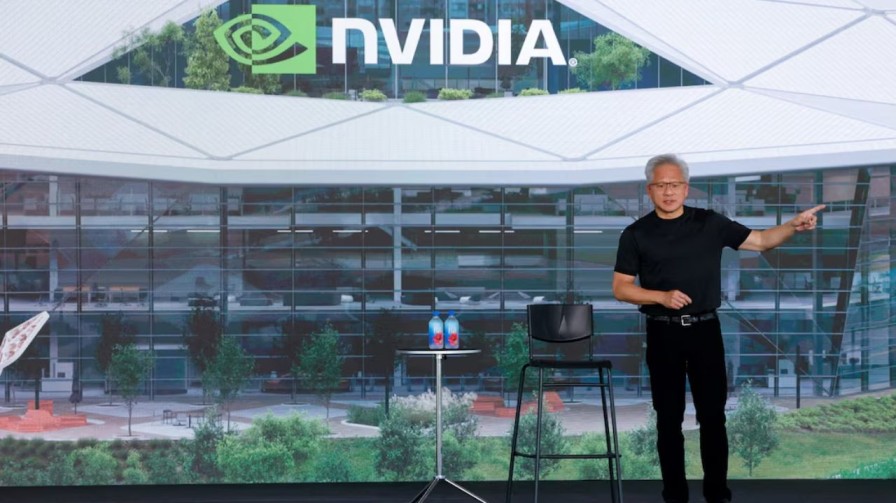
Nvidia $150 Billion Taiwan: Nvidia’s CEO Jensen Huang pledges $150 billion a year in Taiwan, calling it the epicenter of AI — and breaking ground on a new headquarters set to open by 2030.
When Jensen Huang took the stage in Taipei on Wednesday to celebrate the launch of Nvidia’s planned Taiwan headquarters, he did not arrive with cautious language or carefully hedged projections. He arrived with a number: $150 billion a year.
That is how much the chief executive of the world’s most valuable chipmaker now says his company spends annually in Taiwan — and the figure, he suggested, is not a ceiling but a trajectory. It reflects a transformation in Nvidia’s relationship with the island that has quietly become one of the most consequential in global technology.
Why Smart, Hardworking People Still Feel Stuck in Their Careers
“Four years ago, five years ago, Nvidia was spending about $10 to $15 billion dollars a year in Taiwan,” Huang told the crowd assembled for the celebration. “Now we’re spending $100 [billion], going to $150 billion dollars in Taiwan each year.” The shift he described — more than a tenfold increase over roughly half a decade — tracks almost exactly with the explosion of demand for AI infrastructure that his company’s chips helped set off.
Taiwan is the epicenter of the AI revolution. This is where the chips come, packaging comes, this is where the systems are made, this is where AI supercomputers were created.”
A Building and a Statement
The event itself was for something tangible: a Taiwan headquarters that Huang said will break ground this year and is targeted to open in 2030. But the announcement carried a weight far beyond real estate. By putting down permanent roots in Taipei, Nvidia is formalizing what has been an increasingly deep operational and strategic bond with the island’s technology ecosystem.
The new campus will bring Nvidia closer to TSMC — the Taiwan Semiconductor Manufacturing Company — which manufactures a large share of the advanced chips that power modern AI systems. The relationship between the two companies sits at the very foundation of the current AI buildout. Nvidia designs the chips; TSMC makes them possible. Little of the generative AI wave that has reshaped the technology industry since 2022 could have happened without that partnership running smoothly at industrial scale.
Key Facts: Nvidia $150 Billion Taiwan
- $150B/year is Nvidia’s current and growing annual spend in Taiwan, up from $10-15B just five years ago.
- Nvidia’s Taiwan HQ will break ground in 2026 and is set to be operational by 2030.
- TSMC, the world’s largest contract chipmaker, is a critical Nvidia manufacturing partner based in Taiwan.
- Nvidia’s market capitalization stands at approximately $5 trillion, making it one of the most valuable companies ever.
- Around 1,000 employees attended the Taipei launch celebration alongside Huang’s family.
More Than a Business Decision
There was something unusually personal about Wednesday’s celebration. Huang, who was born in Taiwan and moved to the United States as a child, spoke on a stage that his parents, wife, daughter, and son attended alongside roughly a thousand company employees. The headquarters announcement was also, in some ways, a homecoming story.
“Taiwan is booming,” he said simply. For Huang, the statement was not just an economic observation. It was the kind of thing someone says about a place they feel connected to — a place whose success carries meaning beyond the quarterly figures.
A Long Bet on an Island Under Watch
Taiwan’s central role in the global semiconductor supply chain has made it one of the most closely watched places on earth. Geopolitical tensions over the island’s status have led governments, including the United States, to invest heavily in domestic chip production — precisely because so much of the world’s advanced semiconductor capacity is concentrated in such a small and strategically sensitive place.
Nvidia’s $150 billion annual commitment does not resolve that tension. If anything, it deepens the world’s dependence on Taiwan’s manufacturing infrastructure even as other efforts seek to diversify it. Huang did not address that paradox directly on Wednesday. What he offered instead was a clear-eyed view of where Nvidia stands today and where it intends to plant its flag for decades to come.
“The number of partners we work with here in Taiwan, incredible,” he said. It was, as statements of corporate strategy go, both measured and absolute — the kind of thing that sounds simple until you consider the scale behind it.
Huang did not specify the number of years over which the $150 billion annual figure would apply. What he made clear was that it was a direction, not a deadline.