


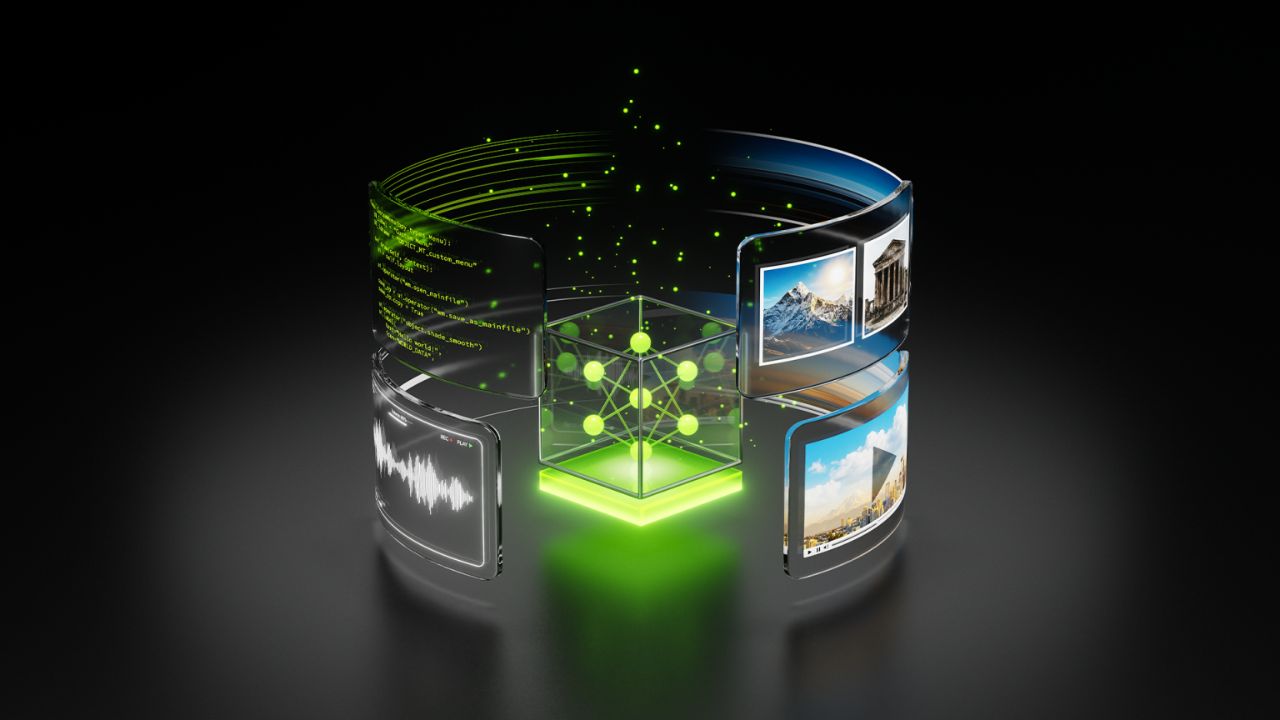
NVIDIA Nemotron 3 Nano Omni Architecture Explained unifies vision, audio, and language in a single 30B hybrid MoE model, delivering 9x more throughput for enterprise AI agents at lower cost.
Enterprises building AI agents have spent years stitching together separate vision, audio, and language models into a single pipeline. NVIDIA’s new open multimodal model makes the case that the stitching was always the problem — and that a single unified system built on a hybrid mixture-of-experts core is the answer.
There is a structural problem at the center of most enterprise AI agent deployments today, and it rarely shows up in the marketing. When an agent needs to process a screen recording, analyze a call transcript, and interpret a PDF simultaneously, it does not do this with one model. It chains together three or more specialized systems, passes data between them, and hopes that enough context survives each handoff to produce a useful result. NVIDIA’s Nemotron 3 Nano Omni was designed from the ground up to eliminate that chain entirely.
Released on April 28, 2026, the model is NVIDIA’s answer to the growing demand for a single perceptual backbone that enterprise agents can rely on. Built on a 30 billion parameter hybrid mixture-of-experts architecture, it processes text, images, audio, video, documents, charts, and graphical interfaces in one unified inference pass. The company says it achieves the highest throughput of any open omnimodal model evaluated under real production conditions — and it does this while also leading multiple industry accuracy benchmarks.
The Core Problem With Fragmented Model Chains
To understand why Nemotron 3 Nano Omni matters, it helps to understand what it is replacing. A typical agentic system today might use a vision-language model for screenshots and documents, a separate speech recognition system for audio, and a large language model as the reasoning backbone. Each of these models operates independently. Each adds inference hops. Each introduces the risk of losing the thread between modalities.
In a customer support scenario, for example, an agent might receive a screen recording of a user’s session, an audio file of a call, and a text log of the same interaction. Processing these with separate models means the agent never sees the full picture at once. It sees three summaries. Context gaps introduce errors, and those errors compound over long interactions.
What changes with Nano Omni: All modalities — video, audio, text, and images — enter a single shared perception-to-action loop. The model activates only the experts required for each modality within its MoE core, reducing compute overhead while preserving cross-modal context across the full reasoning chain.
Architecture: How It Actually Works
Nemotron 3 Nano Omni’s 30B-A3B designation means the model has 30 billion total parameters but activates roughly 3 billion per inference step — the defining characteristic of a mixture-of-experts design. Only the expert subnetworks relevant to the current modality and task are engaged, which keeps compute costs manageable without sacrificing the breadth of knowledge encoded in the full parameter set.
// TEXT
Language Core
A strong text decoder serves as the central reasoning engine. All cross-modal bridges are trained around it, reducing multimodal training instability while maximizing language accuracy for continuous perception tasks.
// AUDIO
NVIDIA Parakeet Encoder
Audio integration is built on NVIDIA’s Parakeet encoder, extending beyond simple transcription into semantic audio understanding using NVIDIA Granary and Music Flamingo datasets.
// VISUAL
C-RADIOv4-H + EVS
High-resolution images are processed through the C-RADIOv4-H vision encoder. For video, an Efficient Video Sampling layer uses 3D convolutions to capture motion between frames and compress visual tokens for efficient context window use.
The hybrid MoE core itself combines Mamba layers, which handle sequence and memory efficiency, with transformer layers for precise reasoning. This combination is what NVIDIA credits for the model’s claim of up to four times improved memory and compute efficiency compared to a dense architecture of comparable capability.
Benchmarks: What the Numbers Actually Show
NVIDIA has published benchmark results across a wide range of evaluations, and the pattern that emerges is consistent: Nano Omni leads in accuracy on document intelligence tasks while also delivering the highest throughput for video and audio workloads among open omnimodal models.
The throughput numbers deserve particular attention because NVIDIA measured them in a way that reflects real deployment conditions rather than synthetic maximums. The benchmarks fix per-user throughput at a constant level — the point where each individual user still experiences the interaction as responsive — and then measure how much total system throughput can be sustained at that threshold. This is what actually matters for enterprise economics.
How It Was Trained: A Three-Stage Pipeline
The model’s training methodology is unusual in how systematically NVIDIA expanded modality coverage across successive stages, rather than attempting to train all modalities simultaneously from the start. The approach is also notable for the scale of reinforcement learning applied after supervised fine-tuning.
NVIDIA also incorporated 11.4 million synthetic visual question-answer pairs, roughly 45 billion tokens, generated through an iterative pipeline development process using NeMo Data Designer. The team has published a detailed account of that process, including what worked and what failed, which is an unusually honest piece of documentation for a model release of this scale.
The Open Data Commitment
One of the more significant aspects of this release is not the model itself but the data stack that comes with it. NVIDIA is extending the same openness it established with the text-focused Nemotron 3 family into multimodal territory.
The full pre-training, post-training, and evaluation recipe is publicly available, covering the entire pipeline from initial training through alignment. Developers can reproduce the training, adapt it for domain-specific applications, or use it as a starting point for their own hybrid architecture research.
Privacy-First Local Deployment With NemoClaw
One of the more practical applications NVIDIA demonstrated is a privacy-first video reasoning setup using the NemoClaw runtime. The architecture runs Nemotron 3 Nano Omni inside an NVIDIA OpenShell sandboxed environment with a privacy router, which means user video data never leaves local infrastructure.
“Unlike traditional systems that hallucinate based on transcriptions, Nemotron 3 Nano Omni uses a native visual-temporal pipeline to see what is happening on screen — enabling near-instant, high-fidelity transcription and summarization that captures visual context that audio-only models miss entirely.”
This is directly relevant for industries where data sovereignty is not optional — healthcare, finance, legal, and government use cases where sending video or audio to an external API is either prohibited or inadvisable. The model’s open weights and support for local runtimes including Ollama, llama.cpp, and LM Studio make this a realistic deployment option, not just a theoretical one.
Where Developers Can Access It Today
The model is available immediately through multiple channels. For cloud-based inference, it is on Hugging Face, OpenRouter, and build.nvidia.com as an NVIDIA NIM microservice. Major cloud providers including Amazon SageMaker JumpStart and Oracle Cloud Infrastructure are live at launch, with Microsoft Foundry coming soon.
For developers who want to run the model locally, GGUF checkpoints are available for Ollama and llama.cpp. NVIDIA has also published a full set of deployment cookbooks covering configuration templates, performance tuning guidance, and reference scripts for vLLM, SGLang, TensorRT-LLM, and Dynamo, the last of which adds disaggregated serving, intelligent routing, multi-tier KV caching, and automatic scaling support.
What This Actually Means for Enterprise AI Teams
For engineering teams building agentic systems, the practical implication of Nemotron 3 Nano Omni is straightforward: the perception layer of their agent stack can now be a single model with a single API surface. There is no longer a need to maintain separate vision, speech, and document processing pipelines, synchronize their outputs, or debug the context gaps between them.
The nine-times throughput advantage over comparable open omni models, if it holds in production workloads as diverse as NVIDIA’s benchmarks suggest, also means the economic case for running this kind of multimodal agent at scale changes significantly. Lower inference cost per task, higher concurrency under the same hardware budget, and a simpler operational footprint are all meaningful improvements for organizations trying to justify enterprise AI deployments on real unit economics.
The fully open weights and training recipes add a dimension that API-only model providers cannot match: organizations can inspect exactly what the model was trained on, fine-tune it for their domain using LoRA SFT or GRPO reinforcement learning, and deploy it on hardware they control. For regulated industries, that combination of transparency and control is often the deciding factor.
Whether Nemotron 3 Nano Omni becomes the default perception backbone for enterprise AI agents will depend on how it performs in the production workloads that will stress-test it over the coming quarters. The architecture, the benchmarks, and the openness of the release all point in the same direction. The next few months will show whether the production reality matches the promise.