


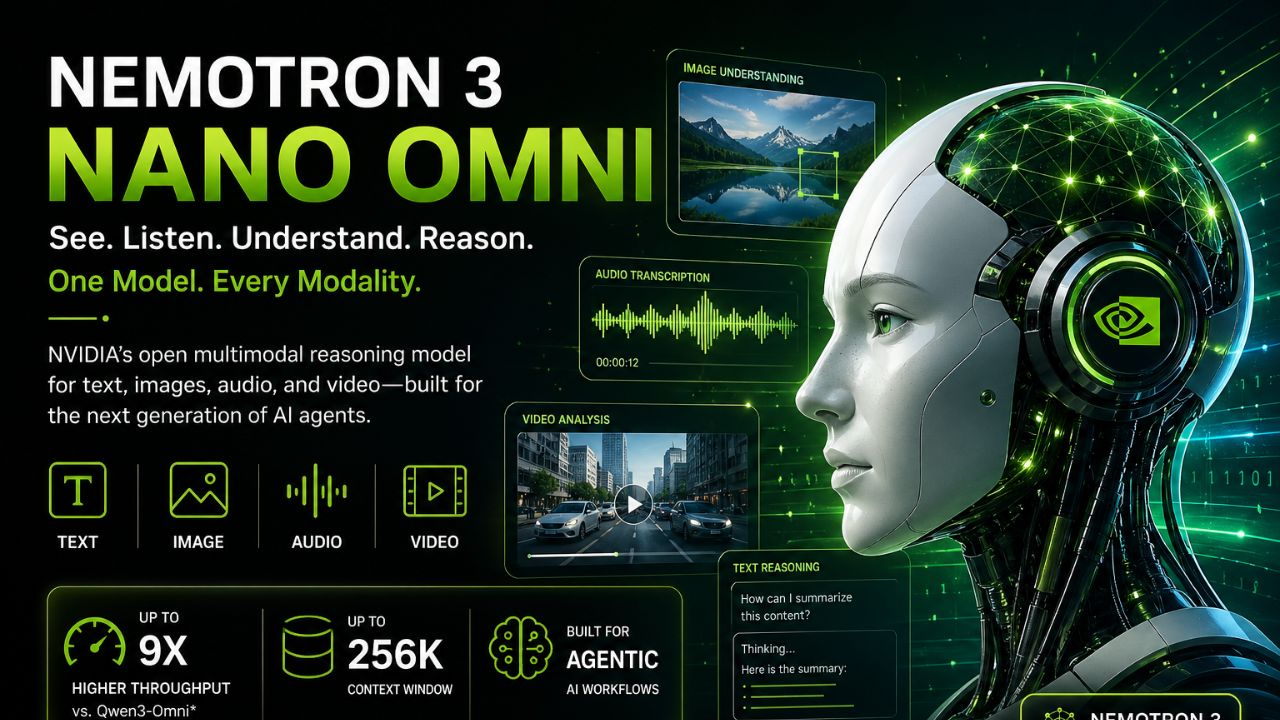
NVIDIA Nemotron 3 Nano Omni unifies vision, audio, and language into one open AI agent model, delivering 9x higher throughput for enterprise workflows at lower cost.
For most of the past few years, building an AI agent that could watch a screen recording, process an audio call, and analyze a document at the same time meant stitching together at least three separate models. Each one specialized in a single modality. Each one added latency. Each one created a gap where context could be lost. NVIDIA has now released a model designed to close all three of those gaps at once.
The company announced Nemotron 3 Nano Omni on April 28, 2026. It is an open, multimodal reasoning model built on a 30 billion parameter hybrid mixture-of-experts architecture. It accepts text, images, audio, video, documents, charts, and graphical interfaces as inputs and produces text output. The company says it delivers up to nine times higher throughput than comparable open omni models while maintaining the same level of interactivity, making it possible for enterprises to run fast, responsive, and cost-effective agentic systems without sacrificing accuracy.
Why Separate Models Created a Real Problem
The issue with today’s common approach is straightforward once you lay it out. An AI agent tasked with customer support might receive a screen recording, a call audio file, and a data log at the same time. Most existing systems would route each of these to a specialized model, wait for each to return a result, then attempt to merge those results into something coherent. Every handoff costs time. Every merge risks losing the thread.
NVIDIA’s Nemotron 3 Nano Omni takes a different path. By incorporating vision and audio encoders directly into its architecture, the model handles all those modalities in a single inference pass. There is no routing, no waiting, and no context fragmentation. The result, according to NVIDIA, is an agent that is not only faster but more accurate over time, because it maintains a unified representation of everything it has seen, heard, and read.
Three Workflows Where It Changes the Game
NVIDIA has been specific about where it believes Nemotron 3 Nano Omni delivers the clearest advantages. Three use cases stand out.
Computer Use Agents
The model powers a real-time perception loop for agents navigating graphical user interfaces. It processes full 1920×1080 pixel screen recordings natively, giving agents high-fidelity visual context about interface state over time.
Document Intelligence
Enterprise agents can now interpret documents, spreadsheets, charts, tables, screenshots, and mixed-media inputs in one pass, reasoning across visual structure and text content in a single unified stream.
Audio and Video Understanding
For customer service, research, and monitoring workflows, the model maintains audio-video context, tying together what was said, what was shown, and what was documented without producing disconnected summaries.
A Vote of Confidence From H Company’s CEO
To build useful agents, you can’t wait seconds for a model to interpret a screen. By building on Nemotron 3 Nano Omni, our agents can rapidly interpret full HD screen recordings — something that wasn’t practical before. This isn’t just a speed boost: it’s a fundamental shift in how our agents perceive and interact with digital environments in real time.”
H Company is among the first wave of companies to publicly demonstrate what the model can do in production. Their latest computer use agent, built on Nemotron 3 Nano Omni, processes native 1920×1080 pixel resolution and showed significant improvement in navigating complex graphical interfaces in preliminary evaluations on the OSWorld benchmark.
Industry Adoption Already Underway
The list of organizations that have already committed to the model or are actively evaluating it is a strong early signal. NVIDIA confirmed that the following companies are already adopting or assessing Nemotron 3 Nano Omni:
Open Weights, Deployable Anywhere
One of the more significant details about Nemotron 3 Nano Omni is not just what it can do, but how organizations can use it. NVIDIA is releasing it with open weights, open datasets, and transparent training techniques. That means enterprises are not locked into NVIDIA’s cloud. They can customize the model using NVIDIA’s NeMo toolchain, deploy it on local hardware such as NVIDIA Jetson or DGX Spark systems, or run it in data center and cloud environments, all while retaining full control over the data and the deployment path.
This matters particularly for industries with strict data localization or regulatory requirements, where sending data to an external API is simply not an option. A healthcare provider, a financial institution, or a government contractor can all run Nemotron 3 Nano Omni on infrastructure they fully control.
Where It Fits in the Broader Nemotron Family
Nemotron 3 Nano Omni is not designed to work alone. NVIDIA positions it as the perceptual layer, or the eyes and ears, within a larger system of agents. It is built to work alongside Nemotron 3 Super, which handles high-frequency execution, and Nemotron 3 Ultra, which manages complex planning and reasoning. Together, the three models cover the full stack of what an enterprise agentic system typically needs.
The broader Nemotron family has crossed 50 million downloads over the past year, suggesting there is an existing developer community ready to put the new model to work. The omni extension brings that community into multimodal and agentic territory for the first time.
What This Signals for Enterprise AI in 2026
The release of Nemotron 3 Nano Omni reflects a broader shift that has been building for some time. Enterprises are moving past the experimental phase of AI and into operational deployment, and the demands of that transition are exposing the real costs of fragmented model architectures. Every extra inference pass costs money. Every context gap introduces errors. Every additional model adds a point of failure.
Unified multimodal reasoning is not a new idea, but delivering it at the efficiency level that NVIDIA is claiming with Nano Omni, and doing so with an open model that enterprises can customize and deploy on their own terms, is a meaningful step forward. Whether the nine times throughput advantage holds across diverse production workloads is something the industry will stress-test over the coming months. But the direction of travel is clear.
AI agents are getting more capable, more integrated, and more efficient. Nemotron 3 Nano Omni is NVIDIA’s bet on what the best version of that future looks like.