


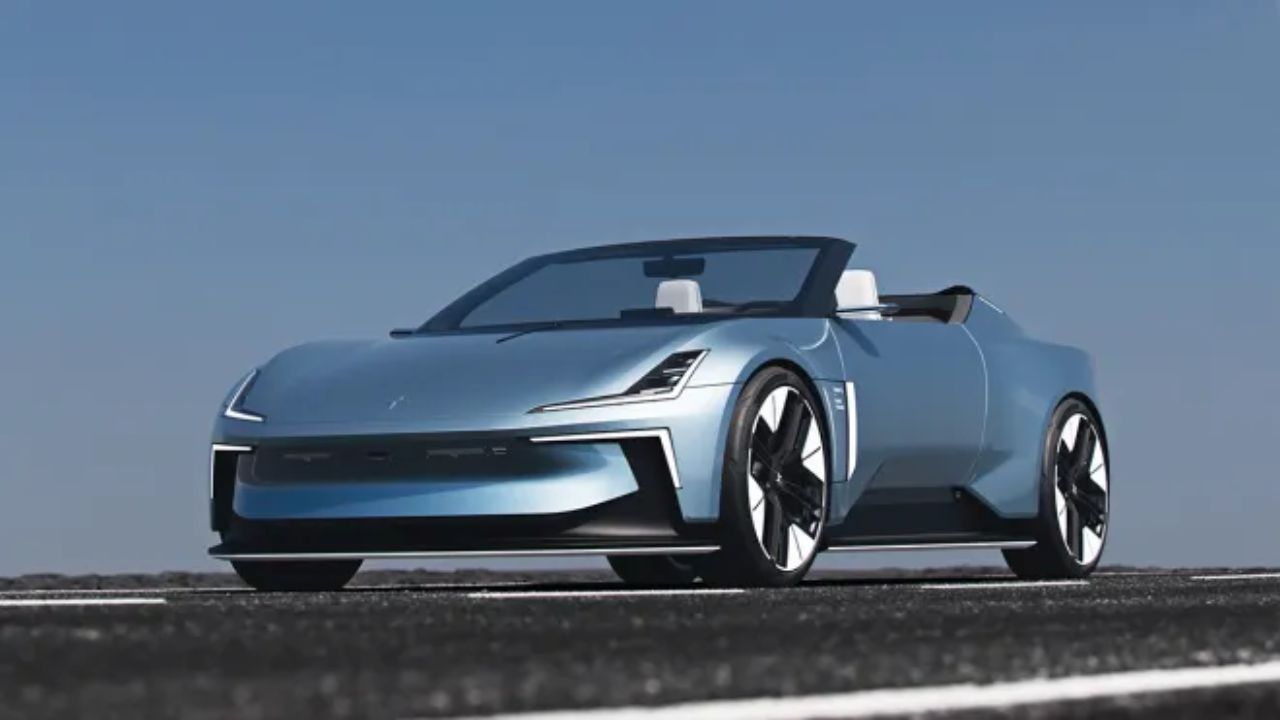
Polestar 6 convertible development is nearly complete, but U.S. tariffs, a reshuffled launch lineup, and no confirmed arrival date have buyers waiting until 2029
The Swedish automaker says its stunning open-top roadster is nearly finished in development — but a wall of tariffs, a reshuffled launch lineup, and questions about the U.S. market have put buyers in an indefinite holding pattern.
Four years after one of the most buzzed-about concept car debuts in recent memory, the Polestar 6 remains in a frustrating purgatory — not dead, not quite alive, and caught in the crossfire of trade policy and a company reshaping its priorities on the fly.
In a recent interview with Edmunds, Graeme Lambert, Polestar’s global head of product communications, confirmed that the sleek two-door convertible is, technically speaking, very close to finished. The majority of its engineering work is done. Its chassis architecture — a bespoke bonded-aluminum structure called the Polestar Performance Architecture, or PPA — is shared with the Polestar 5 sedan, which is already deep into development. What remains is the folding hardtop mechanism and a set of unique rear seats, tasks the company says it has the expertise to complete out of its Sweden operations after shuttering its UK research and development center in 2025.
The key for us is to deliver the 7 and 2 correctly, drive the business forward, and then be in a position to do something else after,” Lambert told Edmunds.
But “technically close to finished” and “coming to a showroom near you” are very different things right now. Polestar has made no secret of the fact that the 6 has been pushed down the priority list, and the reasons are hardly mysterious.
Tariffs changed the math:Polestar 6 Convertible
The Polestar 6 was always going to be an expensive car. It is a low-volume, high-performance, open-top electric roadster with an aluminum-intensive build and a pedigree aimed squarely at the kind of buyer who shops at the top of the market. When Polestar first announced the limited-edition LA Concept edition — 500 units only — those build slots filled up fast.
That early enthusiasm prompted Polestar to shift the 6 to an on-demand production model, meaning it would build the car for anyone willing to put their name on a reservation. But the tariff environment that has taken hold over the past year has dramatically altered the pricing calculus. Because Polestar manufactures its vehicles in China, U.S. import tariffs have hit the brand hard across its entire lineup. A car that was already destined to be expensive is now being pushed into price territory that could put off even serious buyers.
Lambert was candid about the bind. The company’s immediate priorities are the Polestar 7 — a compact SUV aimed at a broader audience — and a next-generation Polestar 2 sedan, both of which use Geely-derived platforms and are positioned as higher-volume, more accessible models. Those are the cars that will drive revenue and help Polestar reach its stated goal of 100,000 annual sales globally.
Polestar 6 — Key Details
Body style: Two-door convertible with folding hardtop
Platform: Polestar Performance Architecture (PPA), bonded aluminum
Architecture: 800-volt, dual-motor
Power (concept spec): 884 horsepower
0–62 mph (concept): 3.2 seconds
Top speed (concept): 155 mph
Originally planned: 2026 production launch
Current estimate: 2028 at the earliest, possibly 2029
A lineup shuffle that keeps moving the goalposts
The model sequencing at Polestar has become a bit of a running story on its own. The Polestar 7 SUV — which will slot below the brand’s existing 3 and 4 crossovers — does not follow the numbering logic one might expect. A next-generation Polestar 2 will arrive after the 7, but it will not carry the Polestar 8 name. The company has confirmed a target of four new models by 2028, and the 6 is not among them.
By Polestar’s own timeline, the earliest the 6 could realistically arrive is sometime after 2028 — and some reports suggest 2029 is the more honest estimate. That is a long wait for a car that generated this much excitement from its first public appearance in March 2022 as the O2 concept.
There is also the unresolved question of whether the Polestar 6 will come to the United States at all. The Polestar 5 sedan, which shares its underpinnings with the 6, has not been confirmed for the U.S. market. If the company ultimately decides that tariff-adjusted pricing makes the American rollout of the 5 untenable, the 6’s fate in this country becomes even murkier.
A platform with more potential than one car
One piece of genuinely interesting news to emerge from Lambert’s Edmunds interview is that the PPA platform underpinning both the 5 and the 6 is not necessarily a dead end financially. Polestar is exploring whether the bonded-aluminum architecture could support a high-performance SUV — a vehicle that would put it in direct competition with the electric Porsche Cayenne, as well as electrified offerings from Lamborghini and Bentley.
That possibility makes more sense of Polestar’s current patience. If the PPA platform can underpin multiple vehicles — a super-sedan, a convertible roadster, and a luxury performance SUV — then the development investment becomes considerably easier to justify. The company is not abandoning the technology; it is figuring out how to make it work harder.
For now, though, the Polestar 6 sits in a familiar place for car enthusiasts: tantalizing, visible on the horizon, and just out of reach. The people who reserved build slots years ago are still waiting. The car is still coming. How long “still” lasts is a question Polestar is not yet ready to answer with a specific date.
What is clear is that the 6 remains the brand’s halo — the car that says something about what Polestar aspires to be, even as it focuses near-term attention on the volume models that keep the lights on. That is not a bad position for a dream car to occupy. It is just a frustrating one if you have been holding your breath since 2022.