


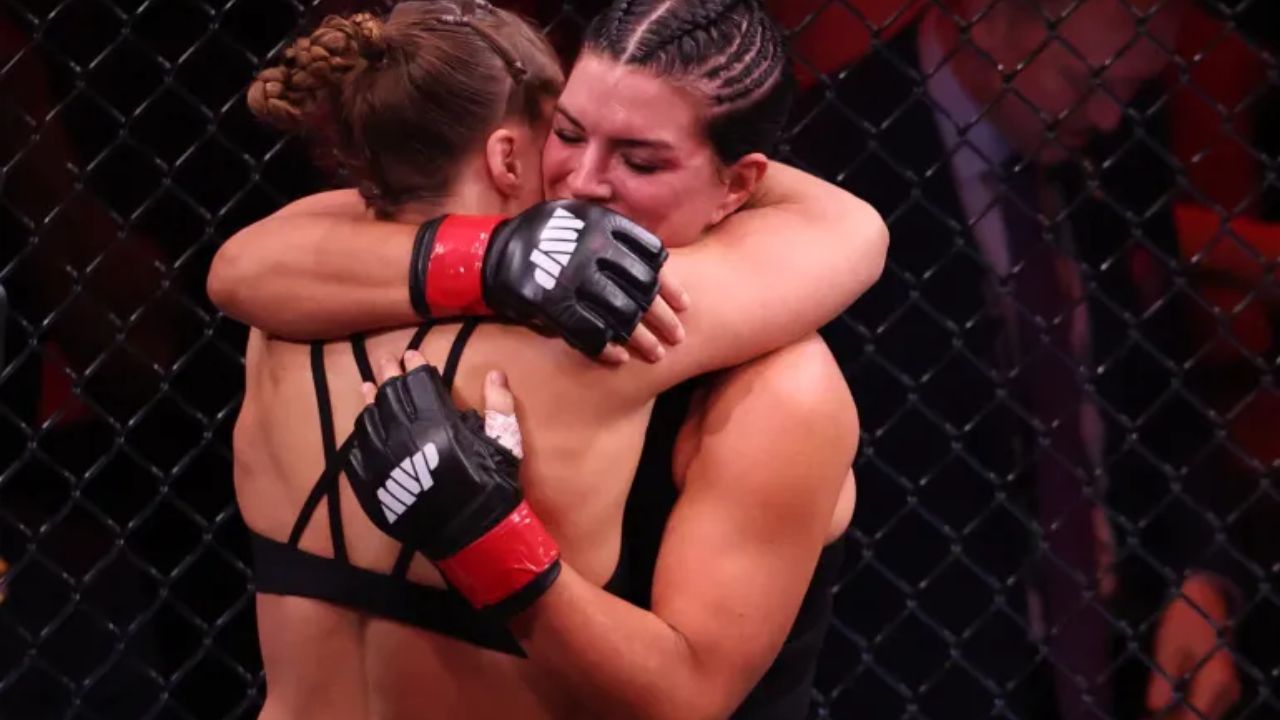
Ronda Rousey vs Gina Carano ended in 17 seconds as Rousey locked in her trademark armbar at Intuit Dome and walked away from MMA for the final time
Two of the women who built women’s MMA into what it is today shared the cage one final time Saturday night — and it was over almost before the crowd could process it had begun.
There was always going to be something poetic about the way Ronda Rousey ended it. Not the career — that already had one ending, a painful one, delivered by Amanda Nunes in 48 seconds back in December 2016 in a moment Rousey has never fully spoken about publicly. This was the other ending.
The one she chose. Saturday night at Intuit Dome in Inglewood, California, Rousey stepped back into the cage for the first time in a decade and did what she has always done best: she found the arm, she locked it, and she did not let go. Seventeen seconds after the opening bell, Gina Carano tapped out, and Ronda Rousey was retired again — this time with a smile on her face.
The fight headlined Jake Paul’s Most Valuable Promotions’ inaugural MMA card, streamed live on Netflix in what marked the platform’s first venture into live mixed martial arts. Rousey and Carano, 39 and 44 years old respectively, are two of the most consequential names the sport has ever produced — figures who did not merely compete in women’s MMA but essentially invented its mainstream version. That history hung over everything Saturday night, even if the actual fight itself lasted less time than it takes to make a cup of coffee.
How It Ended So Quickly
The moment referee John McCarthy waved the fight in, Rousey moved. There was no circling, no feeling-out process, no respect paid to the occasion through caution. She absorbed a Carano leg kick, shot immediately for a takedown, and Carano — 17 years away from competition — could not stop it. Rousey moved to mount, landed a few quick shots to keep Carano occupied, then snatched the armbar the moment she felt the opening. Carano briefly held a guillotine, realized it was not there, released it, and that half-second of release was all Rousey needed. The arm went straight. Carano tapped. It was over.
I was hoping to come out as unscathed as possible. I didn’t really want to hurt her. It was beautiful martial arts — that’s what I think that was. It was art.”
For Rousey, the sequence would have looked familiar to anyone who followed her rise through the sport between 2011 and 2015, a period in which she won eight fights in less than a minute combined. The instincts that made her arguably the most dominant force in the history of women’s MMA had not softened during her years away on her farm in Riverside, California, raising her family and stepping as far from the spotlight as someone of her profile reasonably can.
A Payday and a Purpose
Both fighters were drawn back into competition by a combination of personal motivation and a significant financial offer. Reports indicate each fighter earned several million dollars from Netflix for the bout. For Rousey, the money was secondary to the opportunity to correct the narrative. Her last two fights — losses by knockout to Holly Holm in 2015 and to Nunes in 2016 — left her career without a clean final chapter. She had spent years carrying that, and Carano was the only opponent she said could make a return feel worth it.
Why This Comeback Mattered: Ronda Rousey vs Gina Carano
Rousey is a 2008 Olympic judo bronze medalist who became the face of women’s MMA in 2013 after convincing UFC CEO Dana White to promote women’s competition. She won the UFC women’s bantamweight title and held it through seven defenses. Her knockout loss to Holly Holm in November 2015 was one of the most shocking upsets in UFC history. A second knockout loss to Amanda Nunes in December 2016 ended her UFC run. Saturday marked her first professional MMA appearance since that defeat nearly a decade ago.
The path to Saturday was not entirely smooth. Rousey had initially pursued her return through the UFC but ran into complications after the organization made its move to Paramount and stepped away from the traditional pay-per-view model at the start of 2026. She eventually landed with Most Valuable Promotions, where Paul has promised to continue building a serious MMA slate. Francis Ngannou and Nate Diaz also appeared on Saturday’s card, giving the event genuine combat sports credibility beyond the main event.
Carano: 17 Years Away, 17 Seconds to End It
Gina Carano’s story going into Saturday night was one that deserved more time than the fight gave it. Before Rousey existed in the public consciousness of MMA, Carano was the sport’s most visible female figure. In 2007, she and Julie Kedzie competed in the first women’s fight ever televised on Showtime. Two years later, her featherweight title fight against Cris Cyborg became the first women’s bout to headline a major MMA event. She won seven of her nine professional fights before transitioning to acting, a career that came to an abrupt end in 2021.
Her return to MMA came at Rousey’s direct encouragement and required an extraordinary physical transformation. She entered Saturday having lost more than 100 pounds over 20 months to reach the 145-pound featherweight limit. She described the preparation itself as a victory, a way of reclaiming her health and rediscovering something she had let go of years ago. The 17-second finish denied her the chance to show what that preparation had actually built inside the cage, and that is the part she struggled with afterward.
I wanted that to last longer. I felt like I was so ready, I felt so good. But I haven’t been here for 17 years. I wanted to hit her.”
“I feel great,” Carano said. “I wanted to fight, and I didn’t get that. But she trained. She had her game plan. I have so much love and respect for her, and this was a victory in my life. She changed it. I woke up at 3 a.m. every morning thinking about her. I fell back in love with mixed martial arts.” Asked whether this would be her final fight, Carano declined to close the door definitively, acknowledging that 44 years old and 17 years of inactivity were significant variables to weigh before making any decision.
Rousey’s Final Word: She Is Done
Rousey had no such ambiguity. She said afterward that there is no way the ending could have been better, and that she intends to go home, continue building her family, and leave the cage permanently behind. The line that landed loudest with the crowd — “I want to have some more babies, got to get cooking” — was delivered with the easy humor of someone who has made genuine peace with what comes next.
The emotional weight of the night was also visible in how Rousey spoke about Carano herself. She called Carano her hero, said Carano was the only person who could have brought her back into MMA, and described their shared career arc as something she will never fully be able to repay. The two embraced in the cage after the fight in a moment that was, for those who have followed women’s MMA since its earliest days, genuinely moving.
Gina is the only person who could have brought me back into MMA. She’s my hero. She changed my world, and we changed the world, and I’ll never ever forget that or be able to pay that back enough. I’m so glad we finally got to share this moment.”
Women’s MMA looks nothing like it did when Carano first fought on Showtime in 2007, or even when Rousey walked into the UFC in 2012 and dared Dana White to say no to her. The sport they helped build now fills arenas on its own terms, with champions and contenders who owe a quiet debt to both of them. Saturday night at Intuit Dome, with Netflix streaming live to a global audience and the two pioneers sharing the cage one final time, felt less like a sporting event and more like a closing ceremony for an era that changed everything. It lasted 17 seconds. It took 20 years to earn.