


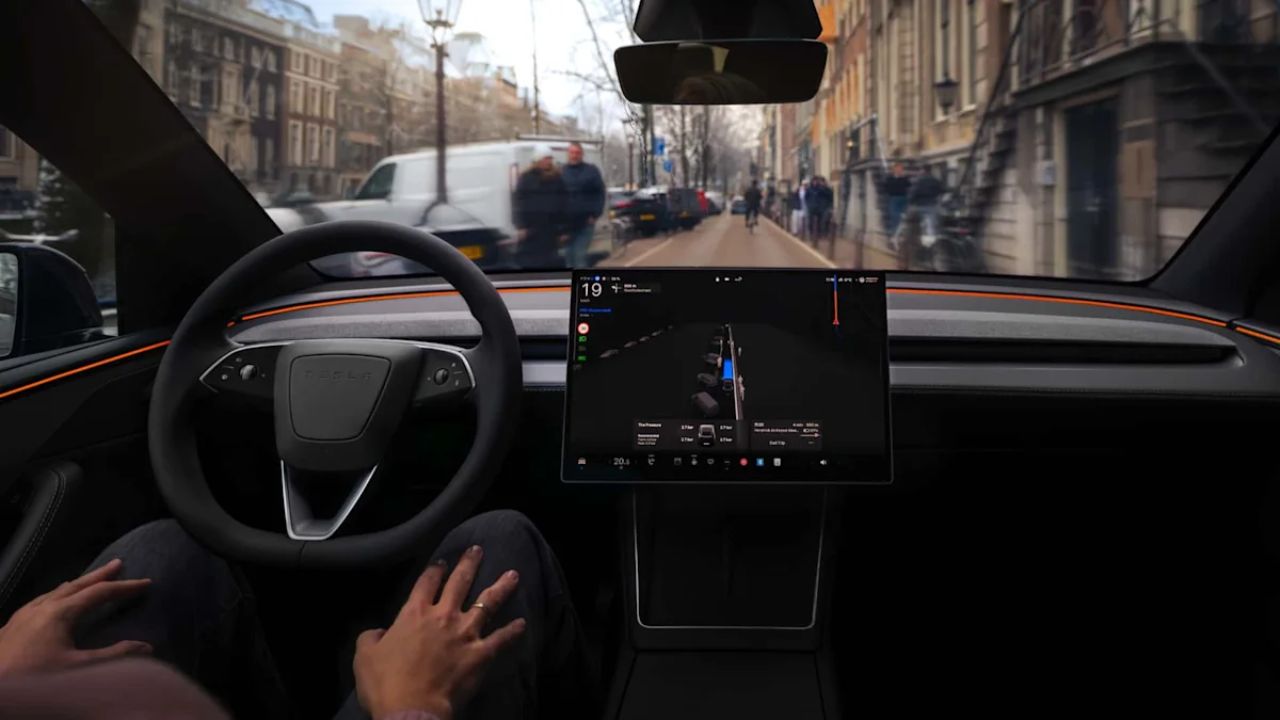
Tesla Full Self-Driving drops one-time purchase option across Europe, shifting to a $99 monthly fee — but the feature is only live in two countries so far.
If you have been waiting to buy Tesla’s Full Self-Driving software outright in Europe, that option is gone. As of this week, Tesla has officially removed the one-time purchase option across its European markets, shifting every buyer to a monthly subscription model. The price is 99 euros or 99 pounds per month, depending on the country — and what you get for that money depends almost entirely on where you live.
In most of Europe, what you are actually paying for is quite limited. The full FSD (Supervised) experience — the hands-free, point-to-point driving system that handles steering, acceleration, braking, intersections, and lane changes — is only legally active in two countries: the Netherlands and Lithuania. Everywhere else on the continent, the subscription unlocks features like Autosteer, but the broader autonomy package the name implies is not yet available.
What the old pricing looked like — and what replaced it
Before this week’s change, European Tesla buyers had two meaningful options beyond the free Basic Autopilot that ships with every car. They could spend 3,800 euros or 3,400 pounds for a permanent license covering Enhanced Autopilot, which included hands-free highway navigation, automatic lane changes, automatic overtaking, and remote summon. Or they could go all the way to the full FSD package for 7,500 euros or 6,800 pounds — a one-time fee that promised what Tesla called “the potential for fully independent driving.”
Both of those paths are now closed to new buyers. The only option going forward is the monthly subscription.
FSD Pricing — Before and After (Europe): Tesla Full Self-Driving
| Package | Previous (one-time) | Current (monthly) |
|---|---|---|
| Basic Autopilot | Free | Free (unchanged) |
| Enhanced Autopilot | €3,800 / £3,400 Removed | No longer sold separately |
| FSD (Supervised) | €7,500 / £6,800 Removed | €99 / £99 per month Active |
| FSD — prior Enhanced Autopilot buyers | — | €49 / £49 per month |
Basic Autopilot — which lets the car steer, accelerate, and brake within its lane with the driver’s attention — remains free, as it always has been.
The regulatory picture: two down, dozens to go
The subscription change lands at a peculiar moment in Tesla’s European regulatory journey. The company only received its first-ever European approval for FSD (Supervised) last month, when the Netherlands’ vehicle authority — known as the RDW — granted type approval for software version 14.3 under UN Regulation 171, the EU standard governing Level 2 driver assistance systems. That approval came after more than 18 months of testing.
For EU-wide approval, 55 percent of member states representing 65 percent of the bloc’s population must vote yes. The next committee meetings are not expected until July and October — making Tesla’s stated goal of EU-wide availability by summer 2026 look increasingly difficult.
Lithuania became the second European country to grant access, doing so on May 20 by formally recognizing the Dutch RDW assessment rather than running its own independent testing program. Under EU Regulation 2018/858, member states can adopt an existing type approval from another country, which is exactly the path Lithuania followed. Hours after the transport authority confirmed the decision, Tesla announced that FSD was rolling out to eligible Lithuanian owners.
For now, the system is restricted to vehicles equipped with Hardware 4 — Tesla’s most recent onboard computer suite. Owners with the older Hardware 3 will need to wait for a version of the software called FSD v14 Lite, which Tesla says is planned for later this summer and is designed to accommodate the computing limits of the older hardware.
Does the subscription math actually work out?
Tesla and its supporters have tried to frame the subscription shift as a consumer-friendly move. On the surface, there is something to it. At 99 euros per month, it would take just over six years of continuous payments to reach the former one-time price of 7,500 euros. For buyers who use the feature sporadically — or who live in a country where FSD is not yet available — paying only for the months they actually want it makes sense.
The same move was made in the United States earlier this year, where Tesla removed the 8,000-dollar outright purchase option and shifted to a 99-dollar monthly fee. The pattern is now global.
But the math gets uncomfortable for one particular group of owners: the people who paid thousands of euros years ago for a system that was described, at the time, as a pathway to full autonomy. Tesla CEO Elon Musk has since acknowledged that vehicles equipped with the older Hardware 3 chip will not be capable of full unsupervised driving, and that the company would need to build what it calls micro factories to retrofit those older vehicles with the latest hardware. That announcement did not go over well with owners who felt they had bought into a promise that the company is now walking back.
The bigger picture: subscriptions, ambition, and 10 million customers
Tesla’s push into subscription-only pricing is not purely a pricing philosophy — it is tied directly to the company’s long-term financial ambitions. Musk’s compensation package, valued at roughly one trillion dollars, is linked to a series of product milestones, one of which requires Tesla to reach 10 million active FSD subscribers globally by 2035. As of the first quarter of 2026, the company had approximately 1.3 million paying customers worldwide. The gap between where Tesla is and where it needs to be is significant.
Expanding into Europe, where Tesla has sold hundreds of thousands of vehicles over the past several years, is critical to closing that gap. But the country-by-country regulatory process is slow, and the EU-wide vote that Tesla had hoped would open the entire bloc at once has not been scheduled. The next standing committee meetings are expected in July and October, and Tesla’s stated goal of EU-wide availability by summer 2026 now looks like a stretch.
For most European Tesla owners today, the practical reality is this: they can subscribe to FSD for 99 euros a month, receive features like Autosteer and some navigation assistance, and wait — alongside everyone else — for their country to work through the regulatory process. Whether that wait lasts months or years depends on decisions being made in government offices across the continent, not in Palo Alto.