


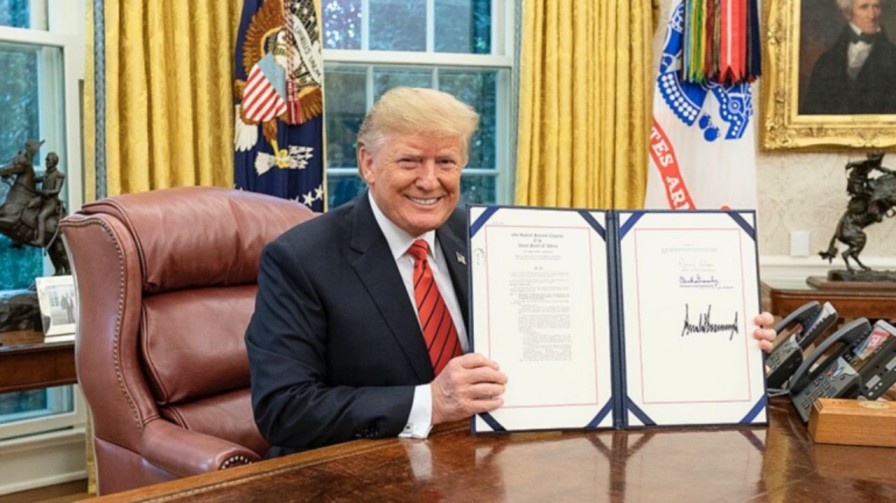
Trump executive order launches Trump IRA.gov to give 56 million workers access to low-cost IRAs and up to $1,000 a year in federal retirement matching funds starting 2027
For tens of millions of American workers, the path to a dignified retirement has always run through their employer. If your job came with a 401(k), you were in the system. If it did not — if you worked for a small business, drove for a delivery app, cleaned houses, or freelanced — you were largely on your own. President Donald Trump signed an executive order on Thursday, April 30, aimed at changing that reality, directing the Treasury Department to build a new federal website where unconnected workers can find, compare, and enroll in private-sector individual retirement accounts with the help of up to $1,000 a year in federal matching funds.
The scale of the problem the order is trying to solve is not in dispute. According to 2025 research from the Pew Charitable Trusts, roughly 56 million Americans lack access to any employer-sponsored retirement plan. White House figures put the number of full-time workers without participation in a retirement plan at 40.6 million, and approximately 48.8 million workers who receive no employer match toward retirement savings. These are not people who chose to opt out. They are people who were never offered a door to walk through.
What the Executive Order Actually Does
The order does not create a new kind of retirement account. What it creates is a front door. TrumpIRA.gov, set to go live on January 1, 2027, will function as a federal comparison portal where workers can filter and evaluate private-sector IRA options by cost, quality, and investment mix, then enroll directly. The Treasury Department is directed to ensure that the financial institutions listed on the site maintain annual expense ratios no higher than 0.15 percent — a strict cap that rules out the high-fee products that have historically eaten into the savings of lower-income investors. Providers are also prohibited from imposing minimum-contribution or minimum-balance requirements, meaning someone can open an account with whatever they can spare that month.
The platform is intended to serve workers who are most underserved by the current system: employees of small businesses, part-time workers, independent contractors, gig workers, and the self-employed. These workers include people who have spent years building someone else’s business without building any savings of their own.
Hard-working Americans deserve retirement security in portable savings vehicles that offer access to low-cost investments similar to those offered to federal workers.”
The Saver’s Match: From Tax Credit to Real Money
Woven into Trump’s executive order is a connection to the federal Saver’s Match, a provision that came out of the Secure 2.0 legislation passed under the Biden administration in 2022 and which goes into effect in tax year 2027. The mechanics of the match matter, and they represent a genuine shift from what existed before.
Previously, low-income workers who saved in a qualifying retirement account could claim a Saver’s Credit — essentially a reduction in the taxes they owed. The problem was structural: you had to put in $2,000 first, then wait until tax season to see any benefit, and even then the reward came as a smaller tax bill rather than as money arriving in your account. The result was predictably low usage. According to White House data, only 5.7 percent of taxpayers claimed the credit, and the average credit amounted to just $191.
How the Saver’s Match Works
- Starting in tax year 2027, the Saver’s Match replaces the old Saver’s Credit. Instead of reducing your tax bill, it deposits money directly into your retirement account.
- Single filers earning up to $20,500 a year qualify for a full match worth 50 percent of up to $2,000 in contributions, for a maximum federal contribution of $1,000 per year. Partial matches are available for single filers earning between $20,500 and $35,500, and for joint filers earning up to $71,000.
- The critical difference: the money goes into your account, not against your tax bill. It is, in effect, free money deposited directly into your future.
- As an example, the White House projects that a 25-year-old low-income worker who saves around $165 per month and qualifies for the full annual match could, at a 6 percent rate of return, accumulate roughly $465,000 by age 65 — with nearly $155,000 of that attributable solely to the government match.
What Researchers and Financial Experts Are Saying
The response from policy researchers and financial planners has been measured — supportive of the goal, cautious about the reach. The central concern is enrollment. Because the Trump plan is built on voluntary participation, workers must choose to visit TrumpIRA.gov, choose to compare options, and choose to open an account. Research consistently shows that without automatic enrollment — where workers are placed into a savings plan by default and must actively opt out — voluntary take-up rates tend to be low, particularly among the lower-income workers the program most wants to reach.
Morningstar researchers modeled what would happen under a federal auto-enrollment scenario and estimated that approximately 32.3 million new savers would enter the retirement savings system. Under a voluntary model, that number could be considerably smaller. The firm also found that workers with 10 or more years of sustained participation in retirement plans could see between 67 and 125 percent higher retirement wealth under auto-enrollment conditions, largely because consistent contributions, compounded over time, are the single biggest driver of a healthy nest egg.
Sometimes wealth isn’t about excess. These programs aren’t really about creating millionaires, but more about sparking the inspiration to start saving.”
At the same time, researchers and advocates say that raising public awareness of the Saver’s Match through a federal platform is genuinely valuable. A 2025 survey by the Pew Charitable Trusts found that 87 percent of workers without access to a workplace retirement plan said they would be more likely to save if they could receive a matching contribution. The knowledge gap, in other words, is real. Many eligible workers simply do not know this benefit will exist.
The Role Congress Must Play: Trump Executive Order
An executive order can build a website and raise awareness. It cannot compel employers to offer retirement plans. It cannot automatically enroll workers. Those steps require legislation, and the administration has made clear it intends to seek it. At the Oval Office signing ceremony, Trump and Kevin Hassett, director of the National Economic Council, said the administration would work with Congress to expand the income eligibility limits for the Saver’s Match, potentially extending the benefit to workers who currently earn too much to qualify.
Two pieces of legislation that have been put forward in Congress would go further. The Retirement Savings for Americans Act, a bicameral bill, calls for the creation of portable, tax-advantaged retirement savings accounts accessible to all workers. The Automatic IRA Act, proposed in the House, would require businesses with more than ten employees to enroll workers automatically in IRA-style plans, with workers retaining the right to opt out. Morningstar’s most optimistic modeling found that if Congress paired auto-enrollment with an expanded and enhanced Saver’s Match, cumulative American retirement wealth could rise by as much as 77 percent over ten years, adding an estimated $1.35 trillion in projected savings.
What This Means for Workers Right Now
For workers who currently have no retirement account, the most immediate takeaway is this: TrumpIRA.gov is not yet live. The site is scheduled to launch on January 1, 2027. The Saver’s Match itself takes effect in tax year 2027. There is nothing to enroll in today through this particular program. But the groundwork is being laid, and workers who fall within the income ranges — single filers under $35,500 or couples under $71,000 — should mark this as something worth returning to when the site goes live.
In the meantime, financial planners note that opening any IRA on your own terms — through a low-cost provider such as a major brokerage or credit union — is an option available today, and doing so now builds the savings habit that makes the eventual match more meaningful. The match rewards people who are already contributing. Getting started early is never the wrong move.
For the 56 million Americans who have spent their working lives without a retirement plan, the executive order is an acknowledgment that the gap is real, and that the federal government has a role in closing it. Whether the policy delivers on that promise will depend on what comes next from Congress, and on whether workers who have never thought much about IRAs decide, when a simple federal website finally points the way, to walk through the door.