


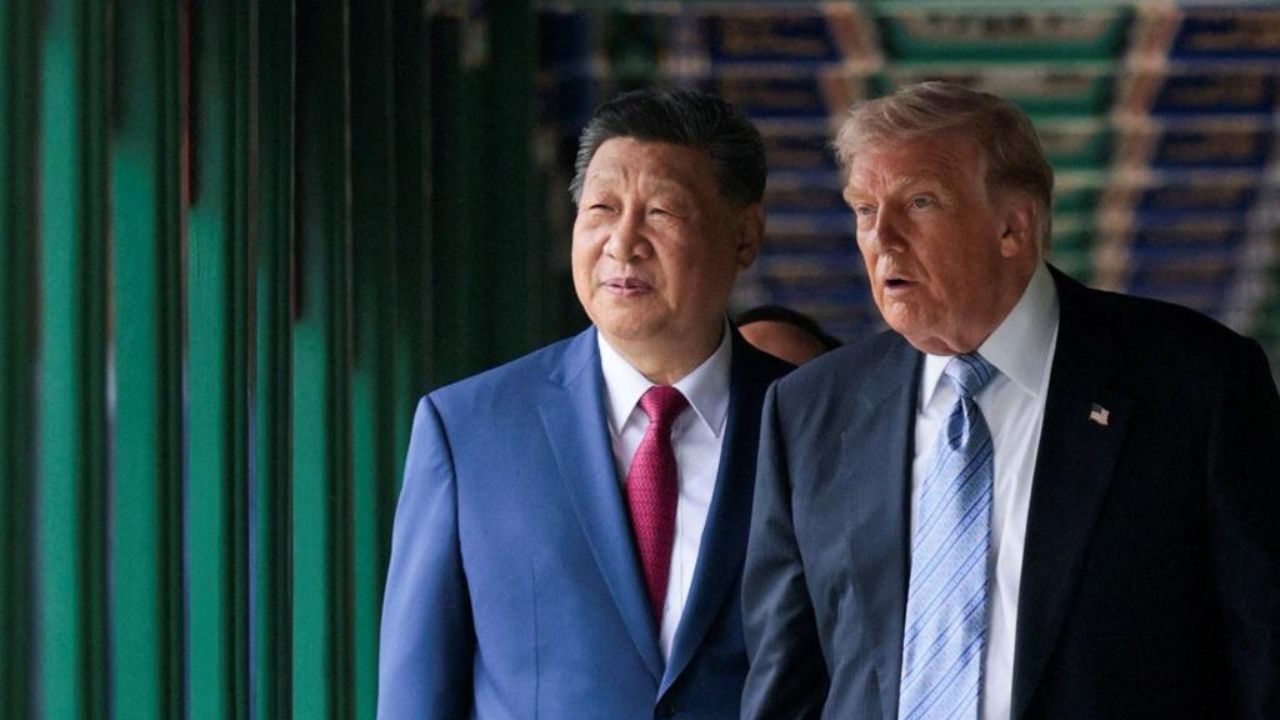
Trump Leaked Pentagon Report: Trump’s Beijing summit was overshadowed by a leaked Pentagon report revealing China is using the Iran war to drain U.S. weapons, build global alliances, and study American military tactics.
A damning leaked intelligence report has revealed the extent to which China is using Donald Trump’s war in Iran to try to diminish the U.S.’s standing on the world stage.
President Donald Trump flew into Beijing on Wednesday carrying the weight of a war that American intelligence agencies say has not gone the way the White House has told the public. Barely hours after Air Force One touched down, a damaging intelligence document was making its way through Washington newsrooms, and the timing could not have been more uncomfortable for an administration already fighting to control the story of its 10-week military campaign against Iran.
The confidential Pentagon assessment, produced by the Joint Staff Intelligence Directorate for Joint Chiefs Chairman Gen. Dan Caine and relayed to The Washington Post by two senior U.S. officials, lays out in stark terms how Beijing has been exploiting the conflict. While Trump sat down with Chinese President Xi Jinping to negotiate on issues ranging from trade to Taiwan, the leaked document was describing precisely how China views those same subjects through the lens of American military overextension.
What the Report Actually Says
The assessment paints a picture of a methodical Chinese strategy. According to the officials who described its contents, Beijing has moved on several fronts simultaneously. China has been publicly branding the Iran conflict as an illegal war — the document notes that Chinese state messaging has repeatedly used that exact word to describe a campaign that was never authorized by the U.S. Congress. At the same time, Beijing has been deepening ties with nations affected by the disruption to shipping in the Strait of Hormuz, using American military action as a diplomatic opening.
Perhaps most consequentially, the report suggests China has been using the conflict as a live laboratory — studying the way the United States wages modern warfare and incorporating those observations into planning for potential future military operations of its own. Defense analysts have long warned that any sustained U.S. engagement in the Middle East hands China exactly this kind of intelligence advantage, and the leaked assessment appears to confirm those concerns at the highest levels of the American military.
China has an opening to portray the United States as an aggressive, unilateralist power in decline because Washington cannot stop itself from getting embroiled in bloody and costly Middle East wars.”
Jacob Stokes, a senior fellow at the Center for a New American Security, told The Washington Post that the report’s findings pointed to how Trump’s war in Iran was meaningfully improving China’s geopolitical position. His assessment was blunt: the conflict has given Beijing a ready-made narrative, and Beijing has wasted no time exploiting it.
The Taiwan Dimension
One section of the leaked report carries implications that go well beyond the current conflict. It highlights that the war has been draining American weapons stockpiles at an alarming pace. That depletion matters not just for the campaign against Iran, but for how the United States might respond if China were ever to move militarily against Taiwan — the democratically governed island that Beijing has long claimed as its own territory.
The logic is straightforward and troubling in equal measure. If American munitions are being consumed faster than they can be replenished by ongoing operations in the Middle East, a simultaneous confrontation in the Pacific becomes an exponentially harder problem for U.S. military planners. The report suggests Chinese strategists are paying close attention to exactly this calculus.
Key Findings at a Glance: Trump Leaked Pentagon Report
- China has publicly labeled Trump’s Iran campaign an “illegal” war, using state messaging to build an international narrative of U.S. overreach.
- Beijing has used the Strait of Hormuz disruption to strengthen ties with countries impacted by the shipping crisis.
- The Pentagon report was prepared for Gen. Dan Caine, Chairman of the Joint Chiefs of Staff, by the Joint Staff Intelligence Directorate.
- Intelligence analysts have flagged that U.S. weapons stockpiles are being drained at a rate that could factor into China’s Taiwan calculus.
- China has invested heavily in renewables and domestic oil, making it less vulnerable to the Strait of Hormuz closure than most Western nations.
- Multiple intelligence assessments have now contradicted the White House’s public claims about the effectiveness of Operation Epic Fury.
A Pattern of Intelligence Contradictions
This leak did not arrive in isolation. Since the war with Iran began in late February, a series of classified assessments have surfaced that tell a story markedly different from the one being offered by the White House and the Pentagon podium. A confidential CIA analysis from early May, described to The Washington Post by four insiders, concluded that Iran could endure a U.S. naval blockade for three to four months before facing serious economic hardship. That assessment landed the day after President Trump praised the Navy blockade as impenetrable and claimed Iran’s missiles were “mostly decimated.”
The New York Times reported that classified assessments from earlier this month show Iran has regained access to 30 of its 33 missile sites along the Strait of Hormuz, along with roughly 70 percent of its missile launchers and a similar share of its missile stockpile. Underground storage facilities, which the Pentagon had pointed to as neutralized, are described in the assessments as mostly or fully operational again.
Defense Secretary Pete Hegseth had told reporters in April that Operation Epic Fury had left Iran’s missile program “functionally destroyed” and its air force “wiped out.” The intelligence picture that has emerged since then does not support those characterizations, and the gap between the official account and the classified reality has become increasingly difficult for the administration to bridge.
The leadership has gotten more radical, determined, and increasingly confident they can outlast U.S. political will.”
The White House Responds
The administration pushed back firmly against both the leak and the coverage it generated. Pentagon chief spokesman Sean Parnell told The Washington Post that any suggestion the global balance of power has shifted away from the United States is “fundamentally false.” White House spokeswoman Olivia Wales offered a similar rebuttal, describing the U.S. military as the most powerful force on the planet with, as she put it, “unmatched power on display for the entire world to see.”
The Chinese Embassy, for its part, struck a careful tone. Spokesperson Liu Pengyu said Beijing is committed to promoting peace, working to de-escalate the situation in the region, and that its focus is on preventing any resumption of fighting rather than seeking to capitalize on the circumstances. That public stance, however, sits somewhat awkwardly alongside what the Pentagon’s own intelligence directorate has assessed to be happening at a strategic level.
Trump himself has shown his frustration openly. In a Truth Social post last week, after The New York Times published its report on Iran’s reconstituted missile capabilities, he wrote that media coverage suggesting Iran was faring well militarily amounted to what he called “virtual TREASON.” He accused reporters and outlets of “aiding and abetting the enemy” and giving Iran “false hope.”
The Nuclear Timeline Question
One of the war’s stated justifications has been preventing Iran from acquiring a nuclear weapon. A separate intelligence assessment, surfaced by Reuters, suggests the conflict has not moved that needle. According to that report, the time Iran would need to build a nuclear device remains essentially unchanged from what it was before Trump launched his attacks — a finding that directly undercuts one of the administration’s central rationales for the campaign.
Trump had claimed after an earlier round of strikes last June that he had “obliterated” Iran’s nuclear program. His officials suggested at the time that the attacks had pushed the timeline back by a year. The more recent assessment tells a different story, one in which the return on military investment, measured against the explicit goal of nuclear prevention, remains elusive.
A Fragile Ceasefire, a Crowded Agenda
Against all of this, Trump arrived in Beijing with a heavily loaded agenda. Trade remains unresolved between the two largest economies on earth. Taiwan is a source of permanent tension. And now Iran — the conflict that Washington launched and Beijing has used to its advantage — is very much on the table as well.
A ceasefire brokered by Pakistan has been in place since early April, but it has not produced a durable peace settlement. Iran has presented a list of demands that includes lifting the U.S. naval blockade, recovering frozen assets, receiving war reparations, and a halt to U.S.-Israeli military activity across the region. Trump told reporters last Saturday he was inclined to reject the offer, saying Iran had not paid a sufficient price. The following day, he reversed course on Truth Social before walking that reversal back again.
What remains constant is the intelligence picture, and that picture is considerably more complicated than the one the administration has presented in its press briefings and social media posts. The leaked report that shadowed Trump’s flight to Beijing is another data point in a pattern that has raised serious questions about the distance between what classified analysts are writing and what the White House is saying out loud.
For now, those conversations are continuing in Beijing, in Washington, and in the corridors of a Pentagon still searching for whoever handed its most sensitive assessments to reporters.