


Trump-Xi summit took a striking turn as Xi invoked the Thucydides Trap, warned on Taiwan, and left Trump silent for hours before a confused Truth Social post blamed Biden
There is a particular kind of silence that falls over a man when he realizes, perhaps for the first time in the room, that he is not the most powerful person present. Observers of the Beijing summit’s opening moments described something close to that silence settling over President Donald Trump on Thursday, as Chinese President Xi Jinping delivered his opening remarks at the Great Hall of the People and invoked one of the most consequential concepts in the modern study of global power — a concept that suggested, with considerable elegance, that America may be a nation in decline.
The words Xi used were “Thucydides Trap.” For those in the room who recognized the reference, the implication was stark. For a president who had arrived in Beijing promising his biggest supporters that he was restoring American greatness, hearing it from the leader of the world’s second-largest economy — framed as a polite but pointed question — was the kind of diplomatic moment that does not wash off easily. Trump said nothing about it publicly for hours. When he finally did respond, the result was an explanation that raised more questions than it answered.
What Xi Actually Said: Trump-Xi Summit
Standing before Trump and a room of American and Chinese officials, Xi turned to the camera of history and asked a question that was not really a question. According to a live translation of his remarks, he said: “The world has come to a new crossroads. Can China and the United States overcome the Thucydides Trap and create a new paradigm of major country relations?”
The phrasing was measured, even professorial. But the underlying architecture of the statement was unmistakable to anyone with a working knowledge of international relations theory. The Thucydides Trap, a concept popularized by Harvard political scientist Graham Allison, holds that when a rising power begins to threaten a ruling power, conflict between them becomes increasingly likely — and historically, nearly inevitable. Allison identified 16 such moments in the past 500 years. Twelve of them ended in war.
In the Western reading of Xi’s framing, China is cast as Athens — the rising, ascending force. That leaves the United States in the role of Sparta: the established power, afraid, watching its dominance slip. Xi has used the Thucydides Trap as rhetorical currency before — he first deployed the phrase publicly in 2014 — but using it in direct conversation with a sitting U.S. president, in Beijing, during a summit that was already being shaped by a leaked Pentagon report documenting Chinese strategic gains, carried a weight that was hard to ignore.
Trump Goes Quiet — Then Goes to Truth Social
In the hours that followed, something unusual happened. A president known for filling every available silence with noise went quiet. Observers and reporters who had been tracking Trump’s relentless posting habits noted that he went uncharacteristically still. Before arriving in Beijing, he had been firing off Truth Social posts at a pace that kept his communications team in a constant state of managed panic — targeting Barack Obama, Supreme Court justices he himself had appointed, and virtually anyone else who crossed his attention. After the doors of the Great Hall of the People closed and he sat across from Xi for more than two hours, that noise stopped.
When Trump did respond, it came the following morning Beijing time — at 5:42 a.m. — in a Truth Social post that left analysts parsing its logic for hours. He wrote, according to multiple outlets who obtained the post, that when Xi “very elegantly” referred to the United States as perhaps being a declining nation, he was referring to the damage inflicted during the four years of what Trump called “Sleepy Joe Biden” and the previous administration. Trump added: “on that score, he was 100% correct.”
There was a problem with that interpretation. As multiple analysts and reporters noted within hours of the post going up, there was no apparent indication in Xi’s remarks that he was referring to Biden at all. The Thucydides Trap is a structural concept about long-term national trajectories, not a partisan comment about a single administration. Xi had been invoking it as far back as 2014, through both the Obama and Trump years. The White House, when pressed, did not offer any substantive clarification — it simply directed reporters to the post itself.
The Taiwan Warning That Landed Like a Closed Door
The Thucydides Trap remark was not the only thing Xi said that shifted the atmosphere in the room. Inside the closed session, Xi delivered a pointed warning on Taiwan — the democratically self-governed island that Beijing claims as its own territory and that has sat at the center of U.S.-China friction for decades. Xi told Trump directly that the Taiwan question is “the most important issue in China-U.S. relations” and that it represents a line the two countries cannot afford to get wrong.
“If it is handled properly, the bilateral relationship will enjoy overall stability. Otherwise, the two countries will have clashes and even conflicts, putting the entire relationship in great jeopardy.”
The warning was unambiguous. Xi further described Taiwan independence and peace in the Taiwan Strait as being “as irreconcilable as fire and water” — a phrase that does not leave much interpretive room. And then something notable happened: when Trump emerged from the meeting and stood beside Xi for photographs at the historic Temple of Heaven, reporters called out questions about whether Taiwan had been discussed. Trump ignored them completely.
Secretary of State Marco Rubio, who was part of the U.S. delegation, subsequently told reporters that arms sales to Taiwan “did not feature prominently” in the discussions. The White House readout of the entire meeting did not mention Taiwan once, choosing instead to focus on trade. The silence, in context, spoke volumes.
A Summit That Produced Warmth but Few Hard Wins
Beyond the dynamics of power and posture, the practical ledger of Day One of the summit was thinner than the White House had hoped to project. Both leaders expressed the desire to strengthen economic ties. Xi spoke of a “new vision” for the relationship, and Trump called Xi a “great leader” and told him he saw a “fantastic future together” for the two nations. The personal flattery flowed freely — from the American side, at least. Xi’s tone was considerably less effusive, more measured, more weighted with the confidence of a leader who arrived at the table knowing his position had strengthened in the preceding weeks.
No major trade deal was announced. A potential agreement on rare earths failed to materialize. There was no breakthrough on artificial intelligence investment. Trump pointed to a commitment from Xi to purchase 200 Boeing aircraft as a tangible outcome, and both sides pledged to work toward cutting off the flow of fentanyl precursor chemicals from China into the United States. Beijing also restored beef trade with Washington ahead of the summit, issuing new import licenses for hundreds of American slaughterhouses — a gesture of goodwill that analysts noted stopped well short of guaranteeing actual purchases.
Day One Outcomes at a Glance
- Xi warned Trump that mishandling Taiwan could lead to “clashes and even conflicts” — the White House readout did not mention Taiwan at all.
- Xi invoked the Thucydides Trap at the opening session, framing the summit around the question of whether the U.S. and China can avoid the historical pattern of conflict between a rising and ruling power.
- Trump’s Truth Social response the next morning interpreted Xi’s remarks as a reference to Biden-era decline — analysts found no basis for that reading in Xi’s actual words.
- No major trade deal was reached. A rare earths agreement, widely anticipated, did not materialize.
- Trump announced Xi had agreed to purchase 200 Boeing jets. Beijing restored beef import licenses as a pre-summit goodwill gesture.
- The meeting ran more than two hours. Trump told Fox News he had prolonged it by introducing 30 business leaders, including Elon Musk, Tim Cook, and Jensen Huang, to Xi before talks began.
- Secretary of State Rubio said arms sales to Taiwan “did not feature prominently” in the session. The Strait of Hormuz, Iran, and fentanyl were confirmed as topics of discussion.
The Business Delegation and the Overtime Meeting
One detail that emerged from Trump’s evening interview with Fox News host Sean Hannity added an unusual dimension to the picture of how the meeting unfolded. Trump revealed that he had disrupted the carefully structured Chinese protocol by insisting on introducing the delegation of American business leaders before the formal talks began. He brought 30 executives — including Musk, Cook, and Nvidia CEO Jensen Huang — into the session and presented them to Xi. He seemed proud of this. Xi, Trump reported, told him it was “a very good idea.” Chinese officials, who are known for meticulous ceremony planning, had apparently not been briefed in advance. The meeting, as a result, ran well beyond its scheduled time.
The CEOs who exited the Great Hall afterward offered the kind of comments that major business leaders tend to offer in moments like these. Musk said the meeting was “wonderful” and that “many good things” had been achieved. Cook gave reporters a peace sign and a thumbs-up. Huang said Xi and Trump had both been “incredible.” None offered specifics.
The Image Xi Was Projecting and the One Trump Was Carrying
What made the dynamic of this summit different from previous Trump-Xi encounters was the broader context in which it took place. Trump arrived in Beijing carrying the political weight of a 10-week war with Iran that multiple leaked intelligence reports had described as far less successful than the White House had claimed. A confidential Pentagon assessment, reported days earlier, had documented how China was using that conflict to strengthen its diplomatic position, study American military tactics, and portray the United States as an overextended and declining power.
Xi, by contrast, arrived with what analysts described as a level of confidence markedly different from his posture in 2017, the last time a sitting U.S. president had visited China. One expert, Scott Kennedy of the Center for Strategic and International Studies, told CNBC that China was entering the meeting “far more confident than in 2017, when it feared even a small rise in U.S. tariffs.” In the intervening years, Beijing had navigated trade wars, tariff escalations, technology restrictions, and the economic pressure of the Strait of Hormuz disruption — and had emerged from each challenge with its position largely intact.
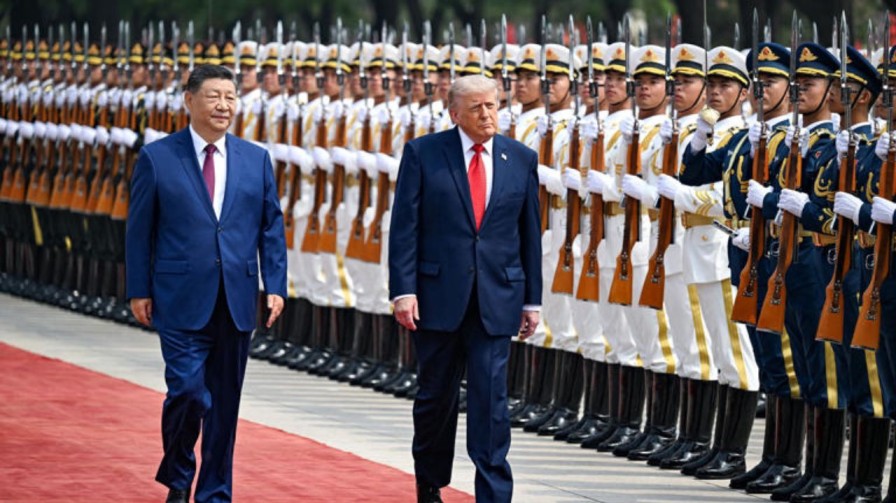
By the time Xi stood at the top of the Great Hall’s steps to greet Trump with a handshake, the scene itself carried meaning that both delegations understood. The pomp was real — the honor guard, the 21-gun salute, the children waving American and Chinese flags — but so was the underlying calculation. Xi had set the tone with a single historical reference and a clear warning about Taiwan. Trump had returned to his hotel, gone to sleep, and woken up to post something that did not quite meet the moment.
At the state dinner that closed Day One, Xi raised a glass and offered Trump a message that was simultaneously welcoming and clarifying. “The great rejuvenation of the Chinese nation and making America great again can go hand in hand,” he said. “We must make it work and never mess it up.” Trump thanked him for what he called a “magnificent welcome like none other” and invited Xi to visit the White House on September 24. Day Two was still to come.