


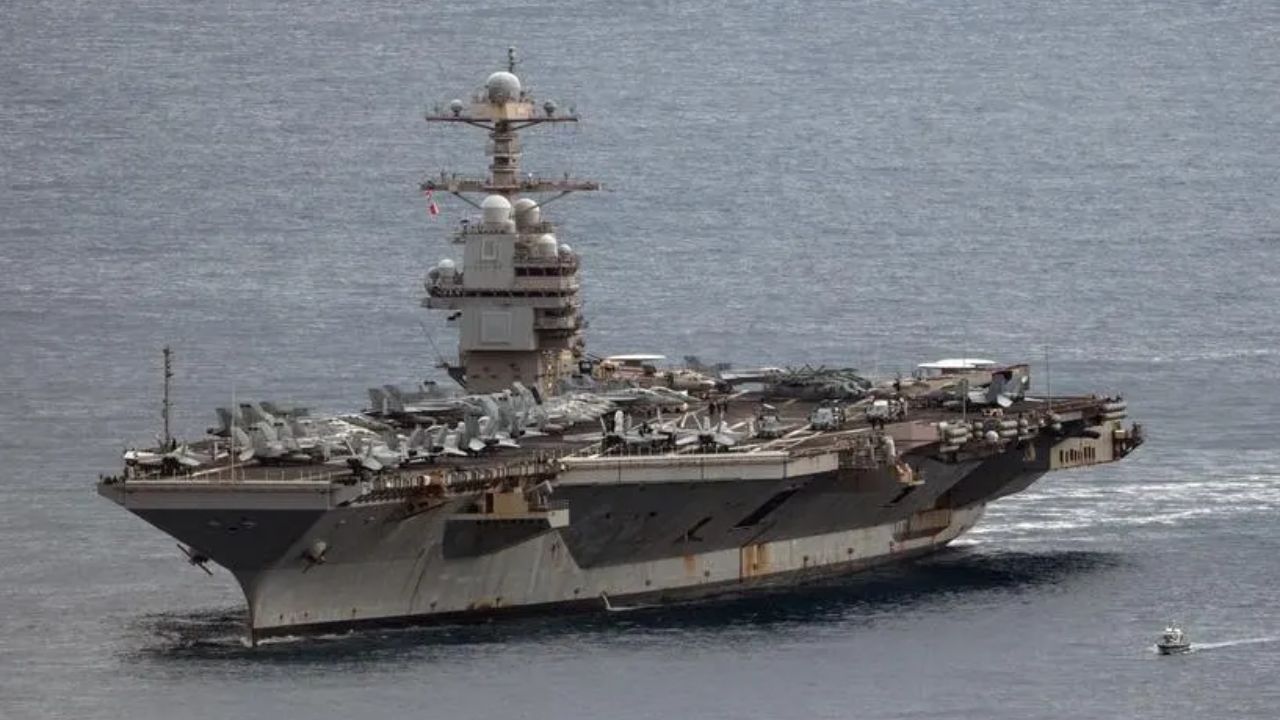
USS Gerald R. Ford has left the Middle East after 311 days at sea — the longest U.S. carrier deployment since Vietnam, closing a chapter of combat, fire, and sacrifice.
After more than ten months at sea — a stretch that broke a post-Vietnam War record and tested the limits of men, machines, and military families alike — the USS Gerald R. Ford has finally turned its bow toward home. The world’s largest and most advanced aircraft carrier has departed the Middle East, leaving behind a region still smoldering with tension as the United States and Iran remain locked in tentative, fragile negotiations.
The Ford’s departure marks the end of an extraordinary chapter in American naval history. What began as a routine deployment to Europe in late June 2025 evolved into one of the most operationally demanding carrier missions in decades, pulling the ship and its roughly 4,500 crew members across the Mediterranean, deep into the Caribbean, and ultimately into the waters of an active conflict zone in the Middle East.
A Deployment That Was Never Supposed to Last This Long
When sailors aboard the USS Gerald R. Ford left Naval Station Norfolk, Virginia, last summer, they expected to be gone for perhaps eight months at most. Standard carrier deployments run six to seven months — long enough to be hard, short enough to manage. Nobody told the families waiting back home that this one would stretch to nearly a year.
The Ford’s deployment entered its 311th day before the ship finally began its homeward transit, surpassing post-Vietnam War benchmarks and drawing comparisons to some of the longest carrier deployments since 1964. Senior Navy officials had, in recent weeks, openly acknowledged the ship was on a path to breaking the modern record. It did exactly that.
Being gone for that long, it’s got to be tough on anybody, especially when they only get a short amount of port visits where they get to really sleep in a normal bed.”
The human toll is real and not easily measured in statistics. Sailors and Marines earn hardship duty pay after 220 days of deployment — but that pay, capped at $495 a month, has not been updated since 2014. At $16.50 a day, it now amounts to less than one hour of minimum wage in California. For families back in Norfolk stretching budgets and raising children alone, that gap feels significant.
From Venezuela to Iran: An Unpredictable Journey
The Ford’s deployment reads less like a planned mission and more like a rolling series of emergencies and escalations. After arriving in European waters, the carrier was redirected to the Caribbean in October, where it played a supporting role in a remarkable operation: the capture and arrest of former Venezuelan President Nicolas Maduro in January 2026. That mission complete, the Ford was then ordered toward the Middle East as tensions between the United States and Iran reached a breaking point.
The carrier entered the Red Sea in early March to participate in Operation Epic Fury, the joint U.S.-Israeli military campaign targeting Iran’s command infrastructure, naval forces, missile sites, and intelligence networks. The opening strikes had involved more than 100 aircraft from land and sea, with Tomahawk cruise missiles among the first weapons employed. The Ford’s Carrier Air Wing 8 brought F/A-18 Super Hornets, electronic attack aircraft, and E-2D Hawkeye early warning planes into the fight — a powerful strike package capable of being retasked between air defense, deep strike, and maritime interdiction missions on short notice.
Fire, Repairs, and the Weight of Exhaustion
Not all of the Ford’s challenges came from the enemy. On March 12, a fire broke out in the ship’s main laundry spaces, damaging multiple compartments and forcing approximately 600 sailors out of their berthing areas. Three crew members were injured, though none suffered life-threatening wounds. The Navy was careful to note the fire was not combat-related, but the disruption to an already overstretched crew was felt immediately.
The carrier pulled into Naval Support Activity Souda Bay on the Greek island of Crete on March 23 for assessment and repairs. Seven berthing compartments required rehabilitation. A scheduled port visit to Split, Croatia, followed for maintenance and crew rest before the Ford reentered the Red Sea in early April to resume operations. The ship’s extended deployment had, by then, placed considerable strain not just on its personnel but on its equipment. Officials expect major repairs and maintenance to be carried out once the carrier returns to the United States.
What the Ford Leaves Behind
The departure of the Ford does not mean the United States is withdrawing from the Middle East. Two other aircraft carriers — the USS Abraham Lincoln and the USS George H.W. Bush — remain in the Arabian Sea, supported by approximately 20 other naval vessels. The USS Bush had been expected to relieve the Ford and has taken up that role. Together, the remaining strike groups continue to enforce a naval blockade of Iranian ports, with CENTCOM reporting that more than 40 vessels have been intercepted or turned back.
The presence of three carriers in the region simultaneously had already made history. The last time the United States maintained that level of carrier presence in the Middle East was in 2003, at the height of the invasion of Iraq, when five carriers were deployed during the “shock and awe” campaign against Saddam Hussein’s government. Even with the Ford now heading home, the current naval posture in the region remains formidable by any modern standard.
President Trump declared in a letter to congressional leaders that hostilities between the United States and Iran had formally terminated, citing the War Powers Resolution of 1973 and noting that there had been no exchange of fire since April 7. Whether that declaration holds — and whether negotiations with Tehran can produce a durable agreement — remains deeply uncertain. Trump himself acknowledged he was “not satisfied” with current proposals even as diplomatic contact continued.
The hostilities that began on February 28, 2026, have terminated.”
The Question of Readiness
Beyond the geopolitics, the Ford’s departure forces a harder question about the sustainability of American naval power. Carrier deployments are typically designed to last six to seven months, giving ships and crews time to recover, train, and prepare for the next cycle. When deployments stretch to nearly a year, those maintenance and training timelines collapse. The result is a more worn-out ship and a harder-pressed fleet.
Military analysts have pointed out that keeping one of the Navy’s most advanced carriers tied to a single theater for nearly twelve months also drains a critical asset that would otherwise be available for missions elsewhere — from the Indo-Pacific to Europe, where carrier availability is already tightly managed. The Ford-class carriers, built around high electrical power and elevated sortie generation rates, were designed precisely for demanding high-end campaigns like Operation Epic Fury. But even the most advanced platform has limits.
For now, the men and women of the USS Gerald R. Ford are focused on something far simpler than strategic calculus. They are going home. After 311 days at sea, across three oceans, through a fire, through combat operations, and through some of the most consequential moments in recent American military history, they are finally, genuinely, heading back to Norfolk.