
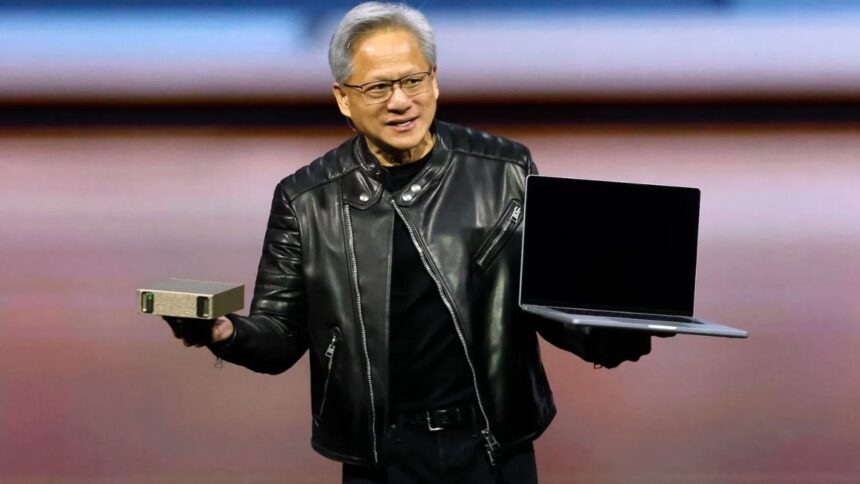
Nvidia Challenges $200 Billion CPU Market: Nvidia enters the massive CPU market with powerful RTX Spark AI Agent PCs launching from Microsoft, Dell, and HP. Discover how these next-gen systems bring local AI performance and agent capabilities to Windows users this fall.
Nvidia is making a bold push into the traditional CPU market, unveiling a new “superchip” that could reshape how people use personal computers in the age of artificial intelligence.
At Computex 2026 in Taipei, the chipmaking giant introduced the RTX Spark, a powerful processor capable of delivering up to 1 petaflop of performance. The company positions it as a game-changer for running AI agents locally and securely on Windows PCs.
A New Generation of AI-Powered PCs
The RTX Spark-powered systems will arrive this fall from several leading manufacturers, including ASUS, Dell, HP, Lenovo, Microsoft Surface, and MSI. Acer and Gigabyte models are expected to follow shortly after.
These new PCs combine strong CPU and GPU capabilities with ample RAM and Nvidia’s CUDA software foundation. The goal is to let users run large language models directly on their devices while supporting advanced AI features in creative tools, gaming, and everyday applications.
Nvidia has also worked with Microsoft to develop secure sandboxes, allowing AI agents to operate safely without compromising user privacy or system stability.
“With RTX Spark and Microsoft Windows, you ask — and the PC does the work,” said Nvidia CEO Jensen Huang. He envisions a future where traditional point-and-click interfaces give way to more natural, agent-driven computing experiences.
More EV News

Targeting Creators, Gamers, and Beyond
The new hardware builds on Nvidia’s strengths in graphics and AI acceleration. The company claims its RTX technology will provide faster performance, superior image quality, and enhanced AI capabilities across more than 1,000 games and applications.
Over 100 software partners have already signed on, including major names like Adobe, Blender, ComfyUI, Riot Games, and Xbox. This broad support suggests the RTX Spark could appeal to both professional creators producing AI-generated content and dedicated gamers seeking the latest performance upgrades.
A $200 Billion Opportunity: Nvidia Challenges $200 Billion CPU Market
The announcement comes on the heels of Nvidia’s impressive financial results and CEO Jensen Huang’s recent comments about expanding beyond GPUs into a much larger CPU market opportunity — one he estimates at $200 billion.
Huang has spoken about a future filled with billions of AI agents that will need powerful computing tools similar to how humans use PCs today. The RTX Spark appears to be Nvidia’s first major step toward making that vision a reality for consumers.
Early Reactions and Context
Microsoft is particularly bullish on the technology. It has branded its version as the Surface Laptop Ultra, calling it the most powerful Surface device the company has ever built.
While specific pricing details have not yet been released, these systems are expected to sit at the premium end of the market. They draw comparisons to Nvidia’s existing DGX Spark mini-computer, which developers can currently purchase for around $4,800.
Industry observers note that Nvidia’s previous attempts at ARM-based Windows devices more than a decade ago faced challenges. However, the company’s current momentum and the vastly more powerful capabilities of the RTX Spark have many believing this effort could fare much better.
What This Means for Everyday Users
If successful, these AI agent PCs could make advanced artificial intelligence tools more accessible and practical for regular users. Instead of relying solely on cloud services, people may soon handle complex AI tasks directly on their laptops with greater speed, security, and convenience.
As the industry moves deeper into the AI era, Nvidia’s latest move signals a significant shift in how personal computing hardware is designed and what consumers can expect from their next device.
Stay tuned for hands-on reviews and pricing details as these systems approach their fall launch. The competition between traditional chipmakers and AI-focused leaders is heating up, and consumers stand to benefit from the rapid innovation.